
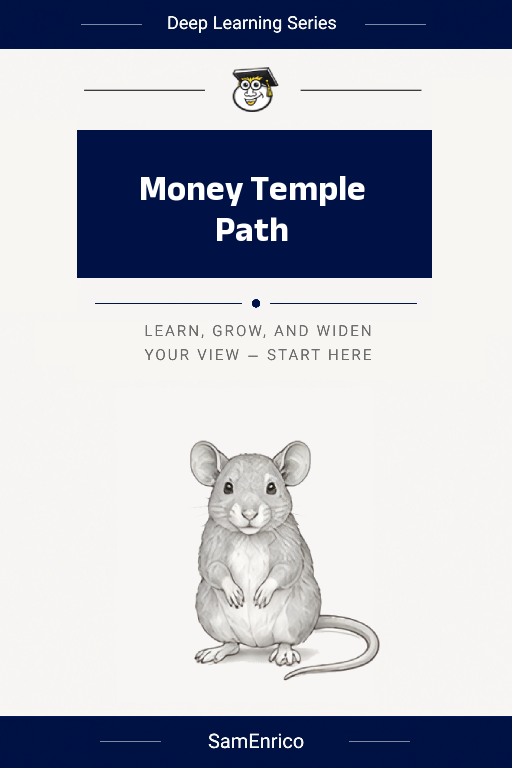
Non-FictionMental WealthSpiritual Finance
Money Temple Path eBook
Transform childhood messages that money is dirty u
Transform childhood messages that money is dirty using sacred rituals, tithing, and ethical investment alignment.
Formats
Free sample
Chapter 1: The Ghost in the Wallet–- The first time I understood that money could be dirty, I was seven years old, hiding behind a sofa while my parents argued about a twenty-dollar bill that had gone missing from my mother's purse. My father's voice was sharp with accusation. My mother's voice was wet with tears. And the twenty dollars—which I had secretly taken to buy a gift for a friend—sat crumpled in my pocket like a hot coal. I didn't confess.
I didn't return the money. Instead, I learned my first lesson about financial shame: silence is safer than honesty, and money is something you hide.Twenty-five years later, I sat across from a therapist who asked me why I couldn't look at my bank account balance without feeling nauseous. I told her about the twenty dollars. I told her about the years of watching my parents treat money as a battlefield—tiptoeing around raises, hiding purchases, whispering about bills behind closed doors. I told her that even though I now earned a comfortable salary, I still felt like a thief every time I deposited my paycheck.
She nodded and said something I have never forgotten: "You don't have a money problem. You have a shame problem that happens to live in your wallet."That is what this chapter—and this entire book—is about. Not budgeting. Not get-rich-quick schemes. Not the mechanics of compound interest or the magic of real estate.
This book is about the ghost that lives in your wallet. The ghost is not money itself. The ghost is the shame, the secrecy, the inherited fear, and the unspoken rules that were passed down to you like a cursed heirloom. You did not ask for this ghost. But until you name it, you cannot begin to release it.This chapter is called "The Ghost in the Wallet" because that is precisely what we are dealing with: an invisible presence that shapes your financial behavior without your conscious permission.
The ghost whispers that you are greedy if you want more, foolish if you have less, and dirty no matter what. The ghost tells you that some money is clean (the offering plate, the gift for a friend, the anonymous donation) and other money is dirty (your salary, your bonus, your inheritance, your savings). The ghost ensures that every financial decision is laced with anxiety, judgment, or avoidance.But here is the good news: ghosts lose their power when they are named. And in this chapter, we are going to name yours.The Emotional Ledger: Why You Keep Two Sets of Books Every human being keeps an invisible accounting system in their mind. Psychologists call it "mental accounting." I call it The Emotional Ledger because it is not neutral—it is loaded with feelings of cleanliness and filth, righteousness and shame.Here is how the Emotional Ledger works.
You unconsciously sort every dollar that enters your life into one of two columns:Clean Money Dirty Money Money given to charity Money earned from work Money placed in the offering plate Money received as a bonus Money gifted to a friend Money inherited from family Money spent on someone else Money saved in your own account Money that leaves your hands quickly Money that stays in your possession Money associated with generosity Money associated with profit Notice the pattern. Clean money is money that leaves you. Dirty money is money that stays with you. This is not a logical system—it is an emotional one. And it is the root of nearly every financial dysfunction you will ever experience.If you believe that money becomes clean only when you give it away, then you will unconsciously sabotage your ability to earn, save, or invest.
Why? Because keeping money feels dirty. Your subconscious mind will find ways to get rid of surplus cash—through impulse spending, bad investments, or simply avoiding opportunities to earn more. You will feel a strange relief when your bank account is low because emptiness feels morally superior to abundance.Conversely, if you believe that certain sources of money are inherently dirty (a salary from a corporation, an inheritance from a wealthy relative, a bonus from a job you do not love), you will treat that money differently. You will spend it carelessly because it is "tainted" anyway.
You will hide it from people you love because you are ashamed of where it came from. You will never fully claim it as yours, which means you will never fully steward it.I have seen this pattern in thousands of people across every income level. The woman who inherited 500,000fromherfatherandfeltsoguiltythatshegavehalfofittoacousinwho"neededitmore"—onlytowatchthecousinblowitonaluxurycar.Themanwhoreceiveda500,000 from her father and felt so guilty that she gave half of it to a cousin who "needed it more"—only to watch the cousin blow it on a luxury car. The man who received a 500,000fromherfatherandfeltsoguiltythatshegavehalfofittoacousinwho"neededitmore"—onlytowatchthecousinblowitonaluxurycar.Themanwhoreceiveda50,000 bonus and immediately spent $30,000 on a vacation he could not afford, because the money felt "dirty" and he wanted it gone. The couple who tithed faithfully every Sunday but could not bring themselves to open a retirement account because saving felt selfish.The Emotional Ledger is not your fault.
You inherited it from parents, pastors, teachers, and a culture that has spent two thousand years sending mixed messages about money. But it is your responsibility to examine it, name it, and begin the work of rewriting it.The Three Lies You Were Sold About Money Before we go any further, we need to identify the specific lies that created your Emotional Ledger. These lies are not universal—each reader will have their own variations—but they tend to cluster around three core falsehoods.Lie #1: Money is the root of all evil.This is the most famous misquotation in history. The actual biblical text (1 Timothy 6:10) says: "The love of money is the root of all kinds of evil." Not money itself. The love of money.
The difference is not theological nitpicking—it is the difference between a healthy relationship with money and a toxic one.When you were taught that money is evil, you learned to fear it, resent it, and distance yourself from it. You learned that poor people are holy and rich people are greedy. You learned that wanting financial security is a sin and that asking for a raise is an act of aggression. You learned to feel dirty every time you looked at your bank account.But money is not evil. Money is neutral.
Money is a tool—like fire, like a knife, like electricity. Fire can warm your home or burn it down. A knife can prepare a meal or wound a person. Electricity can power a hospital or an electric chair. The morality is not in the tool; it is in the hands that wield it.
The same is true of money.Lie #2: Rich people are greedy.This lie is the sibling of the first. It teaches you that anyone with more money than you must have obtained it through exploitation, luck, or moral compromise. It teaches you to resent success—both other people's and your own. It teaches you that wealth and virtue are opposites, that you must…
This is the end of the free sample. Get the eBook to keep going. Buy now
About this book
Details
- Author
- Scott Bethany
- Publisher
- SamEnrico
- Language
- English
- Genre
- Non-Fiction, Mental Wealth, Spiritual Finance
- Released
- 2026-05-29
- Pages (approx.)
- 146
- Available as
- eBook, Audiobook

Read better in the ZLOADR app
Your eBooks on your phone or tablet. Sign in with your SamEnrico account and start reading.
More by Scott Bethany
 Senior Self Esteem After HoardingScott Bethany$11.99
 Qualified Domestic Relations OrderScott Bethany$11.99
 Spending Addiction and ADHDScott Bethany$11.99
 Financial Shame ManagementScott Bethany$11.99
 Self Hypnosis for DrivingScott Bethany$11.99
 Autistic Communication GuideScott Bethany$11.99
 Symptothermal Method GuideScott Bethany$11.99
 Difficult Conversations with ContractorsScott Bethany$11.99
 Mirrored Souls: The Doppelgänger Diaries of the Ancient WorldScott Bethany$11.99
 The Opium Wars: The Warlords of Canton and the Birth of a Crime EmpireScott Bethany$11.99
 How to Produce a PavlokScott Bethany$11.99
 Leopard Cats: Small Wild CatScott Bethany$11.99
You may also like
 Hong Kong Handover 1997Dunn Johnnie$11.99
 Zumba For Postnatal Recovery CourseNeal Christian$11.99
 Zumba for BeginnersLadner Nikia$11.99
 YouTube Comment Mining GuideHumes Pandora$12.99
 Worry Box MeditationCarlin Rudy$11.99
 Workplace Stress MeditationNguyen Lynn$11.99
 Workplace Stress and Sleep RepairHawley Ivory$11.99
 Workplace Perfectionism CureDelaney Jeffry$11.99
 Workplace Injustice Anger GuideWallen Isabelle$11.99
 Work Addiction and Burnout LinkGreenwood Ester$11.99
 Women in Yoga and WellnessBeattie Galina$11.99
 Women in Stand Up ComedyChun Evangeline$11.99