
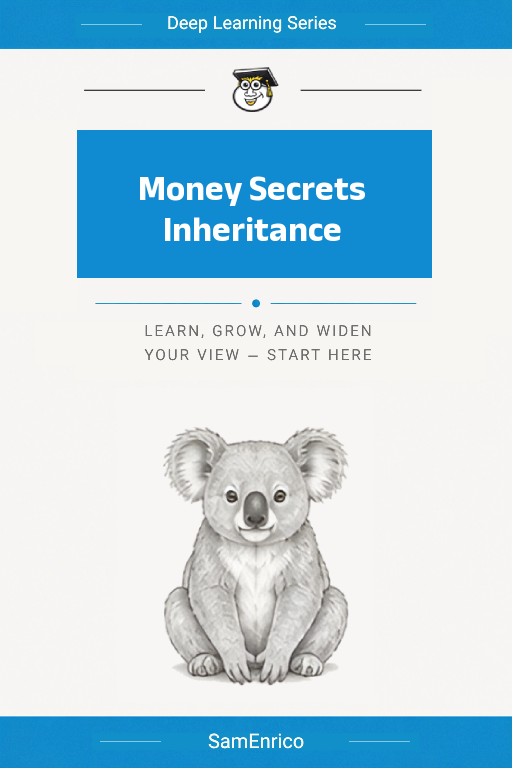
Non-FictionMental WealthImplicit Rules
Money Secrets Inheritance eBook
Examine unspoken rules like 'never sell assets', t
Examine unspoken rules like 'never sell assets', then update them for your modern financial reality.
Formats
Free sample
Chapter 1: The $70 Trillion Handshake...--–- The call came on a Tuesday. Linda, fifty-two years old, a pediatric nurse who had never owned a stock in her life, was sitting in her break room eating a tuna sandwich when her phone buzzed. Her father’s estate lawyer. The words were gentle, rehearsed, and utterly world-changing: “Your father’s trust has been distributed. You are now the sole owner of a concentrated position in regional banking stocks, three commercial real estate properties, and a portfolio of municipal bonds.
The total value is approximately four point two million dollars. We’ll need you to sign the beneficiary forms by Friday.”Linda finished her sandwich. She went back to work. She did not tell a single soul for six months.She is not unusual. She is the face of the largest wealth transfer in human history.Over the next twenty years, an estimated 70to70 to 70to84 trillion will pass from the “Greatest Generation” and Baby Boomers to their children and grandchildren.
That is not a typo. Trillion with a T. To put that number in perspective, it is roughly the entire gross domestic product of the United States, Canada, Mexico, Germany, and Japan combined. It is more money than has ever changed hands in any single century of recorded civilization. And almost none of it is being transferred the way you think.The old story goes like this: A wealthy patriarch dies.
The family gathers in a wood-paneled law office. The will is read. Tears are shed. Checks are cut. Everyone goes home richer, wiser, and more responsible.That is a Hollywood fantasy.The real story, the one that plays out in a million kitchens, break rooms, and therapy offices across the country, looks nothing like that.
The real story is Linda eating tuna fish while sitting on four million dollars she does not know how to manage. The real story is silence followed by a fire hose. The real story is three generations trying to manage money simultaneously, with no training, no shared vocabulary, and no agreement on what the money is even for.This chapter is about why the traditional model of inheritance—silence, then death, then a sudden transfer—is not merely outdated. It is dangerous. And it is why the very first secret of modern inheritance has nothing to do with stocks, bonds, or tax strategies.
The first secret is this: Inheritance is not a baton pass. It is a team sport.The Great Silence To understand why the old model is failing, you have to understand where it came from. The Greatest Generation—those who lived through the Great Depression and World War II—developed a specific set of financial instincts. They were right for their time. They are catastrophically wrong for ours.The first instinct: privacy.
If you grew up watching neighbors lose their homes, if you stood in bread lines, if you survived on ration coupons, you learned that money was a source of shame as much as security. You did not talk about it. You certainly did not talk about it with your children. You protected them from the knowledge, you told yourself, so they would not feel entitled, so they would not be targeted, so they would not grow soft.The second instinct: deferral. You would handle the finances.
You would pay the taxes. You would manage the investments. And when you died, your children would receive the fruits of your labor. Clean. Simple.
Final.These instincts produced a generation of extraordinary savers and terrible communicators. And for decades, the system worked well enough. Lifespans were shorter. Families were geographically closer. Portfolios were simpler—a few stocks, a savings account, a paid-off house.
The gap between death and inheritance was narrow.That world is gone.The Three-Generation Traffic Jam Here is the single most important demographic fact for anyone inheriting money today: Three generations are now managing wealth simultaneously for the first time in history.Let that land. In 1950, the average life expectancy at birth was sixty-eight years. A typical family had two living generations of adults: parents and children. Grandparents, if they were alive, were rarely involved in financial decisions. The inheritance window was short and predictable.In 2026, a healthy sixty-five-year-old can expect to live to eighty-five or ninety.
A healthy eighty-five-year-old can expect to live to ninety-two. That means families now routinely have three—sometimes four—generations of adults alive at the same time. Grandparents in their eighties. Parents in their fifties and sixties. Children in their twenties and thirties.
All of them with opinions. All of them with claims. All of them managing money with different assumptions, different risk tolerances, and different life expectancies.Consider the implications.The eighty-year-old grandmother grew up with Depression-era scarcity. She believes cash is king, debt is sin, and stocks are gambling. She wants to leave her money in Treasury bonds and CDs.
She is terrified of outliving her savings, even though she has three million dollars and excellent health.The fifty-five-year-old mother is a Gen Xer who watched the dot-com crash and the 2008 financial crisis. She trusts index funds but not individual stocks. She believes in diversification, low fees, and buying a house. She is worried about paying for her own retirement, her mother’s long-term care, and her daughter’s student loans.The twenty-eight-year-old daughter is a millennial who has never known a world without the internet. She watched her friends make fortunes in crypto and lose them just as fast.
She believes real estate is overpriced, traditional work is underpaid, and the stock market is a rigged game. She wants liquidity, optionality, and the freedom to quit her job and start a company.These three people love each other. They are also financially incompatible. And under the old model of inheritance, they never have a single honest conversation about money until someone dies.That is a recipe for disaster.The Cost of Silence What happens when you combine massive wealth, multiple generations, and absolute silence? You get the four pathologies of the silent inheritance.Pathology One: The Sudden Onset Paralysis Linda, our pediatric nurse, had never managed more than her own 401(k).
Suddenly, she was responsible for four million dollars. She did not sell the banking stocks, even though she knew nothing about regional banking. She did not sell the commercial real estate, even though she had no idea how to be a landlord. She did nothing. For eighteen months, she did absolutely nothing.This is not laziness.
This is a known psychological response to sudden wealth. Researchers call it “choice overload.” When the stakes are high and the options are infinite, the human brain defaults to the safest possible option: do nothing. The problem is that doing nothing is rarely safe. Inflation eats the cash. Underperforming assets continue to underperform.
And the window for smart tax planning—like step-up in basis—closes with every passing day.Pathology Two: The Intergenerational Ambush The father dies. The will is read. And for the first time, the children discover that one sibling was named executor, another was cut out of the business, and a third received a much larger cash distribution because “she needed it more.” These revelations…
This is the end of the free sample. Get the eBook to keep going. Buy now
About this book
Details
- Author
- Mcneely Brant
- Publisher
- SamEnrico
- Language
- English
- Genre
- Non-Fiction, Mental Wealth, Implicit Rules
- Released
- 2026-05-30
- Pages (approx.)
- 122
- Available as
- eBook, Audiobook

Read better in the ZLOADR app
Your eBooks on your phone or tablet. Sign in with your SamEnrico account and start reading.
More by Mcneely Brant
 Guilt vs Regret ClarificationMcneely Brant$11.99
 Elder Mediation GuideMcneely Brant$11.99
 Shopping Addiction Financial DiaryMcneely Brant$11.99
 Cognitive Behavioral Therapy for Menopause InsomniaMcneely Brant$11.99
 Emotional Intelligence for ParentsMcneely Brant$11.99
 Self Hypnosis for PTSDMcneely Brant$11.99
 Birth Control For PerimenopauseMcneely Brant$11.99
 Navigating Foster Care DiscussionsMcneely Brant$11.99
 The Divine Harmonies: Palestrina’s Sacred RevolutionMcneely Brant$11.99
 Tycho Brahe: The Naked-Eye Astronomer Who Defied the HeavensMcneely Brant$11.99
 Lionfish: Invasive PredatorMcneely Brant$11.99
 A Collector's Handbook to the Vauxhall GlMcneely Brant$11.99
You may also like
 Hong Kong Handover 1997Dunn Johnnie$11.99
 Zumba For Postnatal Recovery CourseNeal Christian$11.99
 Zumba for BeginnersLadner Nikia$11.99
 YouTube Comment Mining GuideHumes Pandora$12.99
 Worry Box MeditationCarlin Rudy$11.99
 Workplace Stress MeditationNguyen Lynn$11.99
 Workplace Stress and Sleep RepairHawley Ivory$11.99
 Workplace Perfectionism CureDelaney Jeffry$11.99
 Workplace Injustice Anger GuideWallen Isabelle$11.99
 Work Addiction and Burnout LinkGreenwood Ester$11.99
 Women in Yoga and WellnessBeattie Galina$11.99
 Women in Stand Up ComedyChun Evangeline$11.99