
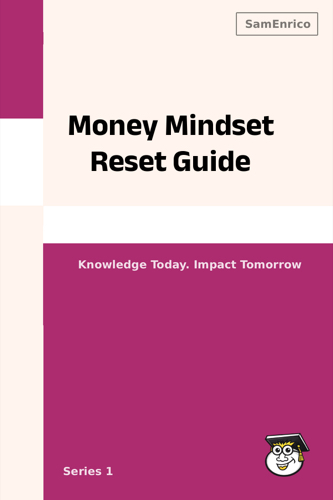
Non-FictionSelf-HelpMoney Mindset
Money Mindset Reset Guide eBook
Changes scarcity thinking to abundance perspective
Changes scarcity thinking to abundance perspective.
Formats
Free sample
Chapter 1: The Ghost in Your Wallet--The first time I understood that money was not about math, I was sitting in a rented conference room in Chicago, watching a forty-three-year-old engineer named Marcus cry.Marcus had just received a promotion. Six months earlier, he had been promoted. The year before that, he had received a bonus larger than his first annual salary out of college. By every external metric, Marcus was winning. His income had tripled in seven years.
He drove a reliable car, owned a modest home, and had no credit card debt. On paper, he was the poster child for responsible financial success.But Marcus was not celebrating. He was drowning."I don't understand it," he said, his voice cracking. "The more I make, the more stressed I get. I check my bank account less now than I did when I was making thirty thousand dollars a year.
I feel like any second, someone is going to realize I don't belong here and take it all away. I can't sleep. I hide bills from my wife even though we can pay them. I donated last year's bonus to charity just to get it out of my sight because having it in my account made me sick."Marcus was not irrational. He was not bad with money.
He was not greedy or ungrateful. Marcus was haunted.The Ghost in Your Wallet What Marcus was experiencing—and what you may be experiencing right now—is what this book calls the Money Ghost. The Money Ghost is the invisible set of beliefs, phrases, emotional reactions, and behavioral scripts you absorbed before the age of ten from your caregivers, culture, community, and religion. It is not a metaphor. It is a neurological and psychological reality.
The Money Ghost lives in your brain's predictive processing systems, running in the background of every financial decision you make, usually without your conscious awareness.Here is the disturbing truth that behavioral economics has confirmed across decades of research: Your financial reality is a perfect reflection of your subconscious money blueprint, not your conscious goals. You can want to be wealthy with every fiber of your conscious mind. You can read books, attend seminars, create spreadsheets, and set ambitious goals. But if your Money Ghost believes something different—if it believes money is dangerous, or that rich people are evil, or that you don't deserve abundance—you will sabotage yourself every single time. You will lose money the moment you get it.
You will avoid opportunities that could change your life. You will feel anxious and ashamed no matter how much you earn.Marcus had a Money Ghost. It whispered to him constantly: "You don't belong here. This will be taken from you. Safety is scarcity.
The less you have, the safer you are."The Ghost had nothing to do with Marcus's actual financial situation. It had everything to do with his childhood.The Origins of Your Money Ghost To understand the Money Ghost, you have to go back. Way back. Before you understood what a mortgage was. Before you knew the difference between a debit card and a credit card.
Before you had ever seen a paycheck.Your brain's relationship with money was formed in the first decade of your life through three primary channels:First, your caregivers. The phrases your parents or primary guardians used about money became the operating system of your financial brain. "Money doesn't grow on trees." "We can't afford it." "Rich people are greedy." "You have to work hard for every dollar." "Money is the root of all evil." "We're not rich people." "What do you think, I'm made of money?" These phrases were not neutral descriptions of reality. They were programming instructions. Your young brain, desperate to understand how the world worked, absorbed them as absolute truth.Second, your culture.
The neighborhood you grew up in, the television shows you watched, the advertisements that surrounded you, the messages about wealth and poverty in your community—all of these shaped your Money Ghost. If you grew up in a community where wealth was viewed with suspicion, your Ghost learned that money makes you a bad person. If you grew up in a community where wealth was flaunted as the only measure of worth, your Ghost learned that you are never enough.Third, your religion or spiritual tradition. Many religious traditions have complex relationships with money. Some equate poverty with piety.
Some promise wealth to the faithful. Some warn that money is a trap. Whatever your tradition taught you about money became part of your Ghost. You may not practice that religion anymore. You may have rejected it entirely.
But the money programming remains.The Seventeen Wealth Files T. Harv Eker, in his groundbreaking book Secrets of the Millionaire Mind, identified seventeen specific differences between how wealthy people think and how poor or middle-class people think. Eker calls these the "Wealth Files." They are not about IQ or education or luck. They are about subconscious programming. Your Money Ghost operates through these files, whether you know it or not.Here are seven of the most consequential Wealth Files.
As you read them, notice which column feels more familiar. Do not judge yourself. Just observe.Wealth File 1: Rich people believe "I create my life." Poor people believe "Life happens to me."This is the foundational file. Scarcity thinking externalizes control. If life happens to you, then you are a victim of circumstance, and there is nothing you can do to change your financial situation.
Abundance thinking internalizes control. You are the primary cause of your results. Not because the system is fair—it isn't—but because the only variable you can reliably change is yourself.Wealth File 2: Rich people play the money game to win. Poor people play the money game to not lose.Playing not to lose means your financial decisions are driven by fear. You save not because you are building abundance but because you are terrified of poverty.
You invest conservatively because you cannot tolerate any risk. You avoid opportunities because you might fail. Playing to win means you make decisions from a place of purpose and vision. You still save and invest carefully, but your motivation is growth, not survival.Wealth File 3: Rich people are committed to being rich. Poor people want to be rich.There is a vast difference between wanting and committing.
Wanting is a wish. Committing is a decision backed by action. Most people say they want to be wealthy, but their daily actions prove otherwise. They spend more than they earn. They avoid learning about investing.
They make excuses. Commitment means you do what it takes, even when it is uncomfortable.Wealth File 4: Rich people think big. Poor people think small.Your income is directly proportional to the number of people you serve and the scale of the problems you solve. Thinking small limits you. Thinking big expands your potential impact—and your potential income.Wealth File 5: Rich people focus on opportunities.
Poor people focus on obstacles.Give the same situation to a scarcity thinker and an abundance thinker. One will see every reason it won't work. The other will see every reason it might. Both are…
This is the end of the free sample. Get the eBook to keep going. Buy now
About this book
Details
- Author
- Pippin Carlyn
- Publisher
- SamEnrico
- Language
- English
- Genre
- Non-Fiction, Self-Help, Money Mindset
- Released
- 2026-06-07
- Pages (approx.)
- 133
- Available as
- eBook, Audiobook

Read better in the ZLOADR app
Your eBooks on your phone or tablet. Sign in with your SamEnrico account and start reading.
More by Pippin Carlyn
 SMART for Financial GoalsPippin Carlyn$11.99
 Burnout Prevention For CaregiversPippin Carlyn$11.99
 Hoffa Vanished In Plain Sight TheoryPippin Carlyn$11.99
 Clubhouse Room Status AnxietyPippin Carlyn$11.99
 Somalia Humanitarian Intervention CriticPippin Carlyn$11.99
 The Shame Urge SurfingPippin Carlyn$11.99
 Zumba Dance StepsPippin Carlyn$11.99
 The Stoic and the Sword: Marcus Aurelius, Philosopher-King of RomePippin Carlyn$11.99
 The Rise of the Tigres: How a Mexican Soccer Revolution Changed a NationPippin Carlyn$11.99
 Growing BrachylaenaPippin Carlyn$11.99
 A Collector's Handbook to the Rover 100Pippin Carlyn$11.99
 How to Produce a Multimedia Over Coax AlliancePippin Carlyn$11.99
You may also like
 Hong Kong Handover 1997Dunn Johnnie$11.99
 Zumba For Postnatal Recovery CourseNeal Christian$11.99
 Zumba for BeginnersLadner Nikia$11.99
 YouTube Comment Mining GuideHumes Pandora$12.99
 Worry Box MeditationCarlin Rudy$11.99
 Workplace Stress MeditationNguyen Lynn$11.99
 Workplace Stress and Sleep RepairHawley Ivory$11.99
 Workplace Perfectionism CureDelaney Jeffry$11.99
 Workplace Injustice Anger GuideWallen Isabelle$11.99
 Work Addiction and Burnout LinkGreenwood Ester$11.99
 Women in Yoga and WellnessBeattie Galina$11.99
 Women in Stand Up ComedyChun Evangeline$11.99