
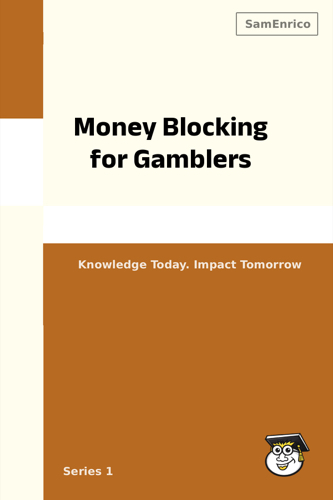
Money Blocking for Gamblers eBook
Protects assets and limits access to betting funds
Protects assets and limits access to betting funds.
Formats
Free sample
Chapter 1: The 2 AM Brain--The cursor hovered over the “Deposit $5,000” button for forty-seven seconds. In that time, your prefrontal cortex—the part of your brain responsible for long-term consequences, logic, and self-control—sent approximately fourteen distinct warning signals. You thought about rent. You thought about the credit card bill. You thought about the look on your partner’s face the last time you had to explain where the money went.
And then, despite every single one of those warnings, you clicked.Two minutes later, the $5,000 was gone. You lost it on a single NBA over-under bet that was decided by a meaningless buzzer-beater in the fourth quarter of a game you didn’t even care about. You didn’t feel relief. You didn’t feel excitement. You felt the unique, hollow nausea of watching money disappear that you knew, even as you clicked, should never have been in play.Here is the question this entire book exists to answer: Why did you click?Not the surface-level answer.
Not “I have a gambling problem” or “I was chasing losses” or “I’m an addict.” Those are descriptions of the condition, not explanations of the mechanism. The real question is mechanical: What happened inside your brain in those forty-seven seconds that allowed a rational adult who knows the house always wins to override every logical impulse and voluntarily hand $5,000 to a corporation that has spent billions engineering that exact outcome?The answer will determine whether you ever gamble again. And the answer is not what you think.The Most Dangerous Assumption in Recovery Most people—including most therapists, most self-help books, and most well-meaning family members—operate under a single, catastrophic assumption about gambling addiction. They believe that wanting to stop is the same as being able to stop. They believe that if you truly understand the consequences, if you truly feel the shame, if you truly commit to change, then willpower will carry you through.This assumption is not just wrong.
It is lethally wrong.Neuroscience has demonstrated conclusively that the addicted brain does not process information the way a non-addicted brain does. When you are in the grip of a gambling urge, your prefrontal cortex—the CEO of your brain, the part that plans, restrains, and evaluates long-term consequences—is systematically overridden by your limbic system, a much older and more primitive network of structures designed for immediate survival, reward-seeking, and impulse gratification. This is not a metaphor. This is measurable brain chemistry. Functional MRI scans of active gamblers show that during a betting urge, blood flow shifts dramatically away from the prefrontal cortex and toward the nucleus accumbens, the brain’s primary reward center.
You are literally not thinking clearly because the part of your brain that does the thinking has been temporarily sidelined.This is why every gambler has experienced the following sequence: You lose a large bet at 11:00 PM. You swear you will never gamble again. You feel genuine remorse. You go to sleep. You wake up at 7:00 AM, and by 7:15 AM, you have already opened a betting app and deposited another $1,000.
You did not forget the loss. You did not stop caring about the consequences. Your brain simply reset overnight, and the 7:00 AM brain—rested, hungry for dopamine, and ignorant of the 11:00 PM remorse—is a different neurological entity than the one that made the promise.The gap between “wanting to stop” and “being able to stop” is not a character flaw. It is a structural feature of addiction. And until you accept that, you will continue to build your recovery on a foundation of sand.The Dopamine Lie To understand why you cannot trust your own brain during a gambling urge, you must first understand dopamine.
You have probably heard that dopamine is the “pleasure chemical.” This is incorrect. Dopamine is not primarily about pleasure. Dopamine is about anticipation and motivation. It is the neurotransmitter that says, “Do that thing again because something good might happen.”Here is how dopamine functions in a healthy brain: You see a slice of cake. Your brain releases a small amount of dopamine, motivating you to eat the cake.
You eat the cake. It tastes good. Your brain releases additional dopamine as a reward, reinforcing the behavior. Over time, your brain learns that cake is rewarding, and the dopamine system helps you remember to seek it out.Here is how dopamine functions in the gambling brain: You open a betting app. Before you place a bet, your brain releases a surge of dopamine—significantly larger than the cake-induced surge—simply in anticipation of the unknown outcome.
You place the bet. The event unfolds. If you win, you get another dopamine hit. But here is the diabolical part: if you lose, you also get a dopamine hit, because the near-miss (your team lost by two points, the slot machine landed one symbol short, the poker hand was beaten on the river) triggers almost the same neural response as a win. And if the outcome is a “loss disguised as a win”—a slot machine spin that pays out fifty cents on a one-dollar bet but celebrates with flashing lights and dramatic music—your brain registers it as a win even though you lost money.The gambling industry has weaponized this neurochemistry.
They have spent billions of dollars—actual, documented research and development budgets—studying exactly how to maximize dopamine release per betting action. They have hired former neuroscientists from top universities to design slot machine algorithms that optimize near-miss frequency. They have engineered mobile apps that deliver visual and auditory rewards even on losing spins. They have created a product that is not a game of chance but a dopamine delivery system disguised as entertainment.And you are not winning against that. No one is.The Myth of the Rock Bottom Gambling memoirs like Down to the Wire and The Biggest Game in Town follow a predictable arc: The gambler hits a spectacular rock bottom—a lost house, a stolen inheritance, an arrest, a suicide attempt.
Then, through sheer force of will and a moment of profound clarity, they turn their lives around. The message, whether intended or not, is that recovery requires a dramatic crisis.This is a dangerous myth for three reasons.First, it suggests that if you have not hit a sufficiently dramatic bottom, you are not “ready” to recover. This keeps gamblers in the cycle longer than necessary, waiting for a catastrophic event that may never come—or that may come in the form of death rather than redemption.Second, it implies that willpower is the active ingredient. The memoir structure—“I was broken, I decided to change, I changed”—reinforces the false belief that wanting to stop is enough. The memoir leaves out the thousands of smaller decisions, the structural interventions, the financial blocks, and the third-party controls that actually made recovery possible.
It is survivorship bias dressed as inspiration.Third, and most critically for this book, the rock-bottom myth focuses entirely on the moment of crisis rather than the mechanics of staying out. Getting sober is one event. Staying sober is thousands of events spread across years. The memoirs cover the first. This book covers the…
This is the end of the free sample. Get the eBook to keep going. Buy now
About this book
Details
- Author
- Burdette Natashia
- Publisher
- SamEnrico
- Language
- English
- Genre
- Non-Fiction, Self-Help, Financial
- Released
- 2026-06-06
- Pages (approx.)
- 129
- Available as
- eBook, Audiobook

Read better in the ZLOADR app
Your eBooks on your phone or tablet. Sign in with your SamEnrico account and start reading.
More by Burdette Natashia
 Appreciated Stock Donation GuideBurdette Natashia$11.99
 Speed Processing Aging GuideBurdette Natashia$11.99
 Generational Apparel RentalBurdette Natashia$11.99
 Gacy Prosecutor William KunkleBurdette Natashia$11.99
 Quit Smoking Coaches GuideBurdette Natashia$11.99
 Night Stalker Petty Criminal StartBurdette Natashia$11.99
 Calcium Bone Health ManualBurdette Natashia$11.99
 The Wings of the Winged Hussars: Love and Valor at Vienna (1683)Burdette Natashia$11.99
 The Siege of Petersburg: Grant's Relentless GambleBurdette Natashia$11.99
 How to Produce Gift BagsBurdette Natashia$11.99
 10 Ways to Use Muddle (Recipe Book)Burdette Natashia$11.99
 A Collector's Handbook to the Cleco CoupéBurdette Natashia$11.99
You may also like
 Hong Kong Handover 1997Dunn Johnnie$11.99
 Zumba For Postnatal Recovery CourseNeal Christian$11.99
 Zumba for BeginnersLadner Nikia$11.99
 YouTube Comment Mining GuideHumes Pandora$12.99
 Worry Box MeditationCarlin Rudy$11.99
 Workplace Stress MeditationNguyen Lynn$11.99
 Workplace Stress and Sleep RepairHawley Ivory$11.99
 Workplace Perfectionism CureDelaney Jeffry$11.99
 Workplace Injustice Anger GuideWallen Isabelle$11.99
 Work Addiction and Burnout LinkGreenwood Ester$11.99
 Women in Yoga and WellnessBeattie Galina$11.99
 Women in Stand Up ComedyChun Evangeline$11.99