
Non-FictionHealth & WellnessMycotoxin Illness
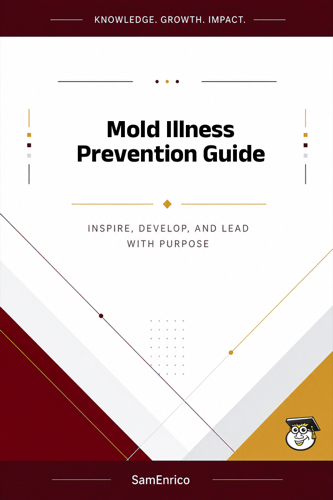
Mold Illness Prevention Guide eBook
Teaches moisture control, remediation, and immune
Teaches moisture control, remediation, and immune support to prevent chronic inflammatory response syndrome.
Formats
Free sample
Chapter 1: The Leak You Never See...--–- The water damage started three years before Sarah noticed anything was wrong. Not a flood, not a burst pipe, not even a drip she could hear. Just a slow, persistent weep from a pinhole in a plumbing elbow buried inside the wall between her master bathroom and bedroom closet. The leak was so small that her water bill never spiked. The drywall never bubbled.
The paint never peeled. But behind that innocent-looking wall, a microscopic ecosystem had been thriving for 1,095 days. Mold was digesting the paper backing of the drywall, the wooden studs, and the cellulose dust that had settled there during construction. By the time Sarah developed the brain fog that made her forget her own phone number, the colony had spread across six feet of wall cavity and was releasing trillions of spores, fragments, and MVOCs into her breathing air every single day.Sarah's story is not exceptional. It is, by every available metric, the new normal.The Silent Epidemic in Your Walls We have been taught to think of mold as a visible problem.
Black spots on shower grout. A fuzzy patch on forgotten bread. A musty basement that needs a dehumidifier and some bleach. This framing is not merely incomplete—it is dangerous. The mold that harms you is almost never the mold you can see.
It is the mold growing inside wall cavities, above dropped ceilings, beneath vinyl flooring, inside HVAC ductwork, and behind bathroom tile. It is the mold that colonizes the dark, humid, undisturbed spaces that home inspections do not reach and that your eyes never find.The Environmental Protection Agency estimates that over 50 percent of homes in the United States have some form of water damage. Other studies push that number to 85 percent when including minor, unreported leaks. Yet only a fraction of homeowners ever investigate beyond surface-level visual inspections. We have built a culture of mold denial, reinforced by the comforting but false belief that if we cannot see it, it cannot hurt us.
The science of the past two decades has dismantled that assumption completely.The Air Tightness Trap The very features that modern homebuyers are told to value—energy efficiency, sealed windows, spray foam insulation, reduced air exchange—have created an unintended consequence: they trap moisture. A home built in 1970 leaked air so freely that it exchanged its entire volume with outdoor air every hour or two. That same home today, after energy retrofits, might take six to eight hours to exchange its air. This is excellent for your heating bill. It is catastrophic for moisture control.Every activity of daily living produces water vapor.
A family of four generates approximately two to three gallons of water vapor per day through breathing, cooking, showering, and drying laundry indoors. In a leaky old home, that vapor escapes through gaps and cracks. In a tight modern home, it condenses on the coldest surfaces—typically window frames, exterior walls, and the underside of roof sheathing. Condensation is water. Water is food for mold.
And unlike the 1970s home where that condensation would dry out between episodes, the tight home stays damp longer, providing the continuous moisture that mold requires to colonize.This is the great irony of modern construction: we have built healthier homes for our energy bills and sicker homes for our bodies.Why "Leak-Free" Is a Dangerous Illusion Consider the places where water hides. A roof flashing that looks intact but has a hairline crack beneath the shingle. A window seal that failed invisibly, allowing condensation to pool inside the wall between the studs. A shower pan that was improperly sloped during installation, so water migrates toward the wall instead of the drain. A refrigerator ice maker line that weeps a teaspoon per day behind the kitchen cabinetry.
A crawlspace with a dirt floor that wicks moisture from the ground, creating 70 percent humidity even though the living space above reads 45 percent.None of these conditions are detected by the human eye during a casual walkthrough. None of them would be caught by a standard home inspection, which is largely visual and non-invasive. And each of them is sufficient to create a mold reservoir large enough to trigger Chronic Inflammatory Response Syndrome in a genetically susceptible occupant.The term "leak-free" is a marketing phrase, not a scientific reality. Every home has water intrusion. The question is not whether water is getting in, but whether it is drying out fast enough to prevent colonization.
This is the single most important concept in mold prevention: drying potential matters more than water exclusion. A home that gets wet but dries completely within 24 to 48 hours will never develop a mold problem. A home that keeps a small amount of water for a long time will.From Sick Building Syndrome to Building-Related Illness The medical literature has long recognized a condition called Sick Building Syndrome. The defining feature is temporary: occupants experience symptoms while inside a particular building, and those symptoms resolve within hours of leaving. Headaches, eye irritation, fatigue, and dry cough are common.
The cause is often a combination of poor ventilation, volatile organic compounds from furniture or cleaning products, and low levels of biological contaminants including mold.Sick Building Syndrome is unpleasant, but it is not life-altering. Leave the building, and you leave the symptoms behind.Building-Related Illness is something else entirely. In Building-Related Illness, the symptoms persist. They do not resolve upon leaving the environment because the biological damage has already been set in motion. The immune system has been triggered into a state of chronic inflammation that continues even after the trigger is removed.
This is CIRS: Chronic Inflammatory Response Syndrome. And it is the difference between a temporary nuisance and a life-altering, career-ending, relationship-destroying disease.The Prevalence Problem How common is CIRS? The data are still emerging, but the numbers are alarming. Dr. Ritchie Shoemaker, the physician who first characterized CIRS in the 1990s, estimated that approximately 24 percent of the population carries the HLA-DR genetic susceptibility that makes them vulnerable.
That is nearly one in four people. In a family of four, statistically, one person is a "canary"—the one who will get sick while everyone else remains healthy, leading to the classic and heartbreaking pattern of the sick family member being told they are crazy, anxious, or making it up.But genetic susceptibility alone does not cause CIRS. It requires exposure to a water-damaged building. And as we have already established, water-damaged buildings are not rare—they are the default state of the modern housing stock. A 2011 study published in the journal Applied and Environmental Microbiology found detectable mold growth in 85 percent of homes tested, with toxigenic species present in nearly half.
A 2017 analysis of insurance claims data found that water damage claims increased by over 70 percent between 2000 and 2015, driven largely by more frequent extreme weather events and the aging of the housing stock.Put these numbers together: 24 percent of people are genetically susceptible. 85 percent of homes have mold growth. The overlap is inevitable and enormous. CIRS is not a rare condition affecting a handful of unlucky individuals. It is a mass environmental illness that we…
This is the end of the free sample. Get the eBook to keep going. Buy now
About this book
Details
- Author
- Norris Bessie
- Publisher
- SamEnrico
- Language
- English
- Genre
- Non-Fiction, Health & Wellness, Mycotoxin Illness
- Released
- 2026-06-11
- Pages (approx.)
- 130
- Available as
- eBook, Audiobook

Read better in the ZLOADR app
Your eBooks on your phone or tablet. Sign in with your SamEnrico account and start reading.
More by Norris Bessie
 Creative Outlier Thinking GuideNorris Bessie$11.99
 Social Entrepreneur Speaking GuideNorris Bessie$11.99
 Pablo Escobar VS AmericaNorris Bessie$11.99
 Stress and Autoimmune Disease ConnectionNorris Bessie$11.99
 The Last Empress: A Century of Forbidden Love and PowerNorris Bessie$11.99
 The Last Whisper of the Silk RoadNorris Bessie$11.99
 Understanding Fanconi Like SyndromeNorris Bessie$17.99
 Ultimate Handbook Guide to Sagamihara : (Japan) Travel GuideNorris Bessie$11.99
 Route SupervisorNorris Bessie$11.99
 UAE VAT for Non ResidentsNorris Bessie$12.99
 Strategy Meeting Tool Kit for FacilitatorsNorris Bessie$12.99
You may also like
 Hong Kong Handover 1997Dunn Johnnie$11.99
 Zumba For Postnatal Recovery CourseNeal Christian$11.99
 Zumba for BeginnersLadner Nikia$11.99
 YouTube Comment Mining GuideHumes Pandora$12.99
 Worry Box MeditationCarlin Rudy$11.99
 Workplace Stress MeditationNguyen Lynn$11.99
 Workplace Stress and Sleep RepairHawley Ivory$11.99
 Workplace Perfectionism CureDelaney Jeffry$11.99
 Workplace Injustice Anger GuideWallen Isabelle$11.99
 Work Addiction and Burnout LinkGreenwood Ester$11.99
 Women in Yoga and WellnessBeattie Galina$11.99
 Women in Stand Up ComedyChun Evangeline$11.99