
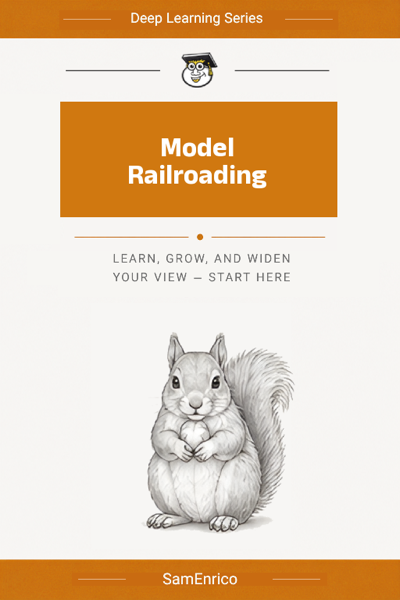
Non-FictionInformativeEducational
Model Railroading eBook
A Coursebook on Model Railroading
by Toth Daren
A Coursebook on Model Railroading
Formats
Free sample
Chapter 1: The Shelf-Sized Universe--–- Every great model railroad begins not with a train, but with a question. The question is not “Which locomotive should I buy?” nor “How much will this cost?” nor even “How long will it take?” The question—the one that separates those who will still be modeling five years from now from those who will have a dusty oval in the attic—is this: What do I actually want to build?This sounds deceptively simple. It is not. Most beginners walk into a hobby shop, see a gleaming locomotive in a box, and fall in love with the object itself. They buy it, take it home, set it on a sheet of plywood, and then stare at it.
The train runs back and forth, or around in a circle, and after a few weeks, the magic fades. The locomotive becomes a trophy. The plywood becomes a coffee table. The hobby becomes a memory.This book exists to prevent that outcome.You are about to build a shelf-sized universe. Not a toy, not a display case, not a collector’s cabinet—a universe.
Your universe will have mountains that cast shadows at 2:00 PM. It will have towns where tiny figures wait for trains that never quite run on time. It will have weather: rust on a boxcar, dust on a depot roof, sunlight fading a billboard from red to pink. And when you flip the switch and send a train moving through that universe, you will experience something that no video game or television screen can replicate: the deep, quiet satisfaction of watching something real that you built with your own hands.But to build a universe, you must first understand the language of the people who have been building them for over a century. This chapter is your Rosetta Stone.The Great Divorce: Toy Trains vs.
Model Railroads Let us begin with a distinction that will save you years of frustration. There is a fundamental difference between a toy train and a model railroad, and the difference has nothing to do with price, scale, or complexity.A toy train is an object that moves. It is designed to be durable, simple, and satisfying to a child (or a child at heart). Toy trains have oversized wheels that rarely derail. They have bright colors that do not fade.
They run on three-rail track with a center pin so that polarity is never an issue. They are wonderful—Lionel, Marx, and American Flyer built an entire American Christmas tradition around them.A model railroad, by contrast, is an illusion. It is a deliberate deception, a trick played on the eye and the mind. The model railroader says: “This piece of painted plaster is a mountain. This strip of dyed sawdust is a meadow.
This tiny brass casting is a steam locomotive’s valve gear.” And for the trick to work, everything must be internally consistent. The mountain cannot be made of the same material as the meadow. The locomotive’s wheels must actually turn. The train must move at a speed that matches the scale distance it is covering.The toy train asks: “Does it run?” The model railroad asks: “Does it feel real?”This book is for the second question.The Post-War Boom and the Birth of Scale Modeling The history of model railroading is, in many ways, the history of childhood itself. Before World War II, most trains were toys for wealthy families.
They were made of stamped tin, painted in bright primary colors, and powered by clockwork springs or temperamental electric motors. They were fun, but they were not realistic.Everything changed after 1945. Thousands of soldiers returned home with new skills in mechanics, electricity, and carpentry. The post-war economic boom gave families disposable income and, for the first time, suburban basements where a layout could be built and left in place. And a small organization founded in 1935—the National Model Railroad Association, or NMRA—began publishing standards for scale accuracy.The 1950s saw the rise of HO scale (1:87) as the dominant format.
HO was small enough to fit a satisfying layout on a 4×8 sheet of plywood but large enough to be worked on with bare hands. Manufacturers like Athearn, Roundhouse, and Revell began producing plastic kits that ordinary hobbyists could assemble and paint. The hobby shifted from buying to building.By the 1970s, a new generation of modelers had taken the craft to an art form. People like John Allen (whose Gorre & Daphetid Railroad became legendary) and Dave Frary (whose scenery techniques remain the gold standard) proved that a model railroad could be a work of art. They introduced concepts like forced perspective, weathering, and selective compression—ideas we will explore in depth throughout this book.Today, the hobby is in a golden age.
Digital Command Control (DCC) allows you to run multiple trains independently on the same track. Laser-cut kits produce structures with window mullions finer than a human hair. Static grass applicators create meadows that look like meadows. But all of these tools are useless without one thing: a clear understanding of the language of the craft.The Essential Vocabulary: Words That Build Worlds Before you read another chapter, you must master these twelve terms. They will appear on every page of this book.
They are the alphabet of your new language.Prototype. This is the real-world railroad that you are modeling. The prototype might be the Pennsylvania Railroad in 1953, the Denver & Rio Grande Western in 1925, or a modern short line like the Montana Rail Link. Your layout is a model of something that exists or once existed. Having a prototype gives you a source of truth: if you wonder whether a building should be brick or wood, you look at a photograph of the prototype.
If you wonder what color to paint a boxcar, you check the prototype’s paint schemes.Scale. Scale is the mathematical reduction ratio between your model and the real thing. The most common scale in the world is HO, which is 1:87. That means one foot on the prototype becomes 1/87th of a foot (about 3.5 millimeters) on your model. N scale is 1:160.
O scale is 1:48. Each scale has different advantages and trade-offs, which we will cover in exhaustive detail in Chapter 2. For now, remember this: scale determines everything. It determines how much space you need, how much detail you can see, how steady your hands must be, and how much money you will spend.Gauge. Gauge is the distance between the inside edges of the two rails.
Standard gauge (the most common worldwide) is 4 feet, 8.5 inches between the rails. In HO scale, that works out to 16.5 millimeters. In N scale, it is 9 millimeters. In O scale, it is 32 millimeters. Here is where beginners get confused: scale and gauge are not the same thing.
You can have HO scale models running on narrow gauge track (called HOn3, where the “n3” means three prototype feet between the rails). You can have O scale models running on 30-inch prototype gauge (On30). Gauge is about the track. Scale is about the train. Do not mix them up.Scratch-building.
This means creating something from raw materials—sheet styrene, wood, brass, or plaster—rather than from a kit. Scratch-building is the highest…
This is the end of the free sample. Get the eBook to keep going. Buy now
About this book
Details
- Author
- Toth Daren
- Publisher
- SamEnrico
- Language
- English
- Genre
- Non-Fiction, Informative, Educational
- Released
- 2026-06-02
- Pages (approx.)
- 129
- Available as
- eBook, Audiobook

Read better in the ZLOADR app
Your eBooks on your phone or tablet. Sign in with your SamEnrico account and start reading.
More by Toth Daren
 TM and Sleep Quality GuideToth Daren$11.99
 Scott Peterson Sharon Rocha TestimonyToth Daren$11.99
 PCOS Hair Thinning GuideToth Daren$11.99
 Fear Nonverbal Escape SignalsToth Daren$11.99
 Homestead Exemption and Property TaxToth Daren$11.99
 The Last Stand: The Miracle on Ice’s Untold OvertimeToth Daren$11.99
 How to Become a Spray-gun-repairer HelperToth Daren$11.99
 Nonprofit Geo Domain GuideToth Daren$12.99
 J&J MedTech PatentsToth Daren$12.99
 Understanding Pediatric T-cell LeukemiaToth Daren$17.99
You may also like
 Hong Kong Handover 1997Dunn Johnnie$11.99
 Zumba For Postnatal Recovery CourseNeal Christian$11.99
 Zumba for BeginnersLadner Nikia$11.99
 YouTube Comment Mining GuideHumes Pandora$12.99
 Worry Box MeditationCarlin Rudy$11.99
 Workplace Stress MeditationNguyen Lynn$11.99
 Workplace Stress and Sleep RepairHawley Ivory$11.99
 Workplace Perfectionism CureDelaney Jeffry$11.99
 Workplace Injustice Anger GuideWallen Isabelle$11.99
 Work Addiction and Burnout LinkGreenwood Ester$11.99
 Women in Yoga and WellnessBeattie Galina$11.99
 Women in Stand Up ComedyChun Evangeline$11.99