
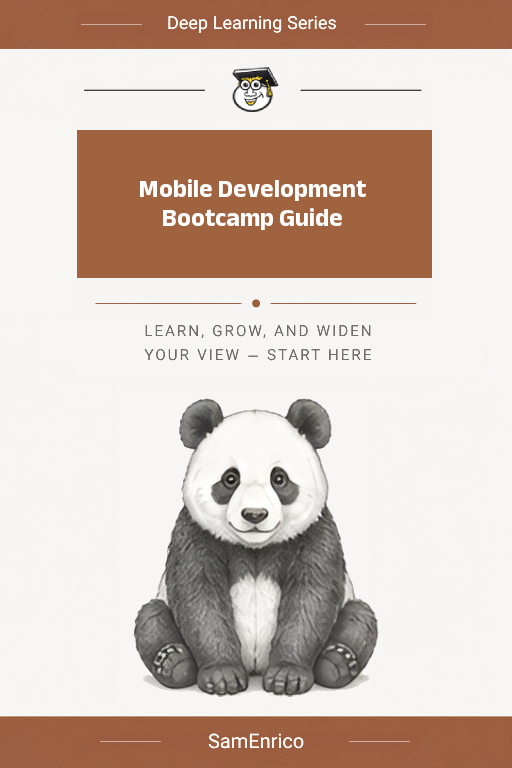
Mobile Development Bootcamp Guide eBook
Choose between iOS and Android bootcamps or CS deg
Choose between iOS and Android bootcamps or CS degree tracks including app store success and job markets.
Formats
Free sample
Chapter 1: The $150,000 Question--Let me tell you something no bootcamp ad will ever say and no CS degree brochure will ever admit: you are about to make one of the most financially consequential decisions of your life, and most people get it wrong not because they are lazy or dumb but because they are asking the wrong question entirely.The wrong question is "Should I go to a bootcamp or get a CS degree?" That is like asking "Should I buy a house or rent an apartment?" without knowing your credit score, your savings, your job stability, or whether you plan to move in six months. The answer depends entirely on you, yet the tech industry loves to fight about this as if one path is universally superior. Bootcamp graduates post angry tweets about useless theory. CS degree holders post smug Linked In articles about fundamentals. And you, the person who just wants to build apps and get paid, are caught in the middle of a religious war that has nothing to do with your actual life.This chapter will give you a different framework.
Not the answer—because I don't know you—but the questions you need to answer for yourself. By the time you finish reading, you will know exactly which path fits your timeline, your bank account, your learning style, and your tolerance for risk. You will also understand why the rest of this book assumes you are building i OS apps first, and why that decision alone could save you six months of struggling against a market that pays Android developers thirty percent less for the same level of experience.Let me start with a story. Not mine, because this book is not about me, but a story that captures everything wrong with how people choose their path into mobile development.A few years ago, a friend of mine—let us call her Sarah—decided she wanted to become an i OS developer. She had a biology degree from a good university and had spent three years working in a lab, pipetting liquids into tiny tubes and feeling her soul leave her body one PCR test at a time.
She had saved about fifteen thousand dollars. She was twenty-six years old. She wanted out.Sarah did what most people do: she Googled "best i OS bootcamps" and found a highly rated twelve-week program that cost fourteen thousand dollars. The website showed smiling graduates holding offer letters from Google and Airbnb. The admissions person told her that their graduates typically saw a three hundred percent return on investment within the first year.
Sarah enrolled, quit her lab job, and moved into her parents' basement to save money during the program.The bootcamp was not bad. It was actually quite good. She learned Swift, she built several projects, she had a career coach who reviewed her resume. But here is what no one told her: the twelve-week timeline assumes you already know how to code. The curriculum was designed for people who had spent six months learning Java Script on their own, not for someone coming from wet lab biology.
Sarah fell behind in the second week, stayed behind through the middle section on networking, and graduated with a portfolio that looked exactly like every other graduate's portfolio: the same weather app, the same to-do list, the same chat app using Firebase.She applied to two hundred and thirty jobs. She got seven first-round interviews. She got zero offers.Six months after graduation, Sarah had burned through most of her savings and was back at her lab job, pipetting liquids into tiny tubes, now with fourteen thousand dollars of debt and a Git Hub repository she could not bear to look at.Here is the part of the story that bootcamps do not want you to hear: Sarah's problem was not her intelligence or her work ethic. Her problem was that she chose the wrong path for her specific situation. She had no coding background, a moderate amount of savings, a high need for structure, and a low tolerance for financial risk.
A twelve-week immersive bootcamp was the worst possible fit for her profile. A six-month self-paced program with live mentorship would have been better. A post-baccalaureate computer science certificate from a state school would have been better. Even teaching herself over nine months while keeping her lab job would have been better, because she would not have been desperate and broke during the job search.But Sarah did not know how to evaluate paths because no one had given her a framework. That is what this chapter is for.The Economic Reality You Cannot Ignore Before we talk about education paths, we need to talk about money.
Not because money is the only thing that matters, but because the entire debate about bootcamps versus degrees exists inside a specific economic context, and if you misunderstand that context, you will make bad decisions.Let me give you the single most important number in this entire book: the i OS App Store generated approximately one hundred and two billion dollars in revenue in 2024. The Google Play Store generated approximately forty-eight billion. That is not a typo. One platform makes more than twice as much money as the other, despite Android having a much larger global market share in terms of devices.Why does this matter for you, a person who just wants to get hired? Because companies follow money.
When the i OS App Store generates more than double the revenue of Google Play, companies invest more in their i OS apps. They hire more i OS developers. They pay those developers more because the revenue per user is higher and because i OS users historically spend more on apps and in-app purchases.Let me put numbers on this. According to data from multiple salary surveys and job posting aggregators, the average junior i OS developer in the United States earns between eighty-five thousand and one hundred and twenty thousand dollars per year. The average junior Android developer earns between seventy-five thousand and one hundred and five thousand.
That is a ten to fifteen thousand dollar gap at the entry level, and it widens at senior levels.Now, before Android developers come for me in the comments, let me be clear: I am not saying Android is a bad career choice. Android developers in specialized fields like gaming or enterprise can earn as much or more than i OS developers. Android has a much larger global market, which matters if you want to work outside North America or Western Europe. And Android's tooling has improved dramatically over the past few years.But for the reader of this book, the person who wants the clearest, most direct path to a high-paying job in the shortest amount of time, i OS is the rational choice. That is why this book focuses on i OS first.
Not because Android is bad, but because your time and energy are finite, and you should put them where the market rewards them most.That said, you will notice that I included a bonus chapter on Android. Here is my philosophy: you should specialize in one platform deeply…
This is the end of the free sample. Get the eBook to keep going. Buy now
About this book
Details
- Author
- Schulte Timika
- Publisher
- SamEnrico
- Language
- English
- Genre
- Non-Fiction, Student's Shortcut, Mobile Dev, iOS Android
- Released
- 2026-05-29
- Pages (approx.)
- 144
- Available as
- eBook, Audiobook

Read better in the ZLOADR app
Your eBooks on your phone or tablet. Sign in with your SamEnrico account and start reading.
More by Schulte Timika
 Bad News Delivery ProtocolSchulte Timika$11.99
 Aging Metabolic Rate HGH RoleSchulte Timika$11.99
 Self Hypnosis for EmpathySchulte Timika$11.99
 Parental Anger Sleep Deprivation CureSchulte Timika$11.99
 The Grieving Parent Self CareSchulte Timika$11.99
 Echoes of the Iron Road: How a Railroad United a NationSchulte Timika$11.99
 The Geometric Genius of Nsibidi: Decoding Africa's Ancient Symbolic LanguageSchulte Timika$11.99
 How to Become a Scale-reclamation TenderSchulte Timika$11.99
 Rural Ecommerce Five Year ViewSchulte Timika$12.99
 Interior Sales ConsultantSchulte Timika$11.99