
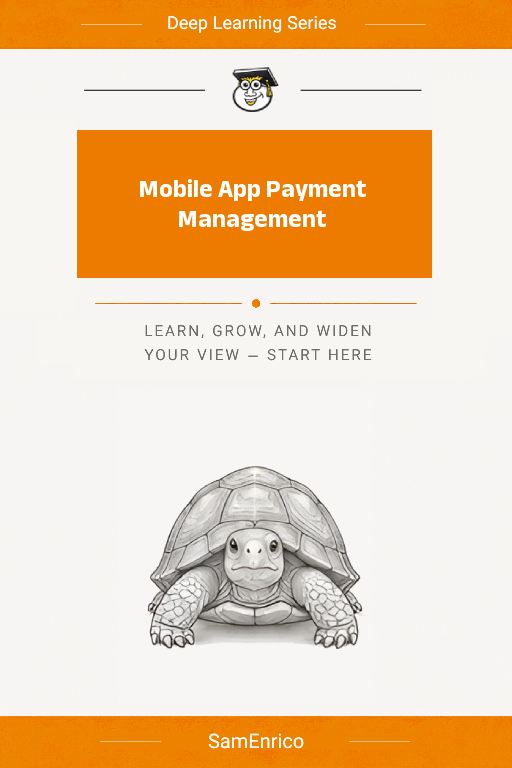
Non-FictionBusiness BriefMobile Finance
Mobile App Payment Management eBook
Track incoming cross-border payments, convert curr
by Farrar Lili
Track incoming cross-border payments, convert currencies, and pay suppliers from a single fintech app.
Formats
Free sample
Chapter 1: The Broken Trifecta--–- Mariana stared at her phone screen, her coffee growing cold on the desk beside her. It was 9:47 AM on a Monday, and she had already spent forty-seven minutes trying to solve a simple problem: moving money from one place to another. A client in San Francisco had paid her 8,500forasoftwaredevelopmentproject.Themoneywassittinginher Pay Palaccount.Hercomponentsupplierin Shenzhen,China,needed€6,200inthreedays.Herteamofdevelopersin Bangaloreneeded8,500 for a software development project. The money was sitting in her Pay Pal account. Her component supplier in Shenzhen, China, needed €6,200 in three days.
Her team of developers in Bangalore needed 8,500forasoftwaredevelopmentproject.Themoneywassittinginher Pay Palaccount.Hercomponentsupplierin Shenzhen,China,needed€6,200inthreedays.Herteamofdevelopersin Bangaloreneeded4,000 in INR today. And her rent in São Paulo was due in five days, in Brazilian reais.Three payments. Four currencies. Five different accounts.She logged into Pay Pal to transfer the USD to her Wise account. Pay Pal charged a 2.5% conversion fee if she converted inside Pay Pal, so she would send USD directly.
That took two clicks. Then she waited. The transfer would take one to two business days to arrive in Wise, because Pay Pal does not use instant rails for cross-border transfers. While waiting, she opened her Brazilian bank app to check her BRL balance for rent. A notification informed her that an incoming wire from a European client had been delayed by an intermediary bank in New York.
The $3,200 payment would arrive in seven to ten business days instead of the promised three.She sighed and opened Whats App. Her lead developer in Bangalore was asking about salaries. She needed to send 4,000in INR.Her Wiseaccounthad EURfromapreviousclient,not USDor INR.Shewouldneedtoconvert EURto USD(0.64,000 in INR. Her Wise account had EUR from a previous client, not USD or INR. She would need to convert EUR to USD (0.6% fee), then USD to INR (another 0.8% fee), then pay via IMPS, India's local rail.
Total fees on the 4,000in INR.Her Wiseaccounthad EURfromapreviousclient,not USDor INR.Shewouldneedtoconvert EURto USD(0.64,000: approximately $56. Total time: two to three days if everything worked perfectly.By 10:30 AM, she had accomplished nothing except starting two transfers that would not settle until Wednesday. She had lost an hour of billable time. And she still had not paid her supplier in China.This was the broken trifecta. And Mariana, like millions of freelancers, e-commerce owners, and small business operators around the world, had accepted it as normal.
It was not normal. It was a tax on global commerce, hidden in plain sight.The Three Siloes That Keep Your Money Hostage Every business that operates across borders faces the same structural problem: banking and payment systems were not designed for the way we work today. Traditional financial infrastructure was built in an era when businesses had one physical location, one currency, and one bank. International transactions were exceptional events, handled by specialized departments with dedicated staff and weeks of lead time.That era is over. Today, a single freelancer in Brazil serves clients in three countries, pays contractors in two more, and manages expenses in her home currency.
A Shopify dropshipper in the United Kingdom buys inventory from China, sells to customers in Australia, and pays a virtual assistant in the Philippines. A small manufacturing company in Germany imports raw materials from India, assembles products in Poland, and exports to the United States.Yet the financial system still operates as if these flows are exceptional. The result is what this book calls the Broken Trifecta: the forced separation of receiving, holding, and paying money into three incompatible siloes.Silo One: Receiving (Getting Paid)The first silo is how you receive money. Most businesses maintain at least one bank account in their home country. They might also have a Pay Pal account, a Stripe account, or a Wise account.
But each of these receiving methods has limitations.Your local bank can receive international wires, but the fees are punishing. A typical wire from the United States to Brazil costs the sender 35−50andthereceiveranother35-50 and the receiver another 35−50andthereceiveranother15-25. Between three and five correspondent banks touch the wire along the way, each taking a fee and adding one to two days of delay. The total time from send to settle is often five to seven business days. And the exchange rate applied by the receiving bank is opaque; banks routinely add a 2-4% spread to the interbank rate, meaning that on a 10,000payment,youlose10,000 payment, you lose 10,000payment,youlose200-400 before the money even arrives.Digital wallets like Pay Pal and Stripe are faster but no cheaper.
Pay Pal charges a 2.5-4% conversion fee plus a fixed fee per transaction. Stripe charges 1-2% for international cards plus conversion fees. And crucially, neither Pay Pal nor Stripe allows you to hold balances in multiple currencies without converting them. If you receive USD but want to hold it in USD, Pay Pal forces you to either convert to your home currency or leave it in a USD balance that cannot be used to pay suppliers outside of Pay Pal's network.Silo Two: Holding (Storing Value)The second silo is where you keep your money between receipt and payment. This is the most overlooked but most costly silo, because it determines how much flexibility you have.Traditional banks offer safety and (in some countries) deposit insurance, but they pay negligible interest on business balances — often 0.01% to 0.10% APY.
Worse, most business accounts do not allow multi-currency holdings. You can hold USD in a US bank account, EUR in a European bank account, and GBP in a UK bank account, but you cannot hold all three in a single account. This forces businesses to maintain multiple accounts across multiple jurisdictions, each with its own monthly fees, compliance requirements, and login credentials.Multi-currency digital wallets like Wise and Revolut solve the holding problem elegantly. You can hold 30-50 currencies in a single dashboard, convert between them at transparent fees, and even earn interest on idle balances (3-5% APY in some jurisdictions). But these wallets have their own limitations: they are not always integrated with your other financial tools (accounting software, invoicing platforms, etc.), and their regulatory status varies by country.
In some jurisdictions, funds held in digital wallets are not covered by deposit insurance.Silo Three: Paying (Sending Money Out)The third silo is how you pay suppliers, contractors, and employees. This is where the fragmentation becomes most painful because each payment destination has its own requirements.Paying a supplier in China requires a Chinese bank account number (which can be 16-19 digits for Union Pay), the bank's SWIFT code, and often a local intermediary bank. Paying a contractor in India requires an IFSC code (11 alphanumeric characters) and a 10-18 digit account number. Paying a developer in Nigeria requires mobile money details (M-Pesa or similar) because traditional banking is unreliable. Paying a supplier in Germany requires an IBAN (22 alphanumeric characters).
Each of these formats is different. Each payment rail has different costs, settlement times, and failure modes.The result is that businesses spend hours each week formatting payments, verifying bank details, and chasing down failed transfers. One study by the Association for Financial Professionals found that the average business spends 7.5 hours per week on cross-border payment administration…
This is the end of the free sample. Get the eBook to keep going. Buy now
About this book
Details
- Author
- Farrar Lili
- Publisher
- SamEnrico
- Language
- English
- Genre
- Non-Fiction, Business Brief, Mobile Finance
- Released
- 2026-05-29
- Pages (approx.)
- 152
- Available as
- eBook, Audiobook

Read better in the ZLOADR app
Your eBooks on your phone or tablet. Sign in with your SamEnrico account and start reading.
More by Farrar Lili
 Virtual Coworking SessionsFarrar Lili$11.99
 Agile Collaboration GuideFarrar Lili$11.99
 Religious Minority Immigrant ChildhoodFarrar Lili$11.99
 Head Tilt MeaningFarrar Lili$11.99
 Anger at Childs Screen TimeFarrar Lili$11.99
 Problem Solving with EmpathyFarrar Lili$11.99
 Dream Aging JournalFarrar Lili$11.99
 Conversation Starters for Coffee ShopsFarrar Lili$11.99
 The Silent Protest: The 1968 Olympics and the Black Power SaluteFarrar Lili$11.99
 The Crimson Tide of Chaldiran: Shah Ismail's Last StandFarrar Lili$11.99
 How to Start a Exhibition Stand Business (Beginners Guide)Farrar Lili$11.99
 How to Produce an Oil HeaterFarrar Lili$11.99
You may also like
 Hong Kong Handover 1997Dunn Johnnie$11.99
 Zumba For Postnatal Recovery CourseNeal Christian$11.99
 Zumba for BeginnersLadner Nikia$11.99
 YouTube Comment Mining GuideHumes Pandora$12.99
 Worry Box MeditationCarlin Rudy$11.99
 Workplace Stress MeditationNguyen Lynn$11.99
 Workplace Stress and Sleep RepairHawley Ivory$11.99
 Workplace Perfectionism CureDelaney Jeffry$11.99
 Workplace Injustice Anger GuideWallen Isabelle$11.99
 Work Addiction and Burnout LinkGreenwood Ester$11.99
 Women in Yoga and WellnessBeattie Galina$11.99
 Women in Stand Up ComedyChun Evangeline$11.99