
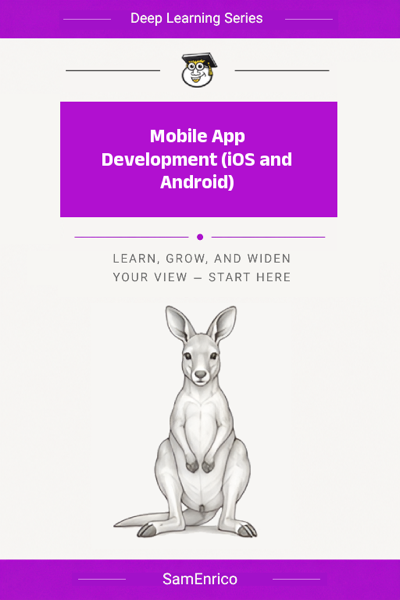
Mobile App Development (iOS and Android) eBook
A Coursebook on Mobile App Development (iOS and An
A Coursebook on Mobile App Development (iOS and Android)
Formats
Free sample
Chapter 1: The Invisible Divide...–- Every year, over 250,000 mobile apps are submitted to the Apple App Store and Google Play Store combined. Of those, roughly 65,000 will be approved. And of those, only about 900 will ever be downloaded more than one million times. The remaining 64,100 apps—the vast majority—will sink into the digital graveyard, not because they were poorly coded or ugly, but because their creators misunderstood a single, fundamental truth: mobile development is not about code. It is about context.This is the most dangerous lie told to aspiring mobile developers: “Learn Swift and Kotlin, and you can build anything.” The truth is far more uncomfortable.
You can be a brilliant programmer—fluent in protocols, extensions, coroutines, and closures—and still build an app that fails instantly because you did not understand that Android users in India expect an app to function on a 4G connection with intermittent power, while i OS users in Manhattan will delete your app if the back button behaves one pixel off from Apple’s Human Interface Guidelines.Context is the invisible divide. This chapter is not about writing a single line of code. It is about understanding why your future code will succeed or fail before you ever type print("Hello World").The Geography of Pixels: Why Your First Platform Choice Matters More Than Your First Framework Let us begin with a simple question: If you have exactly six months and a budget of $20,000 to build and launch a mobile app, which platform do you target first?Most beginner developers answer with technical reasoning: “i OS because Swift is cleaner” or “Android because I don’t own a Mac.” These are convenience answers, not business answers. And they are why 64,000 apps fail.The correct answer lives in a spreadsheet, not an IDE. Open any mobile analytics report from 2024 or 2025, and you will see the same pattern repeated across every region:North America (United States and Canada): i OS commands 58–62% market share.
More importantly, i OS users spend an average of 7.50permonthonin−apppurchases,comparedto7.50 per month on in-app purchases, compared to 7.50permonthonin−apppurchases,comparedto3.20 for Android users in the same region. The average i OS app generates 78% more revenue per download than its Android counterpart.Western Europe (UK, Germany, France): i OS leads with 55–60% share, but the gap is closing. Android dominates in Southern and Eastern Europe, where disposable income is lower and device price sensitivity is higher.Japan: A fascinating outlier. i OS holds 68% market share—the highest of any major economy—and Japanese i OS users spend more per capita on mobile apps than any other country. If you are building a paid app or a subscription service, Japan on i OS is your most lucrative single market.China: Android rules with 78% market share, but this is not the Android you know.
Google Play Services is banned. Chinese Android devices run on custom operating systems from Huawei, Xiaomi, and Oppo, each with its own app store, its own push notification system, and its own set of compatibility quirks. Adding China to your Android strategy is not a checkbox—it is a full-time job.India, Brazil, Indonesia, Nigeria: Android dominates with 85–95% market share. These are “mobile-first” economies where many users have never owned a desktop computer. But there is a catch: the majority of these Android devices are budget models with 2–4GB of RAM, 64GB of storage, and Android versions from two to four years ago.
Your beautifully animated, memory-intensive app will crash on launch for half your potential users.The takeaway is not that one platform is better than the other. The takeaway is that platform choice is a market segmentation decision, not a technical one. If you are building a premium meditation app targeting wealthy professionals in California and London, you build for i OS first. If you are building a payment app for small merchants in Mumbai and Jakarta, you build for Android first—and you build lean.The Fragmentation Monster: Why Android Testing Is a Nightmare (And i OS Is a Garden)Every developer who has shipped to both platforms learns this lesson exactly once, usually after a sleepless week of debugging. Here it is for free: i OS has fragmentation.
Android is fragmentation.Let me quantify this.Apple, as of 2025, maintains approximately 18 distinct i Phone models still receiving software updates (from the i Phone XS through the i Phone 17). Every single one of these devices runs i OS 18 or later. Every one uses either an Apple A12 Bionic chip or newer. Every one has a screen with a pixel density of either 326 PPI (non-Retina) or 458 PPI (Super Retina XDR). The variation is minimal.
When you test on an i Phone 15 simulator, you can be reasonably confident that your app will behave identically on an i Phone 14, 13, and even an i Phone 12 (with minor performance differences).Now consider Android. Google’s Compatibility Definition Document (CDD) allows manufacturers to modify almost everything. As of 2025, there are over 24,000 distinct Android device models active in the market. These devices run Android versions from 11 through 15, with Android 11 (released in 2020) still representing approximately 12% of active devices because budget phones rarely receive updates. Screen resolutions range from 480x854 pixels (low-end) to 1440x3200 pixels (flagship).
Aspect ratios vary from 16:9 to 21:9. Chipsets include Qualcomm Snapdragon (multiple generations), Media Tek Dimensity, Samsung Exynos, Google Tensor, and dozens of lesser-known manufacturers.This is not academic. Consider a practical example: the humble View class in Android. On a flagship Samsung Galaxy S24, a complex layout with twenty nested views will render in under 16 milliseconds (60 frames per second). On a budget Moto E from 2022, the same layout will take 45 milliseconds, causing visible dropped frames and a stuttering user experience.
Your app does not fail on the Galaxy. It fails on the Moto E. And the user in Brazil who bought that Moto E will leave a one-star review saying “app is laggy garbage” before uninstalling.The industry term for this is hardware fragmentation. But the more insidious problem is software fragmentation. An Android user in 2025 might be running:Android 11 (API level 30) – 12% of devices Android 12 (API level 31) – 18% of devices Android 13 (API level 33) – 24% of devices Android 14 (API level 34) – 28% of devices Android 15 (API level 35) – 11% of devices Other/custom – 7%Each version introduces new APIs, deprecates old ones, changes permission behaviors, and fixes (or introduces) security bugs.
If you want to support 95% of Android users, you must target Android 11 (API 30) as your minimum. That means you cannot use any API introduced in Android 12, 13, 14, or 15 without writing backwards-compatible fallbacks. The modern Notification API? Requires Android 13. Edge-to-edge display APIs?
Android 15. Predictive back gestures? Android 14. You will spend weeks writing compatibility layers.The i OS side is almost comically simpler. To support 95% of i OS users, you target i OS 16 (released in 2022).
i OS 16 supports the i Phone 8 and newer—seven generations of devices. The APIs you learn for i OS 16 work almost identically on i OS 18. Apple deprecates features slowly and rarely removes them entirely.Why this matters for your learning path: If you learn Android development through online tutorials, you will almost certainly be taught using a Pixel phone running the latest Android version on a high-end emulator. Your code will work beautifully. Then you…
This is the end of the free sample. Get the eBook to keep going. Buy now
About this book
Details
- Author
- Trimble Karly
- Publisher
- SamEnrico
- Language
- English
- Genre
- Non-Fiction, Informative, Educational
- Released
- 2026-05-09
- Pages (approx.)
- 152
- Available as
- eBook, Audiobook

Read better in the ZLOADR app
Your eBooks on your phone or tablet. Sign in with your SamEnrico account and start reading.
More by Trimble Karly
 Self Hypnosis For Gymnastics RoutineTrimble Karly$11.99
 Beginner Breath Awareness GuideTrimble Karly$11.99
 Dream Interpretation WorkbookTrimble Karly$11.99
 Building Cross Generational RelationshipsTrimble Karly$11.99
 The Garage Sale CompulsionTrimble Karly$11.99
 The Commission Income CopingTrimble Karly$11.99
 Anapanasati for Chronic PainTrimble Karly$11.99
 Sandwich Generation Care GuideTrimble Karly$11.99
 Relationship Anxiety MeditationTrimble Karly$11.99
 The Troll-King’s Riddle and the Knight of the Silver LanceTrimble Karly$11.99
 The Silent Depths: The Titanic’s Forgotten Last BroadcastTrimble Karly$11.99
 The Silk Road Murders: Inside the Dark Web's Most Notorious EmpireTrimble Karly$11.99