
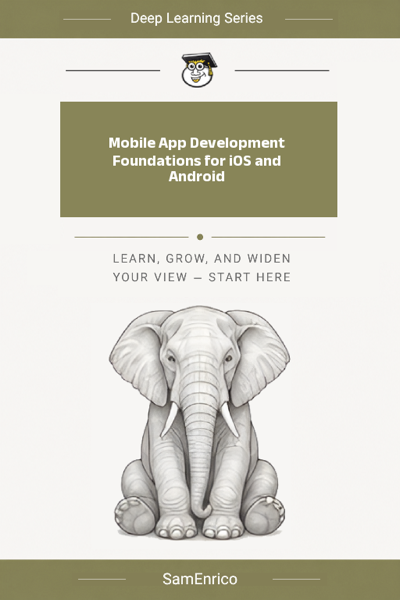
Non-FictionInformativeEducational
Mobile App Development Foundations for iOS and Android eBook
A Coursebook on Mobile App Development Foundations
by Mccallum Yer
A Coursebook on Mobile App Development Foundations for iOS and Android
Formats
Free sample
Chapter 1: Two Phones, One Brain--–- The first thing you need to know about mobile development is that every expert was once completely lost. The second thing? You are about to learn in thirty days what took most professionals three years to piece together from fragmented tutorials, platform-specific bootcamps, and late-night debugging sessions. This book exists because the industry has been teaching mobile development backward. Traditional courses force you to choose a side—i OS or Android—as if building for one platform makes you half a developer. That is like learning to drive only left turns and calling yourself ready for the road.You are here because you suspect there is a better way. There is.Mobile development is not two separate skills. It is one way of thinking expressed in two dialects. Once you understand the underlying logic—how mobile apps handle limited battery, intermittent connectivity, and constant interruptions—you can build for any platform. The code syntax changes. The principles do not. This chapter gives you the mental framework, the toolchain setup, and the market awareness you need before writing a single line of production code. By the final page, you will have both IDEs installed, a "Hello World" app running on simulators for both platforms, and a clear answer to the question every new mobile developer asks: "Should I start with i OS or Android?"The answer, as you will discover, is yes.The Great Misconception: Why "Choosing a Platform" Is Obsolete Walk into any coding bootcamp or scroll through Udemy, and you will find two separate tracks: "i OS Development Bootcamp" and "Android Development Masterclass." This separation made sense in 2014, when i OS used Objective-C and Android used Java, and the two ecosystems shared almost nothing. A developer who knew both was rare, expensive, and often hired as a consultant. Today, Swift and Kotlin are syntactic cousins. Swift UI and Jetpack Compose were designed by engineers who clearly studied each other's work. Modern cross-platform tools like Kotlin Multiplatform allow you to share business logic while keeping native UIs. The wall between platforms has become a picket fence.Yet most educational materials still treat i OS and Android as separate universes. This forces you to learn the same concepts twice—state management, navigation, lists, persistence—in different books, from different authors, with different assumptions about your prior knowledge. You waste months connecting dots that should have been placed side by side from the beginning.This book inverts that model. Every concept is taught for both platforms simultaneously. When you learn about @State in Swift UI, you learn about remember in Compose on the same page. When you build a list, you build it with List and For Each on i OS and Lazy Column on Android in the same exercise. The comparisons are not footnotes or appendices. They are the main text.The result is not just efficiency. It is deeper understanding. When you see how two different frameworks solve the same problem, you extract the universal principle beneath the syntax. That principle transfers to Flutter, to React Native, to whatever comes next. You stop being an i OS developer or an Android developer. You become a mobile developer.Who This Book Is For (And Who Should Read Something Else)Let us be clear about what you need before starting this chapter and this book. You do not need any mobile experience. You do not need to own an i Phone or an Android phone (though it helps). You do not need to have published an app. However, you do need basic programming literacy in any language.That means you should understand:Variables and data types (strings, numbers, booleans)Functions or methods (how to define and call them)Conditional logic (if / else statements)Loops (for and while)Basic data structures (arrays or lists, dictionaries or maps)The concept of objects and classes (what a method is, what a property is)If you have completed one semester of Python, Java Script, Java, C#, or any mainstream language, you are ready. If you have never written a line of code, put this book down and complete Harvard's CS50x or any "Introduction to Programming" course first. Come back in four to six weeks.If you meet that bar, you will succeed. The book assumes nothing else.The Market Reality: Where Your Skills Will Matter Most Before you write code, understand where that code will live. The app economy generates over $500 billion annually, split between Apple's App Store and Google's Play Store. But the split is not even, and it is not simply about which store has more downloads.i OS (The App Store): Approximately 1.5 billion active devices worldwide. The United States is i OS territory—over 60 percent market share, rising to nearly 80 percent among young adults and high-income households. i OS users spend roughly twice as much on apps and in-app purchases as Android users. If you are building a paid app, a subscription service, or any product aimed at North American or Western European consumers, i OS typically generates higher revenue per user. Developers also appreciate that i OS has far fewer device models to test against—roughly two dozen active i Phones versus thousands of Android devices.Android (The Play Store): Approximately 3 billion active devices worldwide. Android dominates everywhere else: Asia, Africa, South America, Eastern Europe. If you want global reach, Android is non-negotiable. The Play Store also has a lower barrier to entry—a one-time 25registrationfeeversus Apple′s25 registration fee versus Apple's 25registrationfeeversus Apple′s99 annual fee. Android allows sideloading (installing apps outside the store), which matters for enterprise distribution and markets where the Play Store is restricted. However, Android developers must contend with fragmentation: different screen sizes, CPU architectures, manufacturer customizations (Samsung's One UI, Xiaomi's MIUI), and inconsistent OS update policies.Where does that leave you? A developer who knows both platforms can work anywhere. Startups love you because you can ship an MVP to both stores with one team. Agencies charge premium rates because clients want both versions. Enterprises hire you to maintain internal apps that must run on whatever device employees carry. According to recent job market data, "i OS + Android" appears in over 40 percent of mobile developer job postings—not as a nice-to-have, but as a requirement.The best strategy is not to choose. It is to learn both and let the market decide which platform pays your bills this month. This book makes that possible.The Toolchain: Installing Xcode and Android Studio Every journey begins with tools. You cannot build a house with a hammer you have never held. The same applies to IDEs. This section walks you through installing and configuring Xcode (for i OS) and Android Studio (for Android). Both are free, both are powerful, and both will feel overwhelming at first. That is normal. You are not supposed to master them today. You just need to launch them, create a project, and run "Hello World."Xcode: Your Gateway to i OSXcode is Apple's integrated development environment. It runs exclusively on mac OS. If you have a Mac, you can install Xcode directly from the Mac App Store. If you do not have a Mac, you have three options: buy a used Mac Mini (the cheapest entry point, around $400-600), rent a Mac in the cloud (services like Macin Cloud), or focus only on Android for now…
This is the end of the free sample. Get the eBook to keep going. Buy now
About this book
Details
- Author
- Mccallum Yer
- Publisher
- SamEnrico
- Language
- English
- Genre
- Non-Fiction, Informative, Educational
- Released
- 2026-06-02
- Pages (approx.)
- 154
- Available as
- eBook, Audiobook

Read better in the ZLOADR app
Your eBooks on your phone or tablet. Sign in with your SamEnrico account and start reading.
More by Mccallum Yer
 Freudian Dream Success StoriesMccallum Yer$11.99
 Ray Dalio PrinciplesMccallum Yer$11.99
 Loving Kindness for the PlanetMccallum Yer$11.99
 Drug Dependency and VeteransMccallum Yer$11.99
 Anapanasati for Social AnxietyMccallum Yer$11.99
 Pauling's Double Nobel DreamMccallum Yer$11.99
 Financial Stress For Foster ParentsMccallum Yer$11.99
 Parent In Home Care GuideMccallum Yer$11.99
 Azerbaijani War RefugeeMccallum Yer$11.99
 The Miracle on Ice: How a Bunch of College Kids Beat the SovietsMccallum Yer$11.99
 The Red River Campaign: Grant's Bloodied Gambit in the West (1864)Mccallum Yer$11.99
 The Iron Tide: How the Yoruba Forged the FutureMccallum Yer$11.99
You may also like
 Hong Kong Handover 1997Dunn Johnnie$11.99
 Zumba For Postnatal Recovery CourseNeal Christian$11.99
 Zumba for BeginnersLadner Nikia$11.99
 YouTube Comment Mining GuideHumes Pandora$12.99
 Worry Box MeditationCarlin Rudy$11.99
 Workplace Stress MeditationNguyen Lynn$11.99
 Workplace Stress and Sleep RepairHawley Ivory$11.99
 Workplace Perfectionism CureDelaney Jeffry$11.99
 Workplace Injustice Anger GuideWallen Isabelle$11.99
 Work Addiction and Burnout LinkGreenwood Ester$11.99
 Women in Yoga and WellnessBeattie Galina$11.99
 Women in Stand Up ComedyChun Evangeline$11.99