
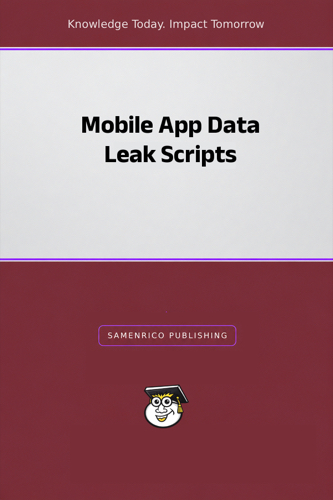
Non-FictionCrisis ManagementApp Security
Mobile App Data Leak Scripts eBook
Notifies users of exposed personal data from app.
by Loftin Bryce
Notifies users of exposed personal data from app.
Formats
Free sample
Chapter 1: The Silent Heist...--–- On a Tuesday morning in March 2023, a forty-two-year-old accountant named Sarah Chen watched her phone buzz with a notification she had never seen before. "Your location has been shared with 47 companies in the last 24 hours," the alert read. She had not installed any new apps. She had not changed any settings. She had been sitting at her desk, working on tax returns, while her phone silently sold her movements to advertisers, data brokers, and at least three companies she had never heard of.
By the time she finished reading the notification, twelve more companies had received her location.Sarah is not a technical person. She does not know what an SDK is, has never heard of certificate pinning, and could not tell you the difference between static and dynamic analysis. But she is also not an anomaly. She is a representative of the 6.8 billion smartphone users on the planet, each carrying a device that, on average, transmits personal data to third parties every 2.3 minutes of screen-on time. The apps on her phone—the weather app she installed for vacation, the flashlights app her son downloaded, the meditation app she uses to fall asleep—are doing exactly what they were designed to do.
They are making money. And the currency they trade in is her life.This book is not about why that happens. There are already excellent books about surveillance capitalism, the attention economy, and the erosion of privacy. This book is about something else entirely. This book is about building the alarm system that should have come with your phone in the first place.The Gap That Should Not Exist Let us begin with a simple fact that will either terrify you or make you angry: there is no built-in mechanism on any major smartphone operating system that tells you when your personal data leaves your device.
Not on i OS. Not on Android. Not on any consumer phone sold in any country with any privacy law.Think about what this means. Your phone knows when the battery is low. It knows when you have an unread email.
It knows when you are walking, driving, or standing still. It knows when an app crashes. It knows when you take a screenshot. But when an app silently uploads your entire contact list to a server in a country with no data protection laws, your phone has exactly nothing to say about it. The screen does not flicker.
The notification shade does not drop. The operating system does not log an entry that you can find without forensic tools.This silence is not an accident. It is a design choice that benefits an industry that has built a trillion-dollar economy on the extraction and resale of personal information. The 2023 Data Breach Investigations Report from Verizon documented that mobile data leaks affected over 4.5 billion user accounts in a single year. That is more than half the population of the planet.
Yet when I ask audiences at security conferences—people who work in information security, who understand the risks—how many have ever received a real-time alert that their data was leaking, I have never seen a single hand rise.Not one.The Invisible Transaction To understand what we are up against, we must first understand how data leaves your phone without your knowledge. The mechanisms are not complex, but they are deliberately obscured from the user interface. Let me walk you through a typical scenario that plays out billions of times per day.You open a free weather app. The screen loads, showing you a cheerful sun icon and the current temperature. What you do not see is what happens in the background during the 1.7 seconds between launching the app and seeing the forecast.First, the app checks its own servers for weather data.
That seems reasonable. But in the same network request, it attaches your device's unique advertising ID, a persistent identifier that cannot be reset without factory resetting your phone on some older Android versions. Second, a third-party analytics SDK embedded in the app—code that the weather app developer did not write and may not fully understand—initializes and begins sending a separate request to a different server, this one containing your approximate location based on Wi-Fi triangulation. Third, an advertising SDK wakes up and requests your GPS coordinates with the highest possible accuracy, along with a list of other apps installed on your device, to build a behavioral profile.These three transmissions happen simultaneously, often before the temperature has finished rendering on screen. The user sees no indication that any of this occurred.
The app does not ask for permission again. The operating system does not prompt. The data simply leaves, and the user goes about their day, unaware that their location, device identifiers, and app usage patterns have just been sold to the highest bidder.This is the invisible transaction. And it is the problem this book exists to solve.What This Book Will Do For You Over the next twelve chapters, you will learn to build scripts that do what your phone should have done from the beginning: notify you when your personal data is exposed.We will start with the fundamentals. Chapter 2 will teach you how to think like an attacker, because you cannot defend against threats you do not understand.
You will learn to set up isolated testing environments using both rooted devices and emulators, and you will get hands-on with the essential tools: Burp Suite for intercepting traffic, Frida for runtime manipulation, and the VPN APIs that allow us to monitor data flows without modifying your device.Then we will dissect the anatomy of a data leak. You will learn where your data hides in local storage, how it travels over encrypted channels, and why third-party SDKs are the single greatest privacy threat on your phone. Each of these chapters includes standardized script logic sections with pseudocode, actual implementation code, and expected outputs—so you can build alongside the text.The heart of the book is Part III, where you will build the leak notifier script itself. You will implement the Uniqueness Algorithm, a statistical method for identifying personally identifiable information without needing to know the user's identity in advance. You will build a four-stage detection pipeline that triggers, captures, analyzes, and alerts.
And you will design a color-coded notification system that tells you, at a glance, whether your password is leaking, your location is being tracked, or your device ID is being shared.For advanced readers, Part IV covers evasion techniques, runtime manipulation, and cross-platform data leaks. You will learn how sophisticated malware hides data in DNS queries and image metadata, how to inject honeytokens to confirm leaks with certainty, and how to write JSON-based rules that work across i OS and Android.Finally, Part V addresses the ethical dimensions of this work. The same scripts that can protect you can also be used to steal from others. We will establish a clear disclosure policy with two tiers: critical leaks (passwords, SSNs, financial data) require private disclosure with a 7-day fix window; non-critical leaks can be shared immediately via the community Leak Signature Repository. You will leave this…
This is the end of the free sample. Get the eBook to keep going. Buy now
About this book
Details
- Author
- Loftin Bryce
- Publisher
- SamEnrico
- Language
- English
- Genre
- Non-Fiction, Crisis Management, App Security
- Released
- 2026-06-10
- Pages (approx.)
- 155
- Available as
- eBook, Audiobook

Read better in the ZLOADR app
Your eBooks on your phone or tablet. Sign in with your SamEnrico account and start reading.
More by Loftin Bryce
 Mike Pompeo CIALoftin Bryce$11.99
 Legal Team ExhaustionLoftin Bryce$11.99
 The Monk Who Loved PlantsLoftin Bryce$11.99
 Reformation Zwingli Zurich Revolution GuideLoftin Bryce$11.99
 The TM Computer MantraLoftin Bryce$11.99
 Medication Nightmares GuideLoftin Bryce$11.99
 IBS Relief Through MicrobiomeLoftin Bryce$11.99
 One Room for Seven PeopleLoftin Bryce$11.99
 The Silent Summit: María de la Cruz and the Forgotten Ascent of ChimborazoLoftin Bryce$11.99
 The Codebreakers of Bletchley: Cracking the EnigmaLoftin Bryce$11.99
 Echoes of the Last Broadcast: The Mysterious Signals of the S.O.S. from the Mary CelesteLoftin Bryce$11.99
 Supply Chain Optimization Using UAVsLoftin Bryce$11.99
You may also like
 Hong Kong Handover 1997Dunn Johnnie$11.99
 Zumba For Postnatal Recovery CourseNeal Christian$11.99
 Zumba for BeginnersLadner Nikia$11.99
 YouTube Comment Mining GuideHumes Pandora$12.99
 Worry Box MeditationCarlin Rudy$11.99
 Workplace Stress MeditationNguyen Lynn$11.99
 Workplace Stress and Sleep RepairHawley Ivory$11.99
 Workplace Perfectionism CureDelaney Jeffry$11.99
 Workplace Injustice Anger GuideWallen Isabelle$11.99
 Work Addiction and Burnout LinkGreenwood Ester$11.99
 Women in Yoga and WellnessBeattie Galina$11.99
 Women in Stand Up ComedyChun Evangeline$11.99