
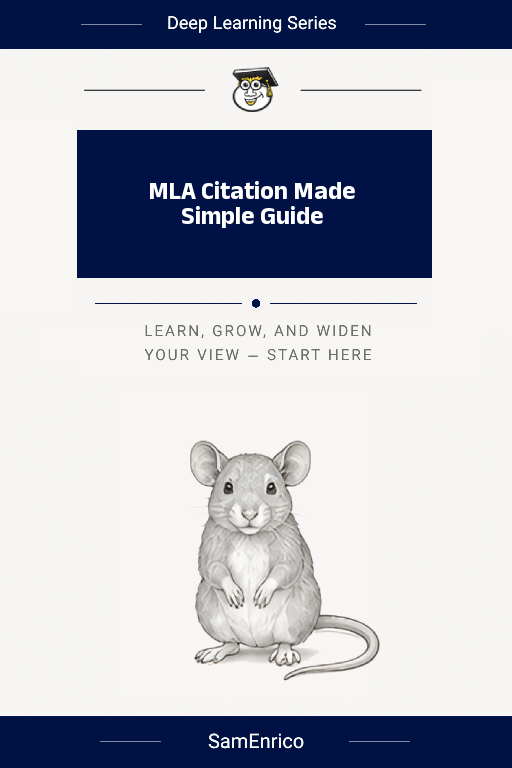
Non-FictionStudent's ShortcutMLA Style
MLA Citation Made Simple Guide eBook
Format in text citations and works cited pages for
by Thomson Kala
Format in text citations and works cited pages for humanities papers using Modern Language Association rules.
Formats
Free sample
Chapter 1: The Plagiarism Trap--–- It was 2:47 AM when Sarah stared at her laptop screen, her cursor blinking mockingly at the end of a sentence she had written thirty minutes ago. The words felt like hers. They sounded like hers. But deep down, she knew they had started somewhere else—a Wikipedia paragraph she had skimmed, a blog post she had half-remembered, a lecture slide she had screenshot on her phone. She changed a few words.
Rearranged a sentence. Called it a paraphrase. By morning, her professor would call it something else: plagiarism. And Sarah had no idea she had done anything wrong.This chapter is for every student who has ever been in Sarah’s position. It is not a lecture about academic integrity delivered from a moral high horse.
It is a confession booth, a warning label, and a practical guide rolled into one. By the time you finish these pages, you will understand not only what plagiarism is—in all its sneaky, unintentional forms—but also why citation is actually your best friend in college, not your enemy. You will learn the crucial difference between a Works Cited page, a Bibliography, and a References list. And you will finally understand why the humanities treat authors and page numbers like gold, while your friends in psychology class obsess over publication dates.Let’s start with a truth that no professor will tell you but every student needs to hear: most plagiarism in college is accidental. It is not the result of a cynical attempt to cheat.
It is the result of confusion, time pressure, and a fundamental misunderstanding of what counts as “common knowledge.” The goal of this chapter is to make sure you never accidentally plagiarize again—not because you are afraid of punishment, but because you finally understand the rules of the game.The Myth of the Intentional Cheater When most students hear the word “plagiarism,” they picture a dramatic scenario: a student in a hoodie, hunched over a keyboard at 3 AM, copying and pasting an entire essay from a “free paper” website. They imagine someone buying a term paper from the dark web or paying a ghostwriter to do their homework. These scenarios do happen. But they are the extreme minority.The vast majority of plagiarism cases that end up in front of academic honesty committees look nothing like that. Instead, they look like this: a student submits a paper with three citations when they should have twelve.
A student paraphrases a source by changing only two or three words per sentence but keeping the original sentence structure intact. A student forgets to put quotation marks around a phrase they lifted verbatim because it sounded “too perfect” to rephrase. A student cites a source at the end of a paragraph when they should have cited after every single sentence that came from that source.These are honest mistakes. But they are still plagiarism.Universities define plagiarism as the use of another person’s words, ideas, or intellectual property without proper acknowledgment. Notice the breadth of that definition.
It does not require intent. It does not require malice. It does not even require that you copy an entire paragraph. A single unique phrase taken from a source without attribution is plagiarism. A distinctive argument structure borrowed without credit is plagiarism.
A graph, a table, a photograph, a dataset—all of these require citations just as much as written words do.The good news is that accidental plagiarism is also the easiest type to prevent. Once you know what to look for, you can catch it in your own writing before anyone else does.The Three Faces of Plagiarism Most students think plagiarism is a single thing: copying text. In reality, plagiarism has three distinct forms, each requiring a different fix. Understanding these three categories is the single most important step you can take toward becoming a confident, citation-ready writer.Face One: Verbatim Copying Without Quotation Marks This is the most obvious form. You take a sentence, a paragraph, or a phrase from a source and paste it directly into your paper.
If you do not put quotation marks around those exact words and provide a citation, you have plagiarized. Even if you change one or two words—substituting “argues” for “suggests” or “many” for “numerous”—it is still verbatim copying if the sentence structure remains identical.The fix is simple: either put quotation marks around the exact words and cite the source, or paraphrase so thoroughly that your version bears no structural resemblance to the original. We will discuss how to paraphrase correctly later in this chapter.Face Two: Patchwriting (The Most Common and Most Dangerous)Patchwriting is the gray area where most accidental plagiarism lives. Patchwriting occurs when you take a passage from a source and make minor changes—swapping out synonyms, rearranging a clause or two, changing the verb tense—but keep the original sentence structure and logical flow. The result is a paragraph that looks like it was written by you but reads like a pale imitation of the source.Here is an example.
The original text reads:“Climate change poses an existential threat to coastal cities, where rising sea levels and increased storm surges threaten infrastructure, drinking water supplies, and the lives of millions of residents.”A patchwritten version might read:Climate change presents an existential danger to coastal urban areas, in which increasing sea levels and more frequent storm surges endanger infrastructure, sources of drinking water, and the safety of countless inhabitants.The words are different. But the sentence structure is identical. The order of ideas is identical. The writer has changed vocabulary but done none of the intellectual work of synthesis, analysis, or reinterpretation. This is still plagiarism, even though a plagiarism checker might not flag it.The fix for patchwriting is to read the source, close it or turn away from the screen, and then explain the idea in your own words as if you were teaching it to a friend.
If you cannot do that without looking back at the original, you do not understand the material well enough to cite it yet.Face Three: Idea Plagiarism (The Sneakiest Form)The most sophisticated form of plagiarism involves stealing ideas rather than words. If a scholar develops a unique argument—for example, that Shakespeare’s Hamlet is secretly a commentary on the Protestant Reformation—and you present that argument as your own original insight, you have plagiarized even if you never quote a single word from the scholar’s writing. You have stolen the intellectual labor of another person.The fix is straightforward: cite the source of the idea. You can say, “As literary critic Stephen Greenblatt argues, the ghost in Hamlet functions as a Lutheran critique of Catholic purgatory.” You have not copied any words. You have simply acknowledged where the idea came from.
That is not plagiarism. That is scholarship.The Patchwriting Test: How to Know If You Have Done It Because patchwriting is the most common form of accidental plagiarism, let me give you a simple diagnostic test. Take the sentence or paragraph you have written. Place it next to the original source text. Now ask yourself…
This is the end of the free sample. Get the eBook to keep going. Buy now
About this book
Details
- Author
- Thomson Kala
- Publisher
- SamEnrico
- Language
- English
- Genre
- Non-Fiction, Student's Shortcut, MLA Style
- Released
- 2026-05-29
- Pages (approx.)
- 155
- Available as
- eBook, Audiobook

Read better in the ZLOADR app
Your eBooks on your phone or tablet. Sign in with your SamEnrico account and start reading.
More by Thomson Kala
 Widower Grief GuideThomson Kala$11.99
 The Self Hypnosis for PerformanceThomson Kala$11.99
 Prince Purple ReignThomson Kala$11.99
 Immigrant Cleaner To TycoonThomson Kala$11.99
 Fiverr Order Cancellation ReductionThomson Kala$11.99
 Breaking the Pornography Habit GuideThomson Kala$11.99
 Public Speaking JournalThomson Kala$11.99
 Copper IUD GuideThomson Kala$11.99
 The Iron Witch of Pskov: A Slavic Sorceress and the Cursed SpireThomson Kala$11.99
 The Maestro of the Outback: Peter Sculthorpe and the Sound of AustraliaThomson Kala$11.99
 London Pop-Up Retail Permit GuideThomson Kala$12.99
 A Collector's Handbook to the Skoda 1000mbxThomson Kala$11.99
You may also like
 Hong Kong Handover 1997Dunn Johnnie$11.99
 Zumba For Postnatal Recovery CourseNeal Christian$11.99
 Zumba for BeginnersLadner Nikia$11.99
 YouTube Comment Mining GuideHumes Pandora$12.99
 Worry Box MeditationCarlin Rudy$11.99
 Workplace Stress MeditationNguyen Lynn$11.99
 Workplace Stress and Sleep RepairHawley Ivory$11.99
 Workplace Perfectionism CureDelaney Jeffry$11.99
 Workplace Injustice Anger GuideWallen Isabelle$11.99
 Work Addiction and Burnout LinkGreenwood Ester$11.99
 Women in Yoga and WellnessBeattie Galina$11.99
 Women in Stand Up ComedyChun Evangeline$11.99