
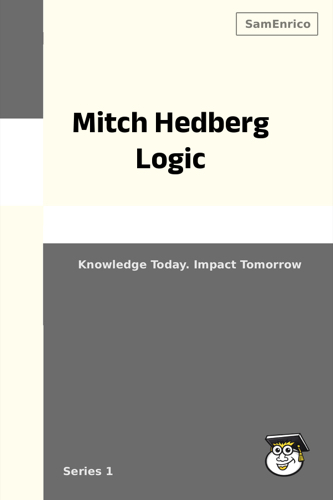
Mitch Hedberg Logic eBook
Reveals the one liner comic's surreal drug influen
Reveals the one liner comic's surreal drug influenced humor.
Formats
Free sample
Chapter 1: The Inauthentic Cheese...--Mitch Hedberg once told an interviewer that he learned more about comedy in the kitchen of a Chili's restaurant than he ever did on a stage. It sounds like a joke—and with Mitch, everything sounded like a joke—but it was the honest truth. Before the sunglasses became a shield, before the cadence became a signature, before the drugs became a punchline and then a tragedy, there was a shy kid from St. Paul, Minnesota who couldn't look people in the eye and found solace in the fluorescent hum of chain restaurant kitchens. The inauthentic cheese, the frozen pre-portioned appetizers, the managers who spoke in corporate platitudes, the customers who treated service workers as invisible furniture—this was the raw material.
This was the kiln. And out of this mundane hell, a completely original comedic voice would eventually emerge, though it took nearly a decade of failure to find it.The North Star State's Reluctant Son Mitch Hedberg was born on February 24, 1968, in St. Paul, Minnesota, the second of three children born to Arne and Mary Hedberg. The family's roots were thoroughly Midwestern—Finnish-Swedish on one side, Czech and German on the other—which meant a cultural inheritance of stoicism, practicality, and a deep suspicion of anyone who talked too loudly or claimed to be special. Mitch would later joke that his family's idea of excitement was "turning the thermostat down two degrees and seeing who complained first." This was not far from the truth.From an early age, Mitch displayed two contradictory traits: a desperate need for attention and a paralyzing fear of being seen.
He would perform little skits for his parents at the dinner table, doing voices and impressions, but the moment anyone outside the family walked into the room, he would clam up completely. His mother Mary later recalled that Mitch once spent an entire family gathering hiding behind a living room curtain, emerging only to deliver a single joke about a duck walking into a bar, then retreating immediately. "He wanted to make people laugh," she said in a rare interview after his death, "but he didn't want to be watched while he did it. He wanted to be a ghost who told jokes."At Harding High School in St. Paul, Mitch was not the class clown.
He was the kid in the back of the room who would mutter something under his breath that made the two people next to him snort with laughter, but who would immediately look down at his desk if the teacher asked him to repeat it. He was barely engaged academically, later claiming he was "barely eligible to graduate" and that his only real skill was "showing up most days." He was not wrong. His grades were unremarkable. His attendance was spotty. But his notebooks—the ones he kept hidden in his backpack, separate from his actual schoolwork—were filled with observations.
Observations about the vending machine that only accepted exact change. Observations about the janitor who always walked the same path. Observations about the way his history teacher pronounced "especially" like "expecially" and how that small mistake made everything the teacher said after it sound like a lie.He dropped out of the social scene entirely by his junior year. He had a small group of friends—fellow misfits who smoked cheap cigarettes behind the gymnasium and listened to alternative rock on static-filled radios—but he was never the center of it. He was the satellite.
The guy who would show up late, say something weird and memorable, and then disappear. One friend from that era described him as "already a comedian, just without a stage. He was performing for an audience of three people in a parking lot. But he took those performances just as seriously as he would later take a sold-out theater."The Chili's Crucible After barely graduating high school in 1986, Mitch did what many aimless eighteen-year-olds did in the Midwest: he got a job in a restaurant. Specifically, he got a job as a cook at a Chili's in suburban Minneapolis.
This was not a career choice. It was not even a deliberate choice. It was simply the only door that opened when he knocked. He needed money. Chili's was hiring.
The interview consisted of a manager named Gary asking him if he could show up on time and if he was afraid of hot oil. Mitch said yes to the first question and lied about the second. He was hired.The Chili's years—and they would stretch, intermittently, for nearly four years—became the single most formative period of his creative development. This is not hyperbole. Almost every major thematic concern of Mitch Hedberg's comedy can be traced directly to the fluorescent-lit purgatory of chain restaurant kitchens.
The rice that comes in bags labeled "RICE, PARBOILED, 25 LB." The frozen hamburger patties separated by squares of wax paper. The "southwestern egg rolls" that contained no identifiable southwestern ingredients. The inauthentic cheese—that processed, pre-shredded, anti-caking-agent-laden abomination that Chili's called "cheddar blend." Mitch would later joke that he had personally shredded zero pounds of cheese in his entire life and that this fact made him "a fraud and a disappointment to my ancestors who made cheese the real way, with their hands and their patience."But it was not just the ingredients. It was the logic of the place. The way the kitchen operated on a set of absurd, unspoken rules that everyone followed without question.
The way the "baked potato" button on the microwave was actually programmed for two minutes and eleven seconds, which no one knew, but everyone pressed anyway. The way the waitstaff and the cooks existed in a state of perpetual, low-grade war communicated entirely through passive-aggressive ticket notes. The way a manager would walk through the kitchen and say something like "let's make sure we're all aligning our priorities with the customer's journey" and everyone would nod as if this collection of sounds constituted a meaningful sentence.Mitch absorbed all of this. He did not take notes—not yet. But he stored it.
He marinated in it. He would later say that working at Chili's taught him that "most of life is just people agreeing to pretend that things make sense when they clearly don't." This realization—that the world runs on a shared fiction of logic—would become the engine of his comedy. The escalator that becomes stairs. The receipt for the donut. The Pringles can that is "designed to hold the chips in place, but fails at that job." These are not random absurdities.
They are precise observations about the gap between how things are supposed to work and how they actually work. And he learned to see that gap in the kitchen of a Chili's.The First Open Mic: Florida, Not Funny In 1988, Mitch decided to try stand-up comedy. The decision came not from a burning passion for the art form but from a simple equation: he was miserable at Chili's, he had no other skills, and he had been making his friends laugh for years. One of those friends—a dishwasher named Todd who had big dreams and no follow-through—told Mitch about…
This is the end of the free sample. Get the eBook to keep going. Buy now
About this book
Details
- Author
- Weldon Roselyn
- Publisher
- SamEnrico
- Language
- English
- Genre
- Non-Fiction, Biography, One Liner
- Released
- 2026-06-06
- Pages (approx.)
- 141
- Available as
- eBook, Audiobook

Read better in the ZLOADR app
Your eBooks on your phone or tablet. Sign in with your SamEnrico account and start reading.
More by Weldon Roselyn
 Nobel Laureates In Chemistry BiologyWeldon Roselyn$11.99
 Affirmation Group GuideWeldon Roselyn$11.99
 Drug Dependency and Self Compassion WorkbookWeldon Roselyn$11.99
 The Physics Nobel NeutrinosWeldon Roselyn$11.99
 Stuttering as Stress SignalWeldon Roselyn$11.99
 Crater Lake MysteriesWeldon Roselyn$11.99
 Work to Live Mindset ShiftWeldon Roselyn$11.99
 The Rise and Fall of Xerxes: Persia's Last Great KingWeldon Roselyn$11.99
 The Veles Conspiracy: A Spy Among the GodsWeldon Roselyn$11.99
 The Bone Harp of the Aswang: A Philippine NocturneWeldon Roselyn$11.99
 How to Become a Brim-and-crown PresserWeldon Roselyn$11.99
 Singapore BOI RequirementsWeldon Roselyn$12.99