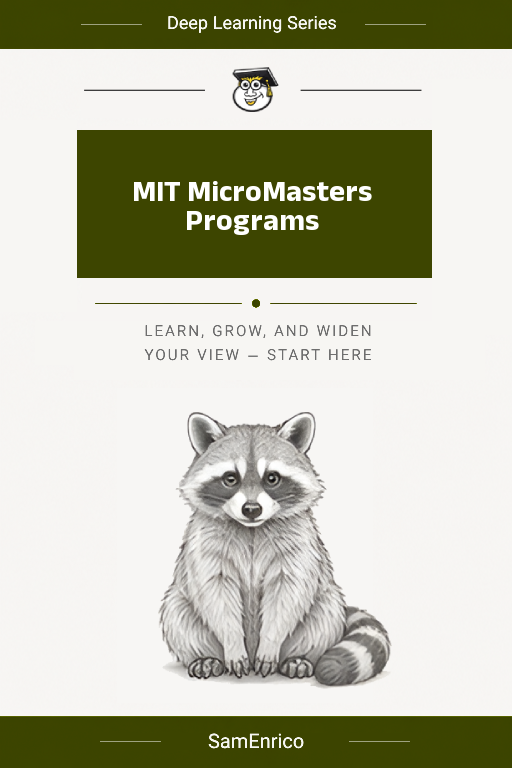
MIT MicroMasters Programs eBook
Complete MIT's Supply Chain, Data Science, or Stat
by Kearns Arron
Complete MIT's Supply Chain, Data Science, or Statistics MicroMasters for graduate-level credentials.
Formats
Free sample
Chapter 1: The Credential Revolution–– The email arrived at 11:47 PM on a Tuesday, and it changed everything. Not with the fanfare of a Hollywood montage or the solemnity of a graduation speech, but with the quiet ping of another notification in an inbox already clogged with newsletters, receipts, and spam. The subject line read: “Your application to MIT Micro Masters® program has been received.” For most recipients, that line is a bookmark. For a small, stubborn few, it becomes a turning point. This book is for the latter—those who sense that the world of professional credentials is cracking open, and who want to step through the widening gap before it closes again.For the past three decades, the hierarchy of professional success has been simple: bachelor’s degree, master’s degree, job.
The prestige flowed downhill from elite universities, and the price tag flowed uphill. But somewhere between the skyrocketing cost of graduate tuition and the dawning realization that corporate recruiters care more about demonstrable skills than Gothic architecture, a revolution began. It didn’t start in a boardroom or a government committee. It started in a laboratory on the Massachusetts Institute of Technology’s Cambridge campus, where a handful of educators asked a dangerous question: What if we gave away our hardest courses for free—and then charged only for the proof that you actually mastered them?That question gave birth to the MITx Micro Masters program, a suite of online, graduate-level credentials that function as both an independent certification and a fast-track pathway to a full master’s degree. Since the first program launched in supply chain management in 2015, over a million learners have enrolled from nearly every country on earth.
Employers like Walmart, Pfizer, and Boeing have integrated these credentials into their talent pipelines. And yet, even as of this writing, the vast majority of working professionals—including those who would benefit most—have never heard of the Micro Masters, or if they have, they dismiss it as “just another MOOC.”That dismissal is a costly mistake.This chapter is not an introduction in the conventional sense. There will be no long-winded mission statement, no tedious roadmap of what’s to come, no throat-clearing. Instead, this chapter is an argument—specifically, the argument that the MIT Micro Masters programs represent the single most underleveraged credential in professional education today. To understand why, we must first unlearn three myths that have quietly governed career advancement for a generation.Myth One: Prestige Is Location-Dependent Walk into any corporate training session in 2024, and ask the room to name the most valuable master’s degrees in business or technology.
Within seconds, someone will mention Stanford, Harvard, Wharton, or MIT. Then ask: where are those degrees physically located? Cambridge, Palo Alto, Philadelphia. The assumption embedded in that answer is that educational prestige is tied to a zip code—that you cannot drink from the well unless you live next to it.The MIT Micro Masters programs shatter that assumption without apology. Every course in every Micro Masters track is designed, recorded, and assessed by the same MIT faculty who teach on-campus master’s students.
The problem sets are the same. The exams are the same. The rigor is the same. The only difference is the price and the commute: 0fortheaudittrack,orapproximately0 for the audit track, or approximately 0fortheaudittrack,orapproximately1,000–1,500perprogramfortheverifiedcertificatetrackthatgrantsacademiccredit.Comparethattothe1,500 per program for the verified certificate track that grants academic credit. Compare that to the 1,500perprogramfortheverifiedcertificatetrackthatgrantsacademiccredit.Comparethattothe80,000–$150,000 price tag of a traditional MIT master’s degree, plus the implicit cost of two years of forgone salary, and you begin to see the magnitude of the disruption.But price is not the primary revolution.
The primary revolution is portability. A Micro Masters credential is not a proxy for being in Boston; it is a proxy for having mastered MIT-caliber material. Employers are slowly learning to read that difference. In a 2022 survey by ed X (the nonprofit platform founded by MIT and Harvard), 79% of hiring managers said they viewed Micro Masters credentials as equivalent to or better than traditional graduate certificates. And 64% said they would consider a Micro Masters as a substitute for a full master’s degree for certain roles.
Those percentages are rising, not falling.Myth Two: Online Learning Is a Compromise The second myth is more insidious because it contains a sliver of truth. For years, “online education” meant talking-head lecture videos, multiple-choice quizzes, and discussion forums where the most common contribution was “I agree with what you said.” That version of online learning was indeed a compromise—a pale imitation of the seminar room.The MIT Micro Masters model is not that. It never was. From the outset, the architects of the program understood that the problem with early MOOCs was not the medium but the pedagogy. Passive video consumption produces passive learning.
So they designed a different machinery: interactive problem sets that adapt to your mistakes; virtual laboratories that simulate real instrumentation; peer-graded assessments that require you to evaluate three other students’ work before you see your own grade; and proctored exams that verify your identity and performance with enough rigor to satisfy accreditors.Consider the Micro Masters in Statistics and Data Science. One of its signature courses, “Fundamentals of Statistics,” requires students to write code in R to analyze real-world datasets from public health and economics. A traditional online statistics course might ask, “What is a p-value?” The MIT version asks: “Here are 10,000 patient records. Use bootstrapping to estimate the 95% confidence interval for treatment effect. Then explain in a short paragraph why your answer differs from the classical t-test.” That is not a compromise.
That is a transfer of genuine competency.And the numbers bear this out. Completion rates for verified Micro Masters tracks range from 5–15% depending on the program. That sounds low until you realize that the average completion rate for free MOOC courses is closer to 3–5%, and that the Micro Masters population is self-selected from a global pool of working adults, many of whom are attempting graduate-level material in a second or third language. The students who finish are not the ones who coasted. They are the ones who survived.Myth Three: Credentials Are Forever The third myth is the quietest and the most dangerous: that the credential you earn today will serve you for the next thirty years.
This myth is the bedrock of the traditional university’s business model. It assumes that knowledge is stable, that curricula can be designed once and refreshed occasionally, and that a degree stamped in 2018 will still open doors in 2048.Anyone who has worked in technology, supply chain, data science, or finance in the last five years knows this is a fantasy. Half-lives of technical skills have collapsed. A master’s degree in artificial intelligence earned in 2020 may already be missing entire subfields like transformer architectures, diffusion models, or responsible AI frameworks. The traditional two-year residential program is simply too slow to respond to changes that occur every six months.The MIT Micro Masters programs offer a different logic: modularity and iteration.
Because the courses are online and designed for continuous improvement, faculty can update problem sets, case studies, and exam questions on a quarterly basis. When a…
This is the end of the free sample. Get the eBook to keep going. Buy now
About this book
Details
- Author
- Kearns Arron
- Publisher
- SamEnrico
- Language
- English
- Genre
- Non-Fiction, Student's Shortcut, MIT
- Released
- 2026-06-01
- Pages (approx.)
- 131
- Available as
- eBook, Audiobook

Read better in the ZLOADR app
Your eBooks on your phone or tablet. Sign in with your SamEnrico account and start reading.
More by Kearns Arron
 Arachnophobia Spider HierarchyKearns Arron$11.99
 Partner Support Recovery GuideKearns Arron$11.99
 From Grinding to LivingKearns Arron$11.99
 The Jungle PrisonerKearns Arron$11.99
 Anger Trigger Timeline MethodKearns Arron$11.99
 Continental Divide UnsupportedKearns Arron$11.99
 Work Spouse Relationship BoundariesKearns Arron$11.99
 Mindfulness for Students CourseKearns Arron$11.99
 The Hollow Crown: How a 19th-Century Con Artist Fooled a NationKearns Arron$11.99The Hollow Crown: How a 19th-Century Con Artist Fooled a NationKearns Arron$11.99
 The Alchemist’s Secret: Robert Boyle and the Birth of Modern ChemistryKearns Arron$11.99
 Growing Cymbalaria (Ivy-leaved Toadflax)Kearns Arron$11.99