
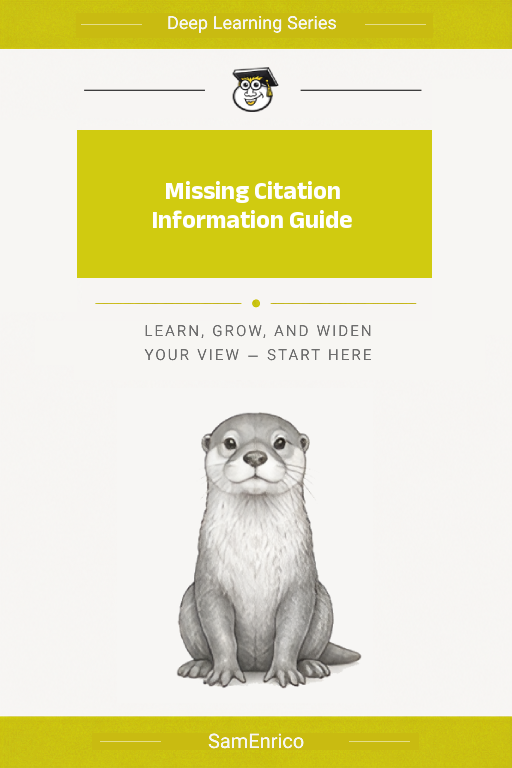
Non-FictionStudent's ShortcutMissing Data
Missing Citation Information Guide eBook
Handle sources without authors, dates, or page num
Handle sources without authors, dates, or page numbers using style specific placeholders and abbreviations.
Formats
Free sample
Chapter 1: The Midnight Citation Crisis...--The clock on Jamie's laptop read 11:47 PM. The paper was due at 8:00 AM. Seventeen pages were written, the argument was solid, and the conclusion was already drafted. Everything was perfect. Everything except for one small problem.
The source that held the keystone evidence for Jamie's entire thesis—a webpage that had seemed so promising at 2:00 PM that afternoon—had no author, no publication date, and page numbers that existed only in some parallel universe where websites still used such things. Jamie had been staring at the screen for forty-seven minutes. The cursor blinked accusingly. The citation would not write itself. And the five stages of citation grief were about to begin.This is not a hypothetical scenario.
This is the reality of academic research in the twenty-first century. You find the perfect source—the one that ties everything together, the one that provides the data your argument needs, the one that makes your thesis original and important. And then you discover that the source is missing the basic information you need to cite it. No author. No date.
No page numbers. Sometimes, no title and no publisher either. The source exists, but the metadata does not. You are left staring at a screen, wondering if you should make something up, leave the citation incomplete, or simply abandon the source and rewrite your argument.This chapter is for everyone who has ever been in Jamie's position. It is for graduate students facing thesis deadlines, for undergraduates writing their first research papers, for professors who should know better but still get tripped up by undated webpages, for librarians who answer the same citation questions every semester, and for anyone who has ever screamed at a citation generator.
This chapter argues that the midnight citation crisis is not the end of your research. It is the beginning of a different kind of citation work—one that requires flexibility, knowledge of style-specific conventions, and a clear understanding of what readers actually need to locate your sources.By the end of this chapter, you will understand why citations exist in the first place, why information goes missing from sources, and the most important rule of missing information: never invent information that does not exist. You will also learn when to find a different source instead of struggling with an incomplete one. And you will meet Jamie again—because Jamie's story is not over. The rest of this book will show Jamie (and you) exactly how to handle every missing-information scenario across APA, MLA, Chicago, IEEE, and CSE styles.The Five Stages of Citation Grief Let us return to Jamie, hunched over the laptop at 11:47 PM.
Jamie is not yet aware of it, but the five stages of citation grief are about to unfold. These stages are so universal that every researcher experiences them, regardless of discipline, experience level, or citation style. Recognizing them is the first step toward moving past them.Stage One: Denial The first stage always begins with a frantic search. The author must be here somewhere. Jamie scrolls to the top of the webpage.
Nothing. Jamie scrolls to the bottom, looking for a byline. Nothing. Jamie checks the page source code (because desperation makes us all do strange things). Still nothing.
Jamie's internal monologue: "The author is probably just... hidden. If I look hard enough, I will find it. Maybe it's in the metadata. Maybe I need to click something.
Maybe..."Denial is the refusal to accept that the information is genuinely missing. It is the voice that says, "I must have missed it," rather than, "It is not there." Denial is not productive, but it is normal. Everyone goes through it. The trick is to recognize denial for what it is and move on quickly.Stage Two: Anger When denial fails, anger arrives. Jamie's internal monologue shifts: "WHO CREATED THIS WEBSITE?
Why would anyone publish something without putting their name on it? Is it a secret? Are they ashamed? And the date—how hard is it to put a date on a webpage? It's literally one line of code.
ONE LINE. And don't get me started on page numbers. I know this isn't a printed book, but surely they could number the paragraphs or something. This is INCOMPETENCE."Anger is a natural reaction to frustration. You have done nothing wrong.
You are trying to do the right thing—giving credit, providing evidence, being a responsible researcher. And the source is making it impossible. The anger is justified. But anger does not write citations. At some point, you have to move on.Stage Three: Bargaining Bargaining is when you start making deals with yourself, with your professor, with the universe.
Jamie's internal monologue: "Maybe if I cite the copyright year from the footer, no one will notice. It's close enough, right? Or maybe I can use the URL as the author? No, that's stupid. What if I just...
don't cite it? The professor will never know where the information came from. I can just say 'according to a website' and move on. That's fine. That's totally fine."Bargaining is dangerous.
This is where the temptation to invent information, cut corners, or commit academic misconduct is strongest. The voice in your head will tell you that it is fine, that no one will check, that the professor does not care about one citation. That voice is lying. Bargaining is a trap. The way out is to remember the first rule of missing information, which we will get to shortly.Stage Four: Depression When bargaining fails—when you realize that you cannot invent information and cannot skip the citation—depression sets in.
Jamie's internal monologue: "I am going to fail. This paper is ruined. I should just drop out and move to a cabin in the woods where no one has ever heard of a citation style. I am a fraud. I do not belong in graduate school.
Everyone else knows how to do this, and I am here at midnight crying over a webpage."Depression is real, and it is painful. But it is also a sign that you have accepted the reality of the situation. You are no longer in denial. You are no longer angry. You are no longer bargaining.
You are simply sitting with the problem, acknowledging that it exists, and preparing yourself for the final stage.Stage Five: Acceptance Acceptance is not happiness. Acceptance is not relief. Acceptance is simply the recognition that there is a better way. Jamie's internal monologue: "There has to be a way to cite this source. Other people have figured it out.
Citation styles have rules for missing information. I just do not know them yet. But I can learn. I will learn. And then I will never be in this position again."Acceptance is the gateway to learning.
It is the moment when you stop fighting the problem and start solving it. This book exists to guide you through that solving process. By the end, you will have a toolkit of strategies for handling any missing information scenario. You will no longer panic when you encounter a source without an author, date, or page number. You will know…
This is the end of the free sample. Get the eBook to keep going. Buy now
About this book
Details
- Author
- Barrera Lucina
- Publisher
- SamEnrico
- Language
- English
- Genre
- Non-Fiction, Student's Shortcut, Missing Data
- Released
- 2026-05-29
- Pages (approx.)
- 125
- Available as
- eBook, Audiobook

Read better in the ZLOADR app
Your eBooks on your phone or tablet. Sign in with your SamEnrico account and start reading.
More by Barrera Lucina
 Holiday Family AnxietyBarrera Lucina$11.99
 Car Payment Financial StressBarrera Lucina$11.99
 Grief And Guilt OverlapBarrera Lucina$11.99
 Key Results DefinitionBarrera Lucina$11.99
 War Resister Deportation FightBarrera Lucina$11.99
 Job Loss for Remote WorkersBarrera Lucina$11.99
 The Stolen Olympic Torch: A Heist That Sparked a RevolutionBarrera Lucina$11.99
 Growing BorassusBarrera Lucina$11.99
 How to Start a Clutch (not for Motor Vehicle) Business (Beginners Guide)Barrera Lucina$11.99
 Cross Cultural Boss GuideBarrera Lucina$12.99
 How to Produce Plastic Processing Machinery PartsBarrera Lucina$11.99
 How to Produce Muffin and Cupcake MakersBarrera Lucina$11.99
You may also like
 Hong Kong Handover 1997Dunn Johnnie$11.99
 Zumba For Postnatal Recovery CourseNeal Christian$11.99
 Zumba for BeginnersLadner Nikia$11.99
 YouTube Comment Mining GuideHumes Pandora$12.99
 Worry Box MeditationCarlin Rudy$11.99
 Workplace Stress MeditationNguyen Lynn$11.99
 Workplace Stress and Sleep RepairHawley Ivory$11.99
 Workplace Perfectionism CureDelaney Jeffry$11.99
 Workplace Injustice Anger GuideWallen Isabelle$11.99
 Work Addiction and Burnout LinkGreenwood Ester$11.99
 Women in Yoga and WellnessBeattie Galina$11.99
 Women in Stand Up ComedyChun Evangeline$11.99