
Non-FictionSelf-HelpRapportMirroring
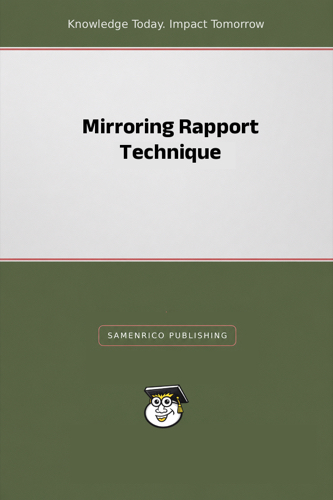
Mirroring Rapport Technique eBook
Build connection by subtly matching another person
Build connection by subtly matching another person's body language and speech patterns.
Formats
Free sample
Chapter 1: The Invisible Language--–- It was 2:47 AM when the hostage negotiator’s phone rang. On the other end of the line, a man who had just lost his business, his marriage, and—in his own mind—his reason for living, was standing on the 14th floor ledge of a downtown hotel. He had not made demands. He had not asked for money or a helicopter. He had simply said, “Don’t come near me,” and then gone silent.
The police had tried logic. “Think of your family,” they said. “This won’t solve anything.” Each reasonable sentence was met with silence, then a small shuffle of feet moving closer to the edge.The negotiator who arrived at 3:12 AM did something that seemed counterintuitive. She did not argue. She did not persuade.
She did not offer solutions. Instead, she sat down on the cold carpet of the hotel hallway—not standing over the man, not maintaining professional distance, but lowering herself to a seated position, matching his physical level. When he spoke, his voice was a ragged whisper. She lowered her own voice to a whisper. When he paused for eleven seconds, she waited eleven seconds.
When he said, “There’s no point,” she did not say, “Of course there is.” She said, “No point?” with an upward inflection that was neither a question nor a challenge but something in between: an invitation.Forty-seven minutes later, he stepped back from the ledge. When asked later what had made the difference, he could not explain it. “She just… understood,” he said. “She didn’t try to fix me. She was just there.
Like she was feeling it with me.”What happened in that hotel hallway was not magic. It was not intuition. It was not the result of a naturally gifted “people person.” It was the deliberate, masterful application of a skill so ancient that it is written into the very architecture of the human brain. It is the skill of mirroring rapport—the invisible language that every human being already speaks, though almost no one knows they are speaking it.The Most Important Conversation You’ve Never Noticed Think back to the last conversation where you felt genuinely understood. Not the one where someone agreed with you, not the one where someone gave you good advice, but the one where you walked away thinking, That person really gets me.
Now ask yourself: what specifically did they say that made you feel that way?You probably cannot answer. And that is precisely the point.The feeling of being understood rarely comes from the words spoken. It comes from something deeper, something that happens beneath the level of conscious awareness. It comes from what communication scientists call behavioral synchrony—the unconscious matching of posture, gesture, vocal tone, and even breathing patterns between two people who are truly connected.Here is the astonishing truth: within seconds of two people beginning a conversation, their bodies begin to dance. Heart rates synchronize.
Pupils dilate in unison. Postures shift in mirror image. One person leans forward; moments later, the other follows. One person’s voice rises in pitch; the other’s rises in response. This is not metaphor.
This is physiological fact, measurable by heart rate monitors, motion-capture cameras, and functional MRI scans.The reason this happens is that the human brain contains a remarkable system of cells called mirror neurons. Discovered accidentally in the 1990s by a team of Italian neuroscientists studying macaque monkeys, these neurons fire not only when you perform an action but also when you observe someone else performing that same action. When you see someone smile, the mirror neurons in your own brain fire as if you were smiling. When you see someone wince in pain, your own pain centers activate. When you watch someone reach for a glass, the motor planning areas of your brain prepare your own hand to reach.This is why you yawn when others yawn.
This is why you flinch when you see someone stub their toe. This is why certain people—the ones who move like you, speak like you, gesture like you—feel immediately comfortable, while others feel inexplicably “off.” Your brain is not just observing them. It is becoming them, at least in part.And here is the implication that changes everything: if rapport is biological, then rapport can be learned.The Myth of the Natural “People Person”We have all met someone who seems to effortlessly charm every room they enter. They make friends quickly. They put nervous people at ease.
They close deals that seemed impossible. We call them “naturals.” We assume they were born with something we lack.This assumption is wrong.What these “naturals” possess is not a gift but an unconscious mastery of mirroring. They have somehow learned—through trial and error, through childhood modeling, through sheer repetition—to match the body language and vocal patterns of the people around them. They do not know they are doing it. If you asked them, they would say they are “just being themselves.” But if you videotaped them and analyzed the footage frame by frame, you would see the same patterns that hostage negotiators, top salespeople, and master therapists use deliberately.The difference between a natural and you is not ability.
It is awareness.Consider the research of Dr. William T. Powers, a physicist turned psychologist who studied how people achieve what he called “control” in social interactions. Powers discovered that the most effective communicators are not those who plan their words most carefully but those who continuously adjust their behavior based on real-time feedback from the other person. They lean in slightly, notice the other person leaning back, and adjust.
They speak faster, notice the other person’s brow furrowing, and slow down. They are not following a script. They are dancing.And here is the liberating news: you already do this, unconsciously, every day. When you talk to a young child, you automatically lower your voice, slow your pace, and simplify your vocabulary. When you speak to an authority figure, you subtly straighten your posture and modulate your tone.
When you are attracted to someone, you find yourself unconsciously matching their gestures, their drinking pace, even their breathing. You are already a mirroring creature. The only thing missing is intentionality.This book exists to give you that intentionality.Defining Rapport: Beyond the Feeling Before we go any further, we must be precise about what we mean by rapport. Most people think of rapport as a feeling—that warm, fuzzy sense of “clicking” with someone. But a feeling is not something you can reliably create on command.
It is an outcome, not a process.In this book, we define rapport differently: Rapport is a state of mutual attention, positive regard, and behavioral coordination between two or more people. Notice that this definition contains no feelings. It describes observable, measurable phenomena. Mutual attention means both people are focused on the same interaction (not checking phones or scanning the room). Positive regard means the absence of active hostility or defensiveness (not necessarily love or friendship—just the absence of friction).
Behavioral coordination means that the participants’ actions are synchronized in time and space.This definition matters because you cannot reliably manufacture…
This is the end of the free sample. Get the eBook to keep going. Buy now
About this book
Details
- Author
- Payton Gillian
- Publisher
- SamEnrico
- Language
- English
- Genre
- Non-Fiction, Self-Help, Rapport, Mirroring
- Released
- 2026-06-10
- Pages (approx.)
- 152
- Available as
- eBook, Audiobook

Read better in the ZLOADR app
Your eBooks on your phone or tablet. Sign in with your SamEnrico account and start reading.
More by Payton Gillian
 Workplace Watercooler ChatsPayton Gillian$11.99
 The Progressive Overload HandbookPayton Gillian$11.99
 Active Listening For ApologiesPayton Gillian$11.99
 The Vanishing Gold of the SS Pacific: A 19th-Century Maritime MysteryPayton Gillian$11.99
 Learn to Play the Contrabass SaxophonePayton Gillian$11.99
 Downspout Splash Block PlacementPayton Gillian$11.99
 AI for Sales Training MaterialsPayton Gillian$12.99
 How to Start a Cards for Automatic Mechanical Instruments Business (Beginners Guide)Payton Gillian$11.99
You may also like
 Hong Kong Handover 1997Dunn Johnnie$11.99
 Zumba For Postnatal Recovery CourseNeal Christian$11.99
 Zumba for BeginnersLadner Nikia$11.99
 YouTube Comment Mining GuideHumes Pandora$12.99
 Worry Box MeditationCarlin Rudy$11.99
 Workplace Stress MeditationNguyen Lynn$11.99
 Workplace Stress and Sleep RepairHawley Ivory$11.99
 Workplace Perfectionism CureDelaney Jeffry$11.99
 Workplace Injustice Anger GuideWallen Isabelle$11.99
 Work Addiction and Burnout LinkGreenwood Ester$11.99
 Women in Yoga and WellnessBeattie Galina$11.99
 Women in Stand Up ComedyChun Evangeline$11.99