
Non-FictionSelf-HelpMirror WorkSelf Esteem
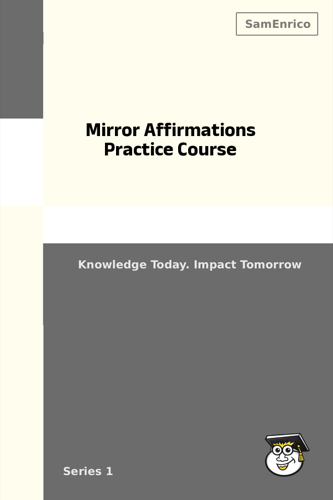
Mirror Affirmations Practice Course eBook
Look into your own eyes while repeating powerful s
Look into your own eyes while repeating powerful statements to build self acceptance.
Formats
Free sample
Chapter 1: The Silent Witness...--–- Most people have never truly looked into their own eyes. Not once. Not really.They have glanced. They have checked for spinach between their teeth, assessed a pimple’s trajectory, or practiced a smile for a job interview. They have used the mirror as a tool for surveillance—scanning for flaws, confirming fears, or avoiding both by looking anywhere but into the pupils that stare back.But looking at your reflection is not the same as looking into yourself.This chapter is not about affirmations.
You will not say a single word to your reflection for the next seven days. That promise may sound strange coming from a book about mirror affirmations, but here is the truth that most self-help books will not tell you: You cannot speak truth to a face you are fleeing.The first task is simpler and harder than any affirmation. You must learn to stay.The Radical Confession: You Have Never Looked Let us run a small experiment. Do not move from where you are reading this. Simply notice: when was the last time you stood before a mirror and held your own gaze for sixty consecutive seconds without speaking, without judging, without adjusting your hair or shirt?If you are like 94 percent of the people I have taught this work to, the answer is never.We are taught from childhood that mirrors are for fixing.
Check your appearance. Correct your posture. Apply, adjust, approve or disapprove, then move on. The mirror is a taskmaster, not a companion. And the eyes?
The eyes are the most dangerous part of the face because they ask a question that no outfit can answer: Who are you when no one is watching?This chapter begins with a radical confession: most people have never truly looked into their own eyes for more than a few seconds. The flinch is automatic. The glance at a stray hair is a rescue operation. The quick scan of the body is a threat assessment. None of this is vanity.
It is survival.And survival can be unlearned.The Psychology of Mirror Anxiety Why does your own face make you uncomfortable?The answer lies not in your reflection but in your history. Drawing from shame theory, particularly the work of researcher Brené Brown adapted for mirror work, we can trace mirror anxiety to a single source: early experiences of being seen as wrong.Think back. Not to a specific memory, necessarily, but to a feeling. When you were a child, what happened when you sought eye contact with a caregiver? Did they meet your gaze with warmth?
With distraction? With irritation? With a critique disguised as concern ("You have something on your face" or "Fix your hair before anyone sees you")?If a parent criticized your appearance, ignored your emotional bids, or used their own reflection as a site of self-hatred, you learned a dangerous lesson: your face equals danger. Specifically, your seen face equals danger. Being looked at means being judged.
Looking at yourself means becoming both the judge and the accused.This is not weakness. This is neurobiology.The brain’s insula—responsible for self-awareness—and the anterior cingulate cortex—responsible for emotional regulation—activate powerfully during eye contact. But if your early experiences taught you that self-awareness leads to shame, your brain learned to suppress that activation. You learned to look away before the feeling could fully arrive.Mirror anxiety is not a character flaw. It is a learned protection mechanism.
And what is learned can be unlearned.The Physical Signs of Mirror Avoidance Before you change anything, you must notice what you currently do. Over the next twenty-four hours, I want you to observe your own mirror behavior without judgment. Do not try to change it yet. Simply notice.Here is what most people discover:The Micro-Flinch. You approach the bathroom sink.
Your eyes rise toward the mirror. And in the millisecond before your face fully appears, your gaze drops to the faucet, the soap dispenser, or your own hands. You did not decide to look away. Your body decided for you.The Flaw Scan. When you do look, your eyes do not rest on your whole face.
They dart to specific targets: a blemish, a wrinkle, an asymmetry, a discoloration. You are not looking at yourself. You are looking for problems.The Hair Flip or Shirt Tug. You use a physical gesture to break eye contact. Fixing your hair, adjusting your collar, wiping a smudge from the mirror—these are not chores.
They are escape routes.The Speed Run. You complete your mirror business (brushing teeth, washing face, applying makeup) in record time. You never linger. You never pause. The mirror is a transaction, not a relationship.The Complete Avoidance.
Some people skip mirrors altogether. They brush their teeth in the shower. They apply makeup with a compact that shows only one eye at a time. They have not seen their own full face in weeks.Which of these sounds like you? Be honest.
There is no wrong answer.The First Practice: Sixty Seconds of Silence Now we begin.For the next seven days, you will perform one practice and one practice only. No affirmations. No scripts. No "I love myself" spoken to trembling lips. Just silence and presence.The Practice:Set a timer for sixty seconds.
Use your phone, a kitchen timer, or a clock on the wall.Stand or sit before a mirror. A bathroom mirror is fine. A full-length mirror is better. A handheld mirror is acceptable if that is all you have.Place your feet flat on the floor. Let your arms rest at your sides or place your hands on your hips.
(Hands on your heart come later. For now, neutrality is the goal.)Breathe normally. Do not force deep breaths. Do not hold your breath. Just let the air move.Look into your own eyes.
Not at your nose. Not at your forehead. Not at the reflection of the wall behind you. Into your own pupils.Do not speak. Do not affirm.
Do not mouth words silently. Just look.When the timer ends, you are done. No analysis. No journaling about what you felt (yet). Just completion.That is it.Most readers will look away by second fifteen.
Some will make it to second thirty. A rare few will last the full sixty seconds, and most of those will report feeling nothing—which is dissociation, not mastery.If you look away, you have not failed. Looking away is the practice. Noticing that you looked away and choosing to return your gaze is the entire point.What You Will Feel (And Why That Is Good)The first time you hold your own gaze for more than a few seconds, you will likely experience one or more of the following:Disgust. Your face looks wrong.
The eyes are too close together or too far apart. The skin is uneven. The expression is strange. This is not objective truth. This is the inner critic (whom we will name in Chapter 2) panicking because you are doing something it was designed to prevent.Laughter.
Nervous, inappropriate, giggling at nothing. This is your body trying to discharge tension. Let yourself laugh. Do not suppress it.…
This is the end of the free sample. Get the eBook to keep going. Buy now
About this book
Details
- Author
- Canez Joannie
- Publisher
- SamEnrico
- Language
- English
- Genre
- Non-Fiction, Self-Help, Mirror Work, Self Esteem
- Released
- 2026-06-09
- Pages (approx.)
- 138
- Available as
- eBook, Audiobook

Read better in the ZLOADR app
Your eBooks on your phone or tablet. Sign in with your SamEnrico account and start reading.
More by Canez Joannie
 The 'Not Yet' Family GuideCanez Joannie$11.99
 We Language InfluenceCanez Joannie$11.99
 Opioid Overdose ResponseCanez Joannie$11.99
 The Concord Academy InsiderCanez Joannie$11.99
 The Last Waltz of the Ritz: Secrets of the 1974 New Year's Eve PartyCanez Joannie$11.99
 Understanding TyphusCanez Joannie$17.99
 VAT Dispute ResolutionCanez Joannie$12.99
 Lagos Angel Investor GuideCanez Joannie$12.99
 Dutch Belted Cattle BreedingCanez Joannie$11.99
 Ultimate Handbook Guide to Ankang : (China) Travel GuideCanez Joannie$11.99
You may also like
 Hong Kong Handover 1997Dunn Johnnie$11.99
 Zumba For Postnatal Recovery CourseNeal Christian$11.99
 Zumba for BeginnersLadner Nikia$11.99
 YouTube Comment Mining GuideHumes Pandora$12.99
 Worry Box MeditationCarlin Rudy$11.99
 Workplace Stress MeditationNguyen Lynn$11.99
 Workplace Stress and Sleep RepairHawley Ivory$11.99
 Workplace Perfectionism CureDelaney Jeffry$11.99
 Workplace Injustice Anger GuideWallen Isabelle$11.99
 Work Addiction and Burnout LinkGreenwood Ester$11.99
 Women in Yoga and WellnessBeattie Galina$11.99
 Women in Stand Up ComedyChun Evangeline$11.99