
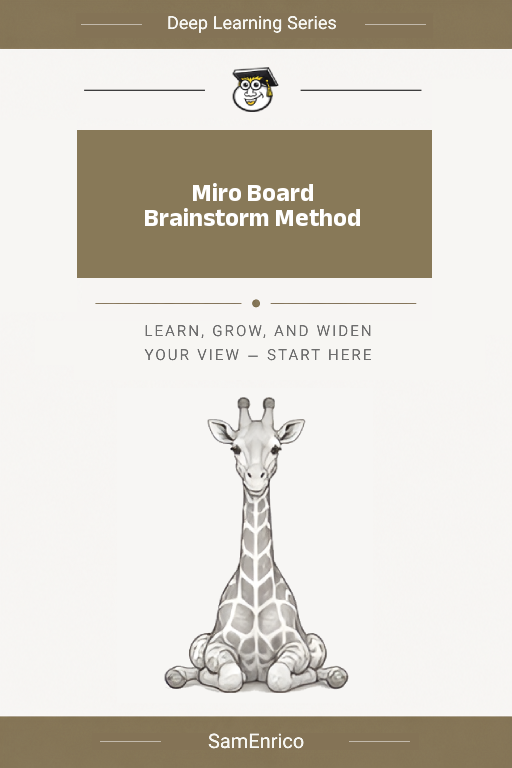
Miro Board Brainstorm Method eBook
Use free Miro board for remote customer co creatio
Use free Miro board for remote customer co creation sessions to validate features before building.
Formats
Free sample
Chapter 1: The $50,000 Sticky Note--–- It begins the way it always does. A product manager walks into a weekly leadership meeting with a grin. "Great news," she announces. "I talked to a customer yesterday — one of our biggest enterprise accounts — and they said they'd love a dashboard feature. They even drew it on a napkin for me.
They said, and I quote, 'If you build this, we'll use it every single day.'"The room lights up. The engineering lead nods approvingly. The CEO asks, "How long?" The product manager estimates six weeks. The CEO counters with four. A compromise is struck at five weeks.
Tickets are written. Sprints are planned. Developers cancel their Friday afternoon plans. A designer stays late to polish the mockups.Five weeks later, the dashboard launches with a company-wide Slack announcement, a confetti emoji, and genuine excitement.And then? Silence.Not a single customer clicks the dashboard.
The enterprise account that "drew it on a napkin" never logs in. When the product manager follows up, the customer says, "Oh yeah, that. I meant it would be nice someday, but we don't actually have time to learn something new right now."The team just burned $50,000 on a sticky note.Not a real sticky note. A metaphorical one. A feature built on a compliment disguised as a requirement.
A hypothesis that was never tested. A decision made in the echo chamber of "that sounds cool" rather than the crucible of "show me the workflow."This chapter is about why that happens — and why a free Miro board is the cheapest insurance policy you will ever buy.The Math of Missing the Mark Let me give you the number that should terrify every product leader, founder, and developer reading this book: 67 percent.According to analysis of data from the Standish Group's CHAOS reports, product development surveys, and internal telemetry from over 3,000 software teams, roughly two-thirds of features built have little to no measurable impact on the desired outcomes. Some studies put the number as high as 80 percent for enterprise software. But let's stick with 67 percent because it is depressingly precise.Think about that for a moment. For every three features your team builds, two of them might as well have never been written.
The code compiles. The pixels render. The button clicks. But nobody uses it, nobody cares, and nobody changes their behavior.Now multiply that by your engineering team's hourly rate.A conservative calculation: three developers at 75perhour(fullyloadedwithbenefitsandoverhead)workingforfiveweeksonasinglefeature.Thatis3developers×40hoursperweek×5weeks×75 per hour (fully loaded with benefits and overhead) working for five weeks on a single feature. That is 3 developers × 40 hours per week × 5 weeks × 75perhour(fullyloadedwithbenefitsandoverhead)workingforfiveweeksonasinglefeature.Thatis3developers×40hoursperweek×5weeks×75 = 45,000.Addadesigner,aproductmanager′stime,QA,andtheopportunitycostofwhattheycouldhavebuiltinstead.Youareeasilyat45,000.
Add a designer, a product manager's time, QA, and the opportunity cost of what they could have built instead. You are easily at 45,000.Addadesigner,aproductmanager′stime,QA,andtheopportunitycostofwhattheycouldhavebuiltinstead.Youareeasilyat50,000 per feature. Often double or triple that.$50,000 for a sticky note that should have been validated in 45 minutes on a free Miro board.I am not exaggerating. I have watched this exact scenario play out at startups, scale-ups, and Fortune 500 companies. The names change.
The industry changes. The dashboard becomes a report becomes an integration becomes a settings page. But the pattern never changes: someone heard a compliment, treated it as a requirement, and built something nobody wanted.The "Mom Test" Problem There is a brilliant book by Rob Fitzpatrick called The Mom Test. The title comes from a simple observation: if you ask your mom whether your business idea is good, she will say yes — not because it is good, but because she loves you and does not want to hurt your feelings. Asking your mom for validation is useless because the signal is corrupted by politeness.The same thing happens when you ask customers, "Would you use this feature?"They will almost always say yes.
Not because they are lying, but because they are being nice, or because they want to maintain a good relationship with you, or because they genuinely believe they would use it — right up until the moment they have to change their actual behavior.Fitzpatrick's solution is to stop asking hypothetical questions and start asking behavioral ones. Instead of "Would you use this dashboard?" ask "How do you track that metric today?" Instead of "Would you pay for this?" ask "When was the last time you tried to solve this problem and what did you do?"The difference is the difference between a compliment and a commitment.A compliment sounds like: "That's a great idea." "I would definitely use that." "This is exactly what we need."A commitment sounds like: "I spent thirty minutes showing you my current workflow." "I introduced you to three other people on my team who have the same problem." "I gave you access to our internal Slack channel where we complain about this."One is free. The other costs time, reputation, or money.Here is the rule that will save you $50,000: On a Miro board, a compliment is worthless. A customer who spends thirty minutes mapping their actual workflow is gold.The entire method in this book is designed to convert compliments into commitments. To stop asking "would you use this" and start asking "show me how you work today."The Living Opportunity Canvas So what do you build instead of a static, doomed-to-be-obsolete Product Requirements Document?You build a Living Opportunity Canvas on a Miro board.A traditional PRD is a Word document or a Google Doc or a Confluence page.
It is written in the past tense. It assumes you already know everything you need to know. It is shared via link, reviewed in a meeting, and then never opened again. It is a tombstone for assumptions.A Living Opportunity Canvas is the opposite. It lives on a Miro board where customers can add sticky notes.
It changes every time you run a co-creation session. It is organized not by feature name but by customer need. It contains not requirements but hypotheses. And it is the single source of truth for validated work only.Here is what goes on a Living Opportunity Canvas:Zone 1: The Helping Zone (Top Left — Locked)One sentence goal: "Reduce time to create a monthly report from twenty minutes to five."One sentence constraint: "Must work on mobile devices with intermittent internet."One sentence persona: "The operations manager who juggles three tools simultaneously."This zone is locked so participants cannot accidentally delete it. It is the north star.
Every session starts here.Zone 2: The Active Ideation Zone (Center — Editable)This is where sticky notes fly. Where customers write their pains, workarounds, and wishes. Where the team brainstorms solutions.This zone is structured for exercises but visually unconstrained. It has pre-placed grids for brainwriting, prompts for reverse brainstorming, and space for raw clusters.Zone 3: The Voting and Clustering Zone (Right Side — Structured)Pre-placed dot voting circles. Cluster titles like "Pains," "Workarounds," "Must-Haves," "Nice-to-Haves."This is where raw ideas become prioritized data.
Where compliments die and commitments survive.Between Zones 2 and 3 sits a Raw Output transitional frame — a holding area where messy clusters are refined before voting.The entire board is cloneable.…
This is the end of the free sample. Get the eBook to keep going. Buy now
About this book
Details
- Author
- Finney Robert
- Publisher
- SamEnrico
- Language
- English
- Genre
- Non-Fiction, Startup Guide, Miro, Co Creation
- Released
- 2026-05-29
- Pages (approx.)
- 149
- Available as
- eBook, Audiobook

Read better in the ZLOADR app
Your eBooks on your phone or tablet. Sign in with your SamEnrico account and start reading.
More by Finney Robert
 Online Gambling SafetyFinney Robert$11.99
 Calisthenics Weighted Vest GuideFinney Robert$11.99
 Bangladeshi Labor Migration OutlookFinney Robert$11.99
 Stress Management for Hair StylistsFinney Robert$11.99
 Feedback Loops For Creative Teams GuideFinney Robert$11.99
 Echoes of the Ark: The Lost Colony of New EdenFinney Robert$11.99
 The Shadow Cabinet: How a Secretive Group Shaped Modern PoliticsFinney Robert$11.99
 Understanding Chromosome 4, Trisomy 4q21Finney Robert$17.99
 Annual Report Reminder SetupFinney Robert$12.99
 OrganistFinney Robert$11.99
 How to Start a Motor Coach Business (Beginners Guide)Finney Robert$11.99