
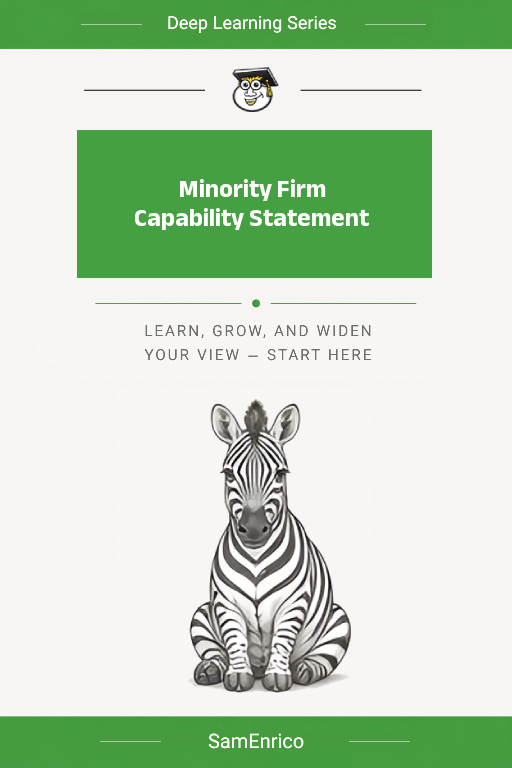
Minority Firm Capability Statement eBook
Write a winning capability statement for minority-
Write a winning capability statement for minority-owned firms with past performance, certifications, and agency-ready formats.
Formats
Free sample
Chapter 1: The 15-Second Graveyard--Every day, thousands of capability statements written by minority-owned firms die a quiet death.They are not deleted out of malice. They are not rejected because the firm lacks skill, certification, or past performance. They die because a contracting officer opened the file, scanned it for fifteen seconds, found nothing that answered the question “Can I give this person money without getting audited?” – and moved on to the next document in a queue of four hundred similar submissions.This is not speculation. It is the documented reality of federal procurement. The average Contracting Officer at a major agency like the Department of Homeland Security or the Department of Defense reviews between fifty and two hundred capability statements per week.
They have, on average, fifteen seconds to decide whether a firm moves forward to the “maybe” pile or lands permanently in the “never” folder. Fifteen seconds. That is the time it takes to microwave a cup of coffee. That is less time than you spent reading the first paragraph of this chapter.The difference between a capability statement that survives those fifteen seconds and one that dies instantly is not the quality of your work. It is not the size of your past contracts.
It is not even the prestige of your certifications. The difference is whether you treat the document like a resume or like a brochure. And right now, the vast majority of minority-owned firms – including many that have been winning work for years – are committing the same fatal error: they are sending brochures to people who asked for resumes.This chapter will teach you why that mistake is costing you millions, how to identify whether your current capability statement is a brochure or a weapon, and what must change before you write another word. By the end, you will never look at your capability statement the same way again. More importantly, neither will the buyers who receive it.The Graveyard Is Full of Beautiful Brochures Let me tell you about a construction firm in Atlanta.
I will call them Excel Construction – not their real name, but the story is real. Excel was a minority-owned firm with fifteen years of experience, an 8(a) certification, a clean safety record, and a portfolio of completed commercial projects worth over twenty million dollars. They had everything a contracting officer could want: capability, longevity, certification, and references.They also had a four-page capability statement. It was beautiful. Full color.
Professional photography. A mission statement on page one that said “Excel Construction is committed to delivering excellence while empowering diverse communities.” A company history on page two. A list of services on page three. A team photo on page four.Excel sent this document to every agency and prime contractor they could find. They followed up with emails.
They attended industry days. They spent eighteen months doing everything right – except the one thing that mattered. They never won a single prime contract. Not one.Then they met a procurement consultant who asked to see their capability statement. The consultant looked at the four-page brochure, closed it, and said something that changed everything: “This is a yearbook.
Contracting officers need a driver’s license.”Within sixty days of rebuilding their capability statement as a single page – no mission statement, no history, no team photo, just data, proof, and certifications – Excel won their first federal prime contract. Within twelve months, they had won three more. The only thing that changed was the document. The firm, the experience, the certifications – all identical. But the document now spoke the buyer’s language, not the owner’s.The brochure went to the graveyard.
The resume went to the bank. And the only difference between the two was fifteen seconds of clarity.The Critical Distinction: Resume vs. Brochure What separates a resume from a brochure? The answer is not length, though that matters. The answer is purpose.A brochure is designed to make you feel good about yourself.
It tells your story. It lists your history. It explains your mission. It includes language like “we are passionate about,” “we believe in,” “our commitment to excellence.” These are not bad things. They are just irrelevant to a contracting officer who has fifteen seconds to answer three specific questions: Can this firm do the work?
Have they done it before? Does awarding to them help me meet my socio-economic goals?A resume, by contrast, is designed to make a decision-maker feel confident about hiring you. It does not explain your mission. It proves your capability. It does not list what you offer.
It shows what you have delivered. It does not describe your team. It provides the data points that allow a buyer to check boxes and move to the next step.Here is the test: hand your current capability statement to someone who knows nothing about your company. Give them fifteen seconds to read it. Then ask them three questions.
First, what specific problem do you solve for a buyer? Second, what proof do you have that you have solved it before? Third, what certification do you hold that helps the buyer meet their goals? If they cannot answer all three questions correctly, your capability statement is a brochure – and it belongs in the graveyard.I have conducted this test with over four hundred minority-owned firms. Less than ten percent passed.
The other ninety percent produced documents that were, for all practical purposes, invisible to the people who matter most.The Share Test: The Single Most Powerful Diagnostic Tool There is another test that is even more brutal and even more revealing. I call it the Share Test. Here is how it works.Imagine a contracting officer receives your capability statement. They have fifteen seconds to scan it. In that fifteen seconds, they decide you are worth a second look.
But they are not the final decision-maker. They need to forward your document to a colleague – a program manager, a technical evaluator, or a higher-level contracting officer. The question is: can they?If your capability statement is a brochure, the answer is no. Because a brochure cannot be forwarded without an explanation. The contracting officer would have to write an email that says, “Take a look at this firm.
I know the document is confusing, but what they actually do is X, and their certification is Y, and their past performance is Z.” That is too much work. The forwarding never happens.If your capability statement is a resume, the answer is yes. Because a resume contains everything the colleague needs to know, embedded in a format that requires no translation. The contracting officer forwards it with a one-line email: “For your files.” And the colleague opens it, spends fifteen seconds, and understands exactly what you do, what you have done, and why you matter to their goals.The Share Test is unforgiving. It exposes every ambiguity, every piece of fluff, every assumption that the reader knows something you have not explicitly stated.
If your capability statement requires a spoken explanation, it has failed.I worked with a minority-owned IT consulting firm in Chicago that had been trying to break into federal contracting for two years. Their capability statement…
This is the end of the free sample. Get the eBook to keep going. Buy now
About this book
Details
- Author
- Dickinson Lanie
- Publisher
- SamEnrico
- Language
- English
- Genre
- Non-Fiction, Business Brief
- Released
- 2026-06-01
- Pages (approx.)
- 151
- Available as
- eBook, Audiobook

Read better in the ZLOADR app
Your eBooks on your phone or tablet. Sign in with your SamEnrico account and start reading.
More by Dickinson Lanie
 Emotions Anonymous Step WorkbookDickinson Lanie$11.99
 Validation For JealousyDickinson Lanie$11.99
 Diabetes and ED GuideDickinson Lanie$11.99
 The Self Compassion Parent GuideDickinson Lanie$11.99
 The Bundy Modus Operandi StudyDickinson Lanie$11.99
 The Great Canadian Boiler Room Scam: How Post-War Greed Fueled a Financial Crime WaveDickinson Lanie$11.99
 Locksmithing (Basic Key Cutting)Dickinson Lanie$11.99
 How to Start a Blooms Made of Copper Business (Beginners Guide)Dickinson Lanie$11.99
 Follow Up Journalist GuideDickinson Lanie$12.99
You may also like
 Hong Kong Handover 1997Dunn Johnnie$11.99
 Zumba For Postnatal Recovery CourseNeal Christian$11.99
 Zumba for BeginnersLadner Nikia$11.99
 YouTube Comment Mining GuideHumes Pandora$12.99
 Worry Box MeditationCarlin Rudy$11.99
 Workplace Stress MeditationNguyen Lynn$11.99
 Workplace Stress and Sleep RepairHawley Ivory$11.99
 Workplace Perfectionism CureDelaney Jeffry$11.99
 Workplace Injustice Anger GuideWallen Isabelle$11.99
 Work Addiction and Burnout LinkGreenwood Ester$11.99
 Women in Yoga and WellnessBeattie Galina$11.99
 Women in Stand Up ComedyChun Evangeline$11.99