
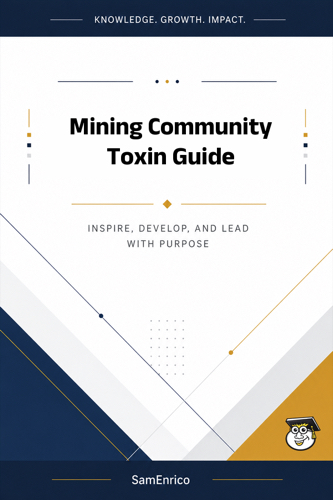
Non-FictionHealth & WellnessMining Safety
Mining Community Toxin Guide eBook
Test for heavy metals in soil and water if living
Test for heavy metals in soil and water if living near active or abandoned mines.
Formats
Free sample
Chapter 1: What The Eye Cannot See...--The first thing you need to understand about mining contamination is that it will never announce itself. There will be no foul smell rising from your well. No strange color blooming in your morning glass of water. No warning taste on your child's lips after they've played in the backyard dirt. The poisons left behind by mines—abandoned, active, or orphaned—are almost entirely invisible to the human senses.
And that invisibility is precisely what makes them so devastating.This is not a book about environmental disasters you can see. This is a book about the disasters you cannot.Imagine waking up one morning in a small town nestled against a hillside that, fifty years ago, was a thriving copper mine. The mine closed before you were born. The buildings are gone. The land has been reclaimed by grass and scrub oak.
Your real estate agent told you it was "historic mining country" with "character." You bought the property because it was affordable, because the views were beautiful, because you wanted your children to grow up somewhere with room to run.You have no idea that beneath that picturesque hillside, a chemical reaction that began when the mine opened is still unfolding. Pyrite—fool's gold, the miners called it—is oxidizing. Rainwater percolating through the abandoned waste rock is turning acidic. That acid is leaching arsenic, cadmium, and lead from the rock like tea steeping in hot water. And that toxic tea is moving.
Slowly, invisibly, inexorably, it is traveling through groundwater toward your well.You cannot see it. You cannot taste it. Your children will play in the yard for years, and you will never know.That is what the eye cannot see.The Communities That Discovered Too Late The Navajo Nation learned this lesson across generations. Between 1944 and 1986, over four million tons of uranium ore were extracted from Navajo land. The mines were considered strategic assets for the Cold War arms race.
Miners were told the dust was harmless. Families built homes from mine waste rock because it was free and plentiful. Children played on tailings piles that glowed faintly in the dark.By the 1990s, the cancer rates told the story no one wanted to hear. Lung cancer. Bone cancer.
Kidney failure. Birth defects. The US Environmental Protection Agency eventually identified more than 500 abandoned uranium mines on the Navajo Nation. Hundreds of unlined evaporation ponds. Thousands of contaminated structures.
Drinking water wells with uranium levels ten times the federal safety standard. And no responsible party left to pay for cleanup—most of the mining companies had declared bankruptcy or simply disappeared decades earlier.The Navajo EPA estimates that over thirty percent of the population near former mining sites has been exposed to toxic levels of heavy metals. The full health toll will never be known because the latency period for some cancers exceeds forty years. Grandparents and grandchildren are getting sick from the same mine, half a century apart.But the Navajo Nation is not unique. It is merely the most documented.The town of Picher, Oklahoma, was built over the Tar Creek Superfund site—a legacy of lead and zinc mining that began in the early 1900s.
For generations, families raised children in homes built on contaminated soil. The lead poisoning rates among Picher children were among the highest in the nation. By 2009, the federal government had bought out the entire town. Picher is now a ghost town. The school is closed.
The post office is shuttered. The churches stand empty. The residents dispersed, many of them never knowing the full extent of what had been in their backyards.In Butte, Montana, the Berkeley Pit—a former open-pit copper mine—fills with water so acidic and metal-laden that migrating snow geese land on its surface and die within hours. The water is orange with iron. The edges of the pit are fenced off.
But the contamination does not stay in the pit. It moves through groundwater into the surrounding community. Residents have lived with arsenic in their wells for decades. Some have adapted. Others have died.These are not cautionary tales from the distant past.
These are ongoing crises. And they share a common thread: in every case, the residents discovered the contamination themselves, long after the mines closed, long after the companies left, long after any regulator had knocked on their door.The Orphaned Mine Crisis To understand why you cannot rely on the government to protect you, you need to understand the legal and economic reality of orphaned mines.In the United States, the modern era of mining regulation began with the Surface Mining Control and Reclamation Act of 1977. This law required mining companies to post bonds for reclamation—money set aside to clean up the site after mining ended. It required environmental impact statements. It required water monitoring.
It was, for its time, a significant step forward.But here is the problem: the law was not retroactive. Mines that closed before 1977 were exempt. And there are tens of thousands of them.The Government Accountability Office estimates that there are over 500,000 abandoned mine features across the United States—shafts, tunnels, waste rock piles, tailings ponds, open pits. Of these, at least 140,000 pose environmental or health hazards. The EPA's Superfund program, which is responsible for cleaning up the worst sites, has only listed about 1,300 sites total.
The backlog is measured in decades.And even when a site is listed, the cleanup is not guaranteed. Superfund sites can languish on the National Priorities List for twenty years or more while the EPA negotiates with potentially responsible parties—if any can be found. If the original mining company went bankrupt, the state becomes responsible. If the state refuses, the site becomes an "orphan."An orphaned mine is exactly what it sounds like: a contaminated site with no parent company willing or able to pay for cleanup. The liability falls to taxpayers.
But taxpayers do not write blank checks. They write budgets. And budgets mean priorities. And priorities mean that your backyard might wait thirty years while a site downstream gets funded first.The result is a kind of toxic triage. The worst sites get attention.
The moderately contaminated sites wait. And the subtly contaminated sites—the ones with arsenic at three times the safe level instead of fifty times—may never be addressed at all.That is where this book comes in.Why "Looks Clean" Is Not Safe You might be thinking: My property looks fine. The water tastes fine. The grass grows. The deer drink from the creek.
How bad could it be?This is the most dangerous assumption you can make.Heavy metals do not behave like biological contaminants. A well with bacterial contamination will make you sick within days—vomiting, diarrhea, fever. You will know something is wrong. You will test the water. You will fix the problem.Heavy metals do the opposite.
They accumulate.Arsenic builds up in your tissues over years. It damages DNA incrementally. It causes cancer not by a single catastrophic event but by a million tiny insults to your cells, each one pushing you slightly closer to malignancy. You will feel nothing until the…
This is the end of the free sample. Get the eBook to keep going. Buy now
About this book
Details
- Author
- North Larraine
- Publisher
- SamEnrico
- Language
- English
- Genre
- Non-Fiction, Health & Wellness, Mining Safety
- Released
- 2026-06-10
- Pages (approx.)
- 137
- Available as
- eBook, Audiobook

Read better in the ZLOADR app
Your eBooks on your phone or tablet. Sign in with your SamEnrico account and start reading.
More by North Larraine
 The Empty Aquarium GuideNorth Larraine$11.99
 Somatic Trigger Release GuideNorth Larraine$11.99
 Lip Lines Vertical Wrinkle CourseNorth Larraine$11.99
 Public Speaking Hypnosis ScriptsNorth Larraine$11.99
 InsurTech Investment PlanNorth Larraine$11.99
 Anger In Dating RelationshipsNorth Larraine$11.99
 Alcohol Recovery After FiftyNorth Larraine$11.99
 FDR New York GovernorNorth Larraine$11.99
 Titanic's Lost Sister: The Haunting Secrets of the BritannicNorth Larraine$11.99
 The Silent Signal: How Apollo 16’s Lost Data Changed Space ExplorationNorth Larraine$11.99
 Black Diamonds and the Hollow DrillNorth Larraine$11.99
 Online Arbitrage and SourcingNorth Larraine$11.99
You may also like
 Hong Kong Handover 1997Dunn Johnnie$11.99
 Zumba For Postnatal Recovery CourseNeal Christian$11.99
 Zumba for BeginnersLadner Nikia$11.99
 YouTube Comment Mining GuideHumes Pandora$12.99
 Worry Box MeditationCarlin Rudy$11.99
 Workplace Stress MeditationNguyen Lynn$11.99
 Workplace Stress and Sleep RepairHawley Ivory$11.99
 Workplace Perfectionism CureDelaney Jeffry$11.99
 Workplace Injustice Anger GuideWallen Isabelle$11.99
 Work Addiction and Burnout LinkGreenwood Ester$11.99
 Women in Yoga and WellnessBeattie Galina$11.99
 Women in Stand Up ComedyChun Evangeline$11.99