
Non-FictionBusiness BriefLabor Economics
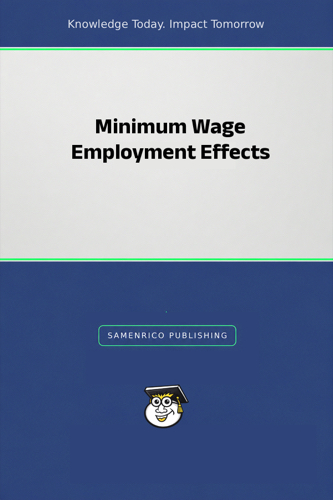
Minimum Wage Employment Effects
Analyze how price floors in labor markets create u
Analyze how price floors in labor markets create unemployment.
Formats
About this book
Free sample
Chapter 1: The Teenager Who Disappeared--–- In 1938, a seventeen-year-old named Miguel Vélez woke up before dawn in his family’s wooden house on the outskirts of San Juan, Puerto Rico. He had worked at a textile factory for eleven months, earning five cents an hour. The work was monotonous—feeding fabric into a clattering sewing machine, sweeping floors, stacking finished goods—but it was work. That paycheck, meager as it was, bought rice, beans, and the occasional scrap of salted cod for his mother and three younger siblings. Miguel was not ambitious in the way of politicians or poets.
He simply wanted tomorrow to look like today: a roof, a meal, the quiet dignity of not being a burden.On October 24, 1938, that future vanished.The United States Congress had passed the Fair Labor Standards Act, a landmark piece of New Deal legislation designed to lift American workers out of destitution. The law established a federal minimum wage of twenty-five cents per hour. To a factory owner in Pittsburgh or a hotel manager in Chicago, this seemed modest—a floor so low that it barely registered as a constraint. But in Puerto Rico, where the average hourly wage was five cents, the new minimum was a fivefold increase. Overnight, the cost of employing Miguel became five times more expensive.His boss called a meeting at 7:00 AM.
Twenty-seven workers stood in a loose semicircle around a grease-stained desk. The owner, a Spanish immigrant who had built the factory from nothing, held a telegram from the mainland. His voice cracked as he read it aloud. He could not afford to pay twenty-five cents an hour. The math was simple: his profit margins had never exceeded ten percent.
A fivefold wage increase would erase those margins entirely. He had three options—raise prices, automate, or close. Raising prices was impossible because mainland competitors would undercut him. Automation required capital he did not have. So he chose the only path left.The factory closed at noon.Miguel walked home in a daze.
He did not understand the Fair Labor Standards Act. He did not understand price floors, labor demand curves, or the…
This is the end of the free sample. Get the eBook to keep going. Buy now
Contents
- Chapter 1
- Chapter 2
- Chapter 3
- Chapter 4
- Chapter 5
- Chapter 6
- Chapter 7
- Chapter 8
- Chapter 9
- Chapter 10
- Chapter 11
- Chapter 12
Details
- Author
- Varney Doretha
- Publisher
- SamEnrico
- Language
- English
- Genre
- Non-Fiction, Business Brief, Labor Economics
- Released
- 2026-06-06
- Pages (approx.)
- 145
- Available as
- eBook, Audiobook

Read better in the ZLOADR app
Your eBooks on your phone or tablet. Sign in with your SamEnrico account and start reading.
More by Varney Doretha
 Remote Work Hydration ReminderVarney Doretha$11.99
 The Social Media Sabbatical GuideVarney Doretha$11.99
 The Sleep Senolytic ConnectionVarney Doretha$11.99
 The Voice of the Game: How a Kenyan Journalist Changed African Sports MediaVarney Doretha$11.99
 Partner Success SpecialistVarney Doretha$11.99
 Learn to Play the Vertical Viola (And Other Members of The Violin Octetfamily)Varney Doretha$11.99
 How to Become a Mailing-machine OperatorVarney Doretha$11.99
 Video Call Conflict MediationVarney Doretha$12.99
You may also like
 Hong Kong Handover 1997Dunn Johnnie$11.99
 Zumba For Postnatal Recovery CourseNeal Christian$11.99
 Zumba for BeginnersLadner Nikia$11.99
 YouTube Comment Mining GuideHumes Pandora$12.99
 Worry Box MeditationCarlin Rudy$11.99
 Workplace Stress MeditationNguyen Lynn$11.99
 Workplace Stress and Sleep RepairHawley Ivory$11.99
 Workplace Perfectionism CureDelaney Jeffry$11.99
 Workplace Injustice Anger GuideWallen Isabelle$11.99
 Work Addiction and Burnout LinkGreenwood Ester$11.99
 Women in Yoga and WellnessBeattie Galina$11.99
 Women in Stand Up ComedyChun Evangeline$11.99