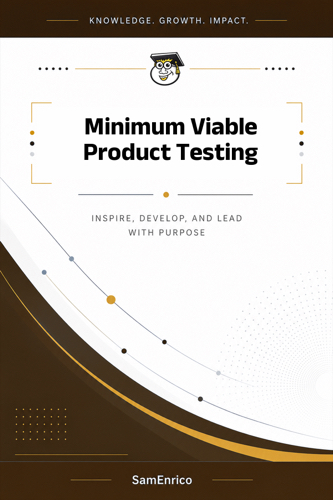
Minimum Viable Product Testing eBook
Builds smallest version to get real user feedback.
Builds smallest version to get real user feedback.
Formats
Free sample
Chapter 1: The Pain Before The Product--–- The email arrived at 11:47 PM on a Tuesday. The subject line read: “We built it. They didn’t come.” Attached was a fifty-seven-slide deck detailing eighteen months of development, a team of twelve engineers, and $2.3 million in burned capital. The product was beautiful. The code was elegant.
The login screen had parallax scrolling. But after six weeks of launch, exactly eleven people had signed up. Three of them were the founder’s relatives. Two were bots. The rest had clicked by accident.This is not an outlier.
This is the rule.Every year, thousands of products launch to exactly this result. Well-intentioned teams spend months—sometimes years—building features they assume customers want, only to discover that assumption was wrong. The cost is staggering: wasted salaries, broken morale, and opportunities lost to competitors who moved faster. But the real tragedy is that almost all of this waste was preventable. Not with more money.
Not with better engineers. Not with faster servers. But with one simple shift in mindset: testing the problem before building the solution.Welcome to the first chapter of Minimum Viable Product Testing: The Build-Measure-Learn Accelerator. If you read only one chapter of this book, make it this one. Because before you can test a solution, before you can build an MVP, before you can run a single experiment, you must answer one question with absolute certainty: Does the problem you are solving actually exist?The Seduction of Solution Mode Human beings are solution-oriented creatures.
When we see a gap, we want to fill it. When we hear a complaint, we want to fix it. When we have an idea, we want to build it. This instinct is called “solution mode,” and it is the single greatest threat to effective product development.Here is how solution mode typically manifests: A founder or product manager has a brilliant idea. They visualize the finished product—the sleek interface, the satisfying animations, the flood of grateful users.
They begin sketching wireframes, writing user stories, assigning sprint tasks. The energy is electric. The team rallies. Code is written. Features are shipped.
And then… silence. No users. No feedback. No revenue. Just the hollow echo of a product built in a vacuum.Consider a startup we’ll call “Task Flow.” The founders believed that freelancers desperately needed a better project management tool.
Their hypothesis: “Freelancers waste three hours per week organizing tasks across spreadsheets, email, and sticky notes. Our all-in-one platform will save them that time.” They spent six months building Task Flow. It had Gantt charts, time tracking, invoice generation, team messaging, file storage, and a Chat GPT-powered assistant. The product worked perfectly. But when they launched, freelancers didn’t sign up.
Why? Because the founders had never asked a single freelancer what they actually struggled with. It turned out that freelancers didn’t think they had a project management problem. They thought they had a client acquisition problem. Task Flow solved a problem that didn’t exist for its target users.Solution mode is seductive because it feels like progress.
Writing code feels productive. Designing interfaces feels creative. Launching features feels monumental. But activity is not progress. Progress is learning what customers actually need—and that requires stepping out of solution mode and into discovery mode.The Critical Distinction: Feature vs.
Pain To escape solution mode, you must internalize a single, powerful distinction: the difference between a feature and a pain.A feature is what you want to build. It is the button, the screen, the algorithm, the integration, the notification system. Features are artifacts of your imagination. They do not exist in the real world until you create them.A pain is what the customer pays to avoid. It is the frustration, the wasted time, the lost money, the embarrassment, the fear, the inconvenience.
Pains are real. They exist whether you build anything or not. Customers have already developed workarounds for their pains—spreadsheets, sticky notes, expensive services, or simply suffering in silence.The most important sentence in this book is this: Customers do not buy features. Customers rent solutions to pains, and the lease expires the moment a better solution appears.When you build a feature that addresses a real pain, customers will fight to use your product. When you build a feature that addresses a pain you invented, customers will ignore you politely—or not so politely.Let us examine a real-world example.
In the early 2000s, a company called Webvan raised $800 million to build a grocery delivery service. Their feature set was extraordinary: temperature-controlled warehouses, custom delivery vans, real-time inventory tracking, and a website that felt like magic. The problem? They never validated that enough customers had a sufficient *pain* with existing grocery shopping to justify the premium pricing. Webvan collapsed spectacularly, burning through $800 million in eighteen months.
Today, grocery delivery is a massive market—but it succeeded only when companies like Instacart validated the pain (urban professionals hate carrying heavy groceries on public transit) before scaling the solution.The feature-pain distinction is not academic. It is the difference between building something people want and building something people ignore.The Customer Interview Sandbox: A Structured Approach to Discovery If you cannot trust your assumptions, and you cannot trust your instincts, how do you validate whether a pain exists? You ask. But not the way most people ask.Most entrepreneurs conduct “confirmation interviews.” They sit down with a potential customer and say something like: “Would you use an app that solves your project management problems?” This is a worthless question. Humans are terrible at predicting their future behavior.
They say “yes” to be polite. They say “yes” because they like the idea of being the kind of person who uses productivity tools. They say “yes” because they want to end the conversation. But when you build the product, they do not show up.The solution is the Customer Interview Sandbox—a structured interview methodology designed to uncover real pains by observing past behavior, not future intentions.The Golden Rule of Discovery Interviews Never ask what someone would do. Always ask what they have done.Past behavior is data.
Future intentions are fiction. If you want to know whether a pain is real, ask about the last time that pain occurred. Ask for specifics: date, time, duration, emotional state, coping mechanisms, workarounds, and costs incurred.Here is a side-by-side comparison:Bad Question (Future Fiction)Good Question (Past Data)“Would you use a tool that organizes your tasks?”“Tell me about the last time you lost track of a task. What happened?”“How much would you pay for this solution?”“What have you spent in the last month on workarounds for this problem?”“Do you struggle with project management?”“Walk me through how you managed your projects last week. Where did friction occur?”The Seven Question Framework After conducting more than five hundred discovery interviews across dozens of products, I have distilled the process into seven questions.
These questions are designed to be used in order, with active listening between each.Question 1: “Tell me about your role and what a typical day looks like.”Why: Establishes context and builds rapport. Do not jump straight…
This is the end of the free sample. Get the eBook to keep going. Buy now
About this book
Details
- Author
- Mosher Fidelia
- Publisher
- SamEnrico
- Language
- English
- Genre
- Non-Fiction, Business Brief, MVP
- Released
- 2026-06-11
- Pages (approx.)
- 155
- Available as
- eBook, Audiobook

Read better in the ZLOADR app
Your eBooks on your phone or tablet. Sign in with your SamEnrico account and start reading.
More by Mosher Fidelia
 Legal Professional Stress GuideMosher Fidelia$11.99
 Intermittent Fasting Success StoriesMosher Fidelia$11.99
 The Bully Proof TeenMosher Fidelia$11.99
 Mitch McConnell GridlockMosher Fidelia$11.99
 Collaborative Observation MethodMosher Fidelia$11.99
 TM for TradersMosher Fidelia$11.99
 Nicotine Replacement Adherence PlanMosher Fidelia$11.99
 HGH And BodybuildingMosher Fidelia$11.99
 The Silk Road in the Sky: The Forgotten Flight of the Kashgari AviatorsMosher Fidelia$11.99
 The Manchurian Candidate: The Untold CIA ExperimentsMosher Fidelia$11.99
 Orpheus and the Lyre That Moved the GodsMosher Fidelia$11.99
 Chain-of-Thought Prompt StrategiesMosher Fidelia$11.99