
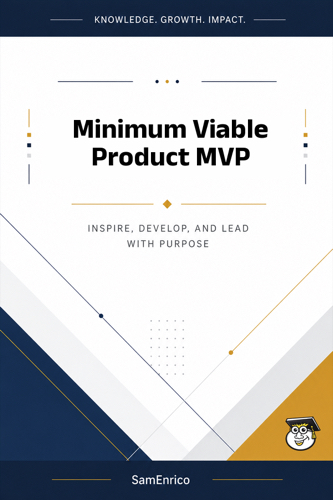
Minimum Viable Product MVP eBook
Smallest thing you can build to learn.
by Kuhn Theo
Smallest thing you can build to learn.
Formats
Free sample
Chapter 1: The Graveyard of Good Intentions--–- In the heart of Silicon Valley, there is a cemetery you will never find on a map. It holds no bodies. Instead, it holds the remains of $34 billion dollars, 1.2 million person-years of wasted effort, and approximately 90,000 startups that raised money, built products, launched with fanfare, and then vanished without a whisper. The headstones are not made of stone but of unused login credentials, abandoned mobile apps, and server logs showing exactly zero daily active users. Welcome to the Graveyard of Good Intentions.The most painful truth about this graveyard is that almost every tombstone bears the same epitaph: "We built what they asked for." Or worse: "We built the cheapest version possible."For the past fifteen years, the startup world has been haunted by a seductive but deeply flawed idea.
The idea goes like this: "An MVP is the cheapest, fastest, crudest version of your product that you can push out the door to see if anyone bites." This idea has been repeated so often in accelerator pitch sessions, founder meetups, and venture capital boardrooms that it has achieved the status of holy writ. It is wrong. And it has cost the world more than a trillion dollars in misdirected energy.This book exists to bury that old definition and resurrect the true meaning of the Minimum Viable Product. An MVP is not the cheapest thing you can build. An MVP is the smallest thing you can build to learn.
Those two definitions—cheap versus small-to-learn—are separated by a gulf as wide as the ocean. One leads to the graveyard. The other leads to product-market fit.The 90% Lie That Everyone Believes Let us start with a number that you have heard before: 90% of startups fail. This statistic is so overused that it has lost its power to shock. We nod along at conferences, tweet it with a sad emoji, and then promptly ignore it when we sit down to build our own product.But let me reframe that number in a way that might actually sting.
According to CB Insights, which analyzed over 2,000 failed startups, the number one reason for failure—cited by 42% of founders—was not running out of money. It was not a bad team. It was not competition. It was building a product that nobody wanted.Think about that for a moment. Forty-two percent of failures happened because founders successfully built something that the market rejected.
They coded. They designed. They tested. They launched. And then they listened to the sound of silence.
They did everything right according to the old definition of MVP. They built something cheap and fast. But they forgot to ask the only question that matters: What are we trying to learn?Consider the cautionary tale of Webvan, a grocery delivery startup that raised $800 million in the late 1990s—an astronomical sum at the time. Webvan built automated warehouses, a fleet of delivery vans, and a sophisticated logistics system. They spent years constructing what they believed was the "minimum viable" version of an online grocery store.
When they launched, they discovered that customers did not actually want groceries delivered in two-hour windows. They wanted lower prices. Webvan filed for bankruptcy in 2001, having learned exactly one thing: they should have tested demand with a single van and a cooler before building an empire.Webvan is not an outlier. It is the rule wearing a more expensive suit.The Build-Measure-Learn Loop: Your Only Engine If the old definition of MVP is broken, what replaces it? The answer comes from a simple but profound framework called the Build-Measure-Learn loop.
This is not theoretical fluff. It is the operating system of effective product development.Here is how it works. Every product idea starts as a hypothesis. You believe that if you build Feature X, then users will do Y, and that will result in Z. That is the Build phase—but crucially, "build" does not mean "write production code for six months." It means "create the smallest possible artifact that can generate learning." Sometimes that artifact is a line of code.
Sometimes it is a landing page. Sometimes it is a human being pretending to be software. We will explore all of these in depth later.The Measure phase is where most teams fail. They measure everything that is easy to count—page views, downloads, registered users—and call it progress. But these are what we will call Vanity Metrics.
They look good on a dashboard. They make you feel productive. And they are utterly useless for learning. The only metrics that matter are Actionable Metrics: numbers that tell you whether users are actually changing their behavior in response to what you built.The Learn phase is the entire point of the exercise. After you build and measure, you must ask one question: What should we do next?
There are only two answers: pivot or persevere. If the data shows that you are moving toward product-market fit, you persevere—you double down, optimize, and scale. If the data shows that you are wrong, you pivot—you change your hypothesis, your customer segment, or your business model. You do not double down on a losing hand just because you have already spent money.The key insight of the Build-Measure-Learn loop is that speed matters more than perfection. A $500 experiment that teaches you something in one week is infinitely more valuable than a $50,000 product that teaches you nothing in six months.
Why? Because time is the only non-renewable resource in a startup. You can always raise more money. You can always hire more engineers. You cannot get back a single day of lost learning.Let me give you a concrete example.
Two founders want to build a meal kit delivery service. Founder A follows the old definition of MVP: she spends $50,000 and three months building a polished website, sourcing packaging, negotiating with suppliers, and designing a beautiful subscription flow. She launches to crickets. She has learned that her assumption was wrong, but she has also burned three months and $50,000.Founder B follows the Build-Measure-Learn loop. She spends $500 and one week building a landing page with a "Pre-order now" button and a mock menu.
She runs $100 in Facebook ads to drive traffic. She measures how many people click the button. Ten percent click—a strong signal. She then takes those clickers and sends them a manual email: "Thanks for your interest. We are testing our service.
What three meals would you want?" She learns that her target customers actually want low-carb options, not the vegetarian options she assumed. She has spent one week and $600. She now knows exactly what to build. Founder B did not build a "cheaper" product. She built a smaller experiment for learning.That is the difference between the graveyard and the path forward.Vanity Metrics vs.
Actionable Metrics: The Great Deception Let us drill deeper into the distinction that will save you years of wasted effort. Vanity Metrics are numbers that go up over time regardless of what you do. They are the junk food of product analytics—calories with no nutritional value.Common Vanity Metrics include:Total registered users. This number always goes up if you have any marketing budget…
This is the end of the free sample. Get the eBook to keep going. Buy now
About this book
Details
- Author
- Kuhn Theo
- Publisher
- SamEnrico
- Language
- English
- Genre
- Non-Fiction, Self-Help, MVP
- Released
- 2026-06-06
- Pages (approx.)
- 148
- Available as
- eBook, Audiobook

Read better in the ZLOADR app
Your eBooks on your phone or tablet. Sign in with your SamEnrico account and start reading.
More by Kuhn Theo
 Dumbbell Only Strength PlanKuhn Theo$11.99
 Postpartum Postnatal Yoga GuideKuhn Theo$11.99
 Hypoarousal Freeze ResponseKuhn Theo$11.99
 Confusion Technique Script GuideKuhn Theo$11.99
 Mindfulness for Nerve PainKuhn Theo$11.99
 Sam Sheppard Trial Publicity OrderKuhn Theo$11.99
 Alcohol Recovery After RelapseKuhn Theo$11.99
 Dreaming for Product DesignKuhn Theo$11.99
 The Last Shot: How the 1972 Soviet Basketball Team Lost More Than a GameKuhn Theo$11.99
 The Unbroken Voyage: The Atlantic Survival of the *Pinta* Crew (1973)Kuhn Theo$11.99
 The Great Bordeaux Heist: A Million-Dollar Wine CaperKuhn Theo$11.99
 Nostro Account Liquidity TrapKuhn Theo$12.99
You may also like
 Hong Kong Handover 1997Dunn Johnnie$11.99
 Zumba For Postnatal Recovery CourseNeal Christian$11.99
 Zumba for BeginnersLadner Nikia$11.99
 YouTube Comment Mining GuideHumes Pandora$12.99
 Worry Box MeditationCarlin Rudy$11.99
 Workplace Stress MeditationNguyen Lynn$11.99
 Workplace Stress and Sleep RepairHawley Ivory$11.99
 Workplace Perfectionism CureDelaney Jeffry$11.99
 Workplace Injustice Anger GuideWallen Isabelle$11.99
 Work Addiction and Burnout LinkGreenwood Ester$11.99
 Women in Yoga and WellnessBeattie Galina$11.99
 Women in Stand Up ComedyChun Evangeline$11.99