
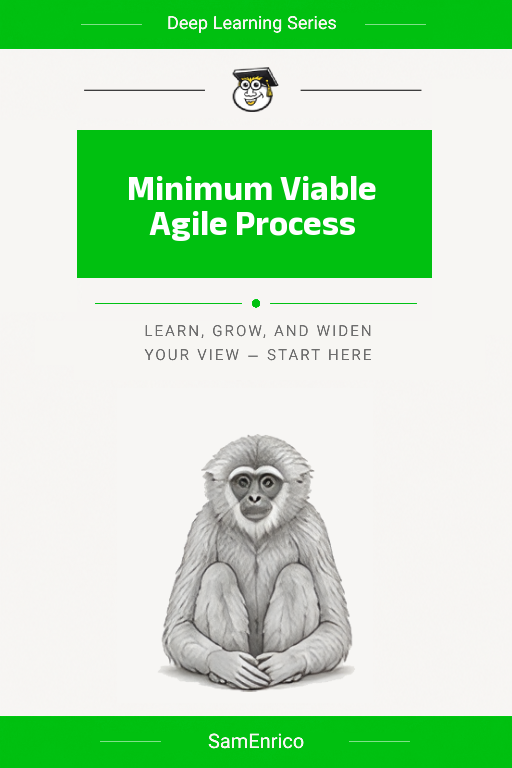
Minimum Viable Agile Process eBook
Start with just a backlog and a weekly review. Add
Start with just a backlog and a weekly review. Add ceremonies incrementally as your team grows from 2 to 20 people without process overload.
Formats
Free sample
Chapter 1: The Backlog Trap–- Every failed agile transformation I’ve ever witnessed began the same way: not with a bad standup, not with a terrible retrospective, but with a backlog that had become a digital landfill.The team started with good intentions. Someone created a shared document or a Trello board. They wrote down everything that needed doing. Features, bugs, ideas, someday-maybe dreams. Then they added more.
And more. Six months later, the backlog had 347 items. Forty-seven of them were labeled “high priority.” Twelve had been started and abandoned. No one remembered what “refactor payment gateway error handling (legacy)” meant, but no one dared delete it.The backlog was no longer a tool. It had become a prison.This chapter is about escape.The Two Mistakes Every Small Team Makes When I say “small team,” I mean two to five people.
You’re small enough that you can all fit around a single table or a single video call without muting issues. You’re small enough that everyone knows what everyone else is working on—or at least, they think they do.At this size, teams make one of two catastrophic mistakes.Mistake One: The Empty Void Some teams have no shared list at all. Work lives in individual heads, in Slack messages, in the dark matter of “oh yeah, I thought we were doing that.” Priorities shift hourly based on who shouted last. Features get started, abandoned, and restarted by different people who didn’t know the work had already begun.The symptom is chaos masked as urgency. “We’re moving fast,” the team tells themselves.
But they’re not moving fast. They’re moving randomly. Velocity is not the same as direction.Mistake Two: The Digital Landfill The opposite mistake is more insidious because it feels like professionalism. The team creates a detailed backlog. They add custom fields: Priority (1-5), Status (Not Started, In Progress, Blocked, Review, Deployed, Verified, Closed), Story Points (1,2,3,5,8,13,21), Epic Link, Sprint Assignment, Release Tag, Customer Request ID.They spend hours grooming tickets.
They move items between columns. They generate reports. They hold meetings to discuss why the reports look the way they do.And they ship nothing.The symptom is activity disguised as progress. The backlog becomes the work. The real work—shipping software that solves real problems—gets suffocated under the weight of its own representation.The Minimum Valuable Increment (MVI)Here is the alternative, and it comes from watching hundreds of small teams who actually shipped: stop breaking work into tasks.
Break work into value drivers.I call this the Minimum Valuable Increment (MVI). An MVI is the smallest unit of work that delivers observable value to someone. Not “writes code” value. Real value. The kind someone would pay for, or thank you for, or notice if it went away.There are exactly three types of value in software development.
Everything else is noise.Type One: Functional Value Functional value is what the user sees, touches, or experiences. When someone says “feature,” they usually mean functional value.Examples:“User can log in with Google”“Search results sort by relevance”“Invoice exports to PDF”“Dark mode remembers user preference”Functional value generates revenue or satisfaction directly. If you ship it, someone notices. If you break it, someone complains. This is the value that sales teams promise and customers demand.But functional value has a dangerous property: it’s visible.
When a team only tracks functional value, they look productive. Tickets move. Features ship. Demos impress. Meanwhile, the system rots from the inside.Type Two: Operational Value Operational value is what keeps the system alive.
No user asks for it. No salesperson pitches it. But when it’s missing, everything stops.Examples:“Log all failed login attempts to Cloud Watch”“Auto-backup database daily with 30-day retention”“Rate-limit API to prevent abuse”“Alert when error rate exceeds 1% for five minutes”Operational value prevents disasters. It’s the insurance policy you never want to use but desperately need when things go wrong. Teams that ignore operational value ship fast until they ship nothing at all—because the system has collapsed under unlogged errors, corrupted data, or security breaches.Type Three: Efficiency Value Efficiency value is what speeds up the team.
It doesn’t change what the software does. It changes how easily the team can change the software.Examples:“Automate dev environment setup from three days to one command”“Reduce CI pipeline from fifteen minutes to five”“Document the incident response runbook”“Create a shared test data fixture so new tests don’t require manual setup”Efficiency value compounds. A day saved this week is a day available every week after. Teams that ignore efficiency value ship slower every month until they ship at the speed of molasses.The Ratio That Changes Everything Every backlog item must declare its type. Write (F) for Functional, (O) for Operational, (E) for Efficiency.
This simple label changes how teams prioritize.For teams of two to five people, I recommend a loose ratio. Don’t measure it precisely. Just keep an eye on it. If you’ve shipped ten Functional items and zero Operational or Efficiency items, you’re building a house on sand. If you’ve shipped ten Efficiency items and zero Functional items, you’re polishing the wheels of a car that has no engine.The sweet spot emerges naturally when you follow the next rule.The Vague Invitation Rule Here is a rule that will make every project manager and certified scrum master uncomfortable.Write backlog items just vague enough to force a two-minute conversation.Not a twenty-minute specification.
Not a five-page requirements document. Not a ticket with twelve acceptance criteria written in Gherkin syntax.A two-minute conversation.Example of a good backlog item:“Improve search speed”That’s it. Three words. No details. No metrics.
No prescribed solution.When someone pulls “improve search speed” into the Ready column, they have a two-minute conversation with whoever knows the most about search. “What does improve mean? Which queries are slow? How slow is too slow? Do we have metrics?” The conversation produces shared understanding.
Then the person goes and writes code.Example of a bad backlog item:“Implement Redis caching for search results with 98% hit rate and p95 latency under 200ms, deploy to staging by Friday, coordinate with Dev Ops for cluster configuration”This ticket is a prison. It prescribes the solution (Redis caching) before anyone has diagnosed the problem. It sets arbitrary targets (98% hit rate) that might be impossible or meaningless. It creates a deadline (Friday) before anyone knows the scope. It invents dependencies (coordinating with Dev Ops) that might not exist.The worst part?
No one will have a conversation about this ticket. They’ll just assign it to someone and hope.The Vague Invitation Rule works because humans are better at talking than writing. A two-minute conversation transfers more context than a twenty-minute document. And context is what prevents the “works on my machine” syndrome, the “I thought you meant” confusion, and the “but the ticket didn’t say” blame game.The 30-Day Pruning Rule Backlogs rot. Items that were important thirty days ago are rarely important today.
But teams keep them out of fear. “What if we need it later?” They never do.Here is the rule: any…
This is the end of the free sample. Get the eBook to keep going. Buy now
About this book
Details
- Author
- Mcknight Mayme
- Publisher
- SamEnrico
- Language
- English
- Genre
- Non-Fiction, Startup Guide, Process Design
- Released
- 2026-06-01
- Pages (approx.)
- 119
- Available as
- eBook, Audiobook

Read better in the ZLOADR app
Your eBooks on your phone or tablet. Sign in with your SamEnrico account and start reading.
More by Mcknight Mayme
 Assignment Deadline ManagementMcknight Mayme$11.99
 Stress Hardiness Training CourseMcknight Mayme$11.99
 Low Volatility SentimentMcknight Mayme$11.99
 Overcoming Loneliness After LossMcknight Mayme$11.99
 The Oxford Debates: Birthplace of the Modern MindMcknight Mayme$11.99
 Refrigeration TechnicianMcknight Mayme$11.99
 How to Produce Baby CerealMcknight Mayme$11.99
 How to Start a Beet Pulp Business (Beginners Guide)Mcknight Mayme$11.99