
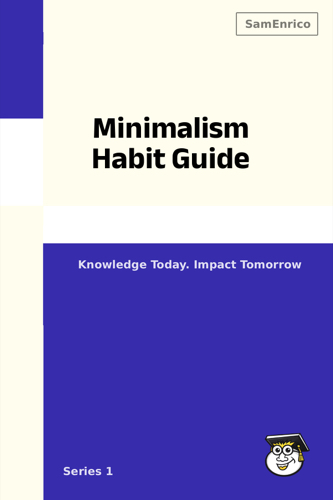
Non-FictionSelf-HelpMinimalism
Minimalism Habit Guide eBook
Build daily decluttering routines that lead to a s
by North Glynda
Build daily decluttering routines that lead to a simpler life.
Formats
Free sample
Chapter 1: The Invisible Tax--Let me tell you about the last time I lost my temper over a spatula.It was a Tuesday evening, which meant nothing except that I was already tired. I had worked eight hours, made dinner, helped with homework, and was now standing in front of an open kitchen drawer looking for the spatula I needed to flip the last batch of pancakes. The drawer would not close. Something was jammed. I pulled harder.
The drawer stuck. I yanked. A avalanche of utensils spilled onto the floor—spatulas, spoons, a whisk, something that looked like it might have been an avocado slicer from 2014. I stood there, spatula in hand, pancake burning, and felt a wave of rage rise up from somewhere deep. Not rage at the drawer.
Not rage at the utensils. Rage at myself for living in a house where a drawer could do this to me.That was the moment I realized I was paying a tax I had never agreed to.Not a financial tax. The government takes enough of those. This was a different kind of tax. A tax on my attention.
A tax on my patience. A tax on my peace. And the worst part was that I had been paying it for years without ever noticing. The spatula drawer was not the problem. The spatula drawer was just the receipt.The Tax You Did Not Know You Were Paying Every object in your home makes a claim on you.
Not a spiritual claim. Not an emotional claim. A cognitive claim. Your brain has limited bandwidth. Scientists call it attentional capacity.
You call it "being able to think straight." Every item you own that is out of place, unused, unneeded, or unloved consumes a tiny slice of that bandwidth. It is not a big slice. A single pen on a counter does not ruin your day. But a hundred pens? A thousand small claims?
That adds up.Here is what that tax looks like in real life.You wake up. You step over a pair of shoes on the floor. That is one micro-decision: do I pick those up now or later? You decide later. But you still noticed them.
That cost a fragment of attention. You go to the bathroom. The counter is crowded with bottles you do not use. You reach for your toothpaste, brushing past three containers of things you bought on sale and never opened. Each one registers.
Each one costs a fragment. You go to your closet. You push past five shirts you never wear to get to the two you actually want. Each push costs a fragment. You go to the kitchen.
The mail is piled on the counter. You see it. You ignore it. That costs a fragment. You are twenty minutes into your day, and you have already paid twenty small taxes.By noon, you have paid hundreds.
By bedtime, thousands. Over a year, hundreds of thousands. Over a lifetime, millions.This is the invisible tax. It is invisible because it is normal. Everyone pays it.
You have paid it for so long that you no longer notice the deduction. But the deduction is real. It comes out of your patience, your focus, your energy, and your peace. And unlike the taxes the government takes, this one gives you nothing in return.The Math of Micro-Decisions Let me make the invisible visible.Cognitive psychologists estimate that the average person makes approximately 35,000 remotely conscious decisions every single day. Most of these are trivial.
Should I look left or right? Should I stand up or sit down? Should I answer this text or finish this sentence? Your brain handles most of them automatically, like a computer running background processes. But automatic does not mean free.
Every decision, even the automatic ones, requires energy. The energy is small, but it is real.Now consider the decisions that clutter forces upon you.Every time you see an object that is out of place, your brain has to decide: ignore it or act on it. That is a decision. Every time you open a drawer that is disorganized, your brain has to scan, filter, and search. That is dozens of decisions.
Every time you move something aside to reach something else, your brain has to track both objects. That is a decision. Every time you close a closet door on a mess you do not want to face, your brain has to suppress the urge to deal with it. That is also a decision—one that costs more energy than acting, because suppression is exhausting.I have watched people declutter their homes. I have watched them before, during, and after.
And I have measured, in a rough but real way, the difference in their daily decision load. Before decluttering, the average person in my observation made between 15 and 30 clutter-related micro-decisions per hour. After decluttering—not perfectly, but meaningfully—that number dropped to between 3 and 7.Fifteen to thirty per hour down to three to seven. That is a reduction of seventy to eighty percent.Do you know what you can do with seventy percent of your daily decision energy that you are currently spending on clutter?Neither do I. Because almost no one has ever freed that much energy to find out.The Opportunity Cost of Keeping Things Economists talk about opportunity cost.
It is the value of what you give up when you choose one thing over another. If you spend an hour watching television, the opportunity cost is the hour you could have spent exercising, reading, or sleeping. The cost is not the time itself. The cost is what you could have done with that time.Clutter has an opportunity cost, too. But it is not measured in hours.
It is measured in fragments.What could you do with the five seconds you currently spend searching for your keys? Nothing much. Five seconds is nothing. But what could you do with the cumulative energy of five thousand five-second searches? That is seven hours of searching over a decade.
Seven hours of frustration, of tension, of starting your day with a small failure. What could you do with seven hours? You could learn the basics of a new language. You could read four books. You could have breakfast with your partner every morning for a month.
You could simply rest.Now multiply that by every other friction point in your home. The ten seconds you spend closing the cabinet door that does not quite fit. The twenty seconds you spend untangling the charging cables every time you need to charge your phone. The thirty seconds you spend moving the pile of laundry from the chair to the bed to the floor and back to the chair.These are not big losses. They are tiny losses.
But tiny losses, compounded over years, become enormous losses. And you feel them. You may not name them, but you feel them as a low-grade exhaustion, a persistent sense of being slightly overwhelmed, a background hum of irritation that you have learned to ignore.You do not have to ignore it anymore.The Psychology of Why We Keep You might be thinking: fine, clutter costs me…
This is the end of the free sample. Get the eBook to keep going. Buy now
About this book
Details
- Author
- North Glynda
- Publisher
- SamEnrico
- Language
- English
- Genre
- Non-Fiction, Self-Help, Minimalism
- Released
- 2026-06-09
- Pages (approx.)
- 132
- Available as
- eBook, Audiobook

Read better in the ZLOADR app
Your eBooks on your phone or tablet. Sign in with your SamEnrico account and start reading.
More by North Glynda
 Group Chat Participation HandbookNorth Glynda$11.99
 Nobel Laureates In Quark PhysicsNorth Glynda$11.99
 Walking Meditation for ArthritisNorth Glynda$11.99
 Repositioning Strategy MapNorth Glynda$11.99
 The Element Hunters: The Race to Discover the Last Natural ElementsNorth Glynda$11.99
 Whispers of the First Garden: The Untold Story of Enkidu’s LamentNorth Glynda$11.99
 BPO Training Program GuideNorth Glynda$12.99
 Payment Reconciliation Automation WorkbookNorth Glynda$12.99
 Social Media Content CreatorNorth Glynda$11.99
 Understanding Gray Platelet SyndromeNorth Glynda$17.99
 How to Start a Cement (wholesale) Business (Beginners Guide)North Glynda$11.99
You may also like
 Hong Kong Handover 1997Dunn Johnnie$11.99
 Zumba For Postnatal Recovery CourseNeal Christian$11.99
 Zumba for BeginnersLadner Nikia$11.99
 YouTube Comment Mining GuideHumes Pandora$12.99
 Worry Box MeditationCarlin Rudy$11.99
 Workplace Stress MeditationNguyen Lynn$11.99
 Workplace Stress and Sleep RepairHawley Ivory$11.99
 Workplace Perfectionism CureDelaney Jeffry$11.99
 Workplace Injustice Anger GuideWallen Isabelle$11.99
 Work Addiction and Burnout LinkGreenwood Ester$11.99
 Women in Yoga and WellnessBeattie Galina$11.99
 Women in Stand Up ComedyChun Evangeline$11.99