
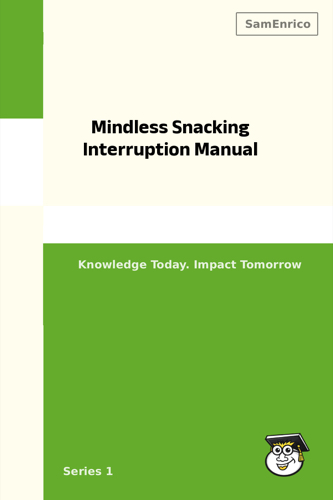
Mindless Snacking Interruption Manual eBook
Teaches awareness techniques to stop unconscious s
Teaches awareness techniques to stop unconscious snacking in front of screens or during stress.
Formats
Free sample
Chapter 1: The Empty Hand Problem--–- You are about to discover something that no diet, no app, and no amount of shame has ever told you. The reason you cannot stop eating in front of screens has nothing to do with willpower, laziness, or a lack of discipline. It has everything to do with the fact that your brain has been hacked by two of the most powerful forces in modern life: infinite digital stimulation and hyper-palatable food engineering. Together, they have created a trance state so effective that you can finish an entire bag of chips, a full season of a show, and a late night of scrolling without remembering a single bite, a single plot point, or a single moment of choice. This chapter is not here to make you feel bad about that.
It is here to wake you up to what is actually happening inside your skull, your body, and your living room. Because you cannot interrupt what you do not see. And right now, you are seeing almost nothing.The Illusion of Choice Let us start with an uncomfortable truth. You believe that every time you reach for a snack while watching Netflix, scrolling Tik Tok, or answering work emails, you are making a decision. You are not.
At least, not in the way you think. Neuroscientists have known for decades that the vast majority of our daily behaviors—upwards of forty to fifty percent by some estimates—are performed on autopilot, without conscious intention or deliberate choice. These are habits. And habits are not decisions. They are neural loops that fire automatically in response to specific cues in your environment.When you sit down on the couch, turn on the television, and within thirty seconds have a handful of pretzels in your mouth without remembering reaching for the bag, that is not a choice.
That is a reflex. It is as involuntary as your knee jerking when tapped with a rubber hammer. The only difference is that the knee-jerk reflex is hardwired from birth, while your screen-snacking reflex was carefully installed over years of repetition. And here is the part that food and tech companies do not want you to know: they have been helping you install it.Consider the design of your average smartphone. Every swipe, every notification, every infinite scroll is engineered to produce a small burst of dopamine—the same neurotransmitter involved in reward, motivation, and addiction.
Now consider the design of your average snack food. Every combination of sugar, salt, and fat is engineered to hit what food scientists call the "bliss point," the precise ratio that maximizes reward without causing sensory-specific satiety (the point at which a food becomes unappealing because you have had too much of it). When you combine infinite scroll with infinite crunch, you create a closed loop of dopamine delivery that your brain never evolved to handle. The result is a trance. And you have been living inside it.The Three Faces of the Trance Not all mindless snacking looks the same.
Through years of research into eating behavior, habit formation, and digital addiction, three distinct trance states have emerged as the primary drivers of unconscious screen eating. You will likely recognize all three, though one will probably feel like it was written about your specific life.The first trance state is Boredom Pixels. This occurs during low-stimulus scrolling—social media feeds, news websites, or any screen activity that is not engaging enough to hold your full attention but is just engaging enough to keep you from getting up. Your brain, craving stimulation, sends you to the easiest available source of dopamine: your hands reaching for whatever snack is nearby. The classic sign of Boredom Pixels is that you are not even enjoying the screen content.
You are just moving your thumb because that is what your thumb does now. And you are eating because your mouth has become an extension of that thumb.The second trance state is Stress Spikes. This occurs when cortisol—the primary stress hormone—surges in response to a work email, a social media argument, a gaming loss, or any other digital stressor. Cortisol does something remarkable to your brain: it temporarily downregulates the prefrontal cortex, the region responsible for executive function, impulse control, and long-term planning. In other words, when you are stressed, your brain literally removes its own brake pedal.
And what does the brain do when the brakes are off? It defaults to the most overlearned behavior in its repertoire. For many people, that behavior is reaching for a snack while staring at a screen. The classic sign of Stress Spikes is that the craving arrives almost instantly after the trigger, with zero build-up, and it feels urgent, even desperate.The third trance state is Zombie Hours. This occurs during late-night streaming or gaming, when fatigue has lowered your inhibitions, blue light from the screen has disrupted your hunger and satiety hormones (specifically ghrelin and leptin), and your circadian rhythm is screaming at you to sleep while your fingers are screaming at you to click "Next Episode." Zombie Hours are particularly dangerous because two biological forces combine: your body is genuinely low on energy (making hunger signals more plausible) and your judgment is genuinely impaired (making portion control nearly impossible).
The classic sign of Zombie Hours is that you cannot remember how many episodes you have watched or how many handfuls you have eaten. Time and calories have both stopped existing.These three trance states are not mutually exclusive. You can experience Boredom Pixels that tip into Stress Spikes when a notification arrives, or you can start with Zombie Hours and stay up so late that stress hormones kick in from pure exhaustion. But naming them matters. Because the first step out of any trance is recognizing which trance you are in.The Invisible Architecture of Overeating Now let us talk about your environment, because this is where the invisible architecture of overeating lives.
In his landmark book Mindless Eating, consumer behavior researcher Brian Wansink conducted a series of studies that should be required reading for anyone who has ever wondered why they ate the whole bag. In one study, he gave moviegoers free popcorn. But here was the twist: some of the popcorn was fresh, and some of it was stale—so stale that it squeaked when you chewed it. After the movie, Wansink asked the viewers how much they had eaten. The ones with fresh popcorn ate forty-five percent more than those with stale popcorn.
That makes sense. But here is the shocking part: the people with the stale popcorn still ate a significant amount. They ate stale, squeaky popcorn simply because it was in front of them. The cue to eat was not hunger. It was not even pleasure.
It was proximity.Wansink's research revealed three environmental factors that invisibly increase how much you eat, and all three are amplified by screens. The first is screen size. In another study, people who ate while watching a larger screen consumed more than those watching a smaller screen, regardless of hunger. The hypothesis is that larger screens are more immersive, and deeper immersion means deeper trance, and…
This is the end of the free sample. Get the eBook to keep going. Buy now
About this book
Details
- Author
- Coolidge Tommye
- Publisher
- SamEnrico
- Language
- English
- Genre
- Non-Fiction, Self-Help, Mindless Eating
- Released
- 2026-06-09
- Pages (approx.)
- 138
- Available as
- eBook, Audiobook

Read better in the ZLOADR app
Your eBooks on your phone or tablet. Sign in with your SamEnrico account and start reading.
More by Coolidge Tommye
 Compulsive Spending for DentistsCoolidge Tommye$11.99
 IBS Restaurant Dining GuideCoolidge Tommye$11.99
 Ecommerce Tariff Strategy GuideCoolidge Tommye$11.99
 Tom Wills: The Man Who Invented Australian Rules FootballCoolidge Tommye$11.99
 Skilled Employment Reference GuideCoolidge Tommye$12.99
 Umbrella Stand CraftCoolidge Tommye$11.99
 Ultimate Handbook Guide to Duque De Caxias : (Brazil) Travel GuideCoolidge Tommye$11.99