
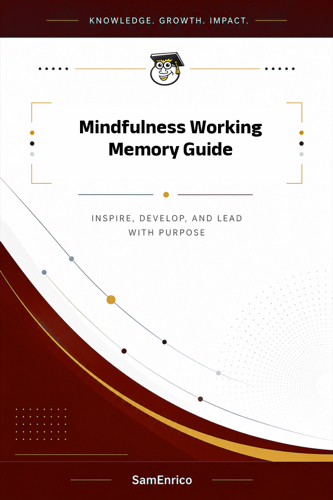
Non-FictionSelf-HelpMindfulness
Mindfulness Working Memory Guide eBook
Practice present-moment awareness to improve atten
by Arce Joette
Practice present-moment awareness to improve attention, which supports encoding and recall.
Formats
Free sample
Chapter 1: The Leaky Bucket--You have walked into a room and forgotten why. You have been introduced to someone and lost their name before the handshake ended. You have read an entire page of a book, reached the bottom, and realized you could not recall a single sentence. You have left the grocery store without the one item you went there to buy, even though you repeated it to yourself in the car like a desperate mantra.None of this means you have a bad memory.It means you have a stolen attention.This is the single most important distinction you will make in this book, and it is worth pausing on before we go any further. The difference between "I have a bad memory" and "my attention was stolen" is not semantic.
It is the difference between shame and strategy, between resignation and recovery, between believing you are broken and realizing you have simply been trained by a world that does not want you to focus.Let me prove it to you in the next sixty seconds.The 60-Second Stillness Set a timer on your phone for one minute. Do not read further until you have done this. Place the phone face down. Sit upright but not rigid. Close your eyes or lower your gaze.
For the next sixty seconds, your only job is to notice how many times your mind reaches for something other than the present moment.A thought about work. A planning of dinner. An itch on your nose. A worry about a conversation you had yesterday. A sudden urge to check your phone.
A judgment about this exercise. A memory of something funny. A rehearsal of what you will say later.Do not stop these things from happening. Do not judge them. Simply count them.
Each time your mind leaves the present moment—the sensation of breathing, the feeling of sitting, the sounds in the room—make a quiet mental tick.Go ahead. Set the timer....Welcome back.How many ticks did you count? For most people, the number is between ten and forty. That means your mind left the present moment every two to six seconds. You were sitting still, doing nothing, with no demands on your attention.
And your attention still leaked like a bucket with holes punched in the bottom.Now imagine what happens when you are trying to remember a name, follow a conversation, study for an exam, or prepare a presentation. Imagine what happens when your phone is buzzing, your email is pinging, your to-do list is growing, and your internal monologue is narrating all of it at once.This is not a moral failure. This is the human brain operating in its default mode. But default does not mean optimal. And it certainly does not mean unchangeable.The Sketchpad That Cannot Hold Water Working memory is the brain's temporary holding space.
Think of it as a mental sticky note. It can hold about four to seven pieces of information at once—for about fifteen to thirty seconds. That is it. That is all you get. A name, a phone number, a mental shopping list, the beginning of a sentence someone just spoke.Here is what happens next.
If you do something with that information—repeat it, write it down, connect it to something you already know—it may transfer to long-term memory. If you do not, it evaporates. This is not a design flaw. It is efficiency. Your brain is not supposed to remember every passing thought, every random fact, every momentary sensation.
It is supposed to filter.The problem is that modern life has turned the filter into a fire hose. You are not trying to hold four to seven pieces of information. You are trying to hold forty to seventy. And the bucket is leaking not because the bucket is broken but because holes are being punched into it every few seconds by notifications, interruptions, task-switching, and the relentless internal chatter of a mind that has never been trained to sit still.Let me give you a number. The average person checks their phone every twelve minutes.
Some studies put it closer to every four to six minutes during waking hours. Each time you check your phone, you reset your attention clock. You pull your focus away from whatever you were encoding—a name, a fact, a sequence of instructions—and you force your brain to start over.But the phone is not the villain. The phone is a tool. The villain is the habit of letting every external stimulus and internal thought hijack your attention without your permission.
The villain is the belief that multitasking is a skill rather than a myth. The villain is the assumption that your memory is failing you when in fact your attention has never been given a fair chance to work.The Myth of Multitasking Let us be clear about something that the research has settled beyond any reasonable doubt. Multitasking does not exist. Your brain cannot do two attention-demanding tasks at the same time. What you call multitasking is actually rapid task-switching.
You shift your attention from Task A to Task B to Task A again, and each shift costs you time, accuracy, and mental energy.The research is consistent. When people attempt to multitask, they take fifty percent longer to complete tasks and make up to fifty percent more errors. The cognitive cost of switching between tasks can be as high as forty percent of your productive time. And here is the part that matters most for memory: each time you switch, you lose the thread of encoding. The information you were holding in working memory—the name, the number, the instruction—does not wait for you to come back.
It evaporates.Try this. Hold your breath. While holding your breath, say your full name out loud. Easy. Now try holding your breath while reciting the alphabet backward.
Notice how much harder that is. Now imagine holding your breath while someone asks you a question, your phone buzzes, and you try to remember what you were just reading. That is your working memory under daily load. It is not designed for this.Autopilot Mode There is another thief of attention, one that has nothing to do with phones or interruptions. It is called autopilot mode.
You have experienced it thousands of times. Driving home from work and realizing you remember nothing of the last ten minutes. Eating a meal and realizing you tasted only the first three bites. Brushing your teeth and realizing you have no idea whether you brushed the left side or the right side first.Autopilot mode is efficient for routine tasks. It frees up mental resources.
But it is catastrophic for memory encoding because memory encoding requires conscious awareness. You cannot remember what you were not present for. If you drive the same route every day and spend the drive planning your evening, you will not remember the drive. If you listen to a lecture while mentally replaying an argument, you will not remember the lecture. If you meet someone new while thinking about what you will say next, you will not remember their name.This…
This is the end of the free sample. Get the eBook to keep going. Buy now
About this book
Details
- Author
- Arce Joette
- Publisher
- SamEnrico
- Language
- English
- Genre
- Non-Fiction, Self-Help, Mindfulness
- Released
- 2026-06-08
- Pages (approx.)
- 132
- Available as
- eBook, Audiobook

Read better in the ZLOADR app
Your eBooks on your phone or tablet. Sign in with your SamEnrico account and start reading.
More by Arce Joette
 Forgiveness for Broken PromisesArce Joette$11.99
 Walking Meditation For Blind And Low Vision CourseArce Joette$11.99
 Workplace Anger Cognitive FixArce Joette$11.99
 The Sikh and Gurkha Loyalist StudyArce Joette$11.99
 Anansi's Web of Shadows: The Spider King’s GambitArce Joette$11.99
 Understanding Ocular HistoplasmosisArce Joette$17.99
 Production Leveling in ERP SystemsArce Joette$12.99
 German University for Middle Eastern StudentsArce Joette$12.99
 How to Become a DrillerArce Joette$11.99
 Uvarovite MiningArce Joette$11.99
You may also like
 Hong Kong Handover 1997Dunn Johnnie$11.99
 Zumba For Postnatal Recovery CourseNeal Christian$11.99
 Zumba for BeginnersLadner Nikia$11.99
 YouTube Comment Mining GuideHumes Pandora$12.99
 Worry Box MeditationCarlin Rudy$11.99
 Workplace Stress MeditationNguyen Lynn$11.99
 Workplace Stress and Sleep RepairHawley Ivory$11.99
 Workplace Perfectionism CureDelaney Jeffry$11.99
 Workplace Injustice Anger GuideWallen Isabelle$11.99
 Work Addiction and Burnout LinkGreenwood Ester$11.99
 Women in Yoga and WellnessBeattie Galina$11.99
 Women in Stand Up ComedyChun Evangeline$11.99