
Non-FictionSelf-HelpMindfulness
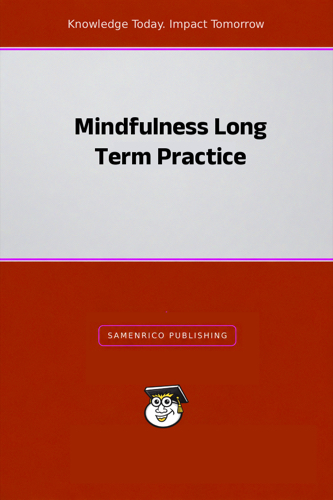
Mindfulness Long Term Practice eBook
Cultivates observing mind that doesn't react to em
Cultivates observing mind that doesn't react to emotions.
Formats
Free sample
Chapter 1: The Autopilot Trap--–- You are driving home from work on a route you have taken a thousand times. The radio is playing something forgettable. Your mind is already at home—replaying a tense conversation from the morning, worrying about tomorrow’s deadline, planning what to cook for dinner. Then, suddenly, you are in your driveway. You have no memory of the last ten minutes of turns, stop signs, or traffic lights.
Your body drove the car while your mind was somewhere else entirely.This is autopilot. And it is not harmless.That same autopilot that navigates your commute also navigates your emotional life. It is what makes you snap at your child for spilling milk—not because the milk matters, but because your mind was already stressed about something else. It is what makes you reach for your phone seventy times a day, each time without a conscious decision. It is what makes you eat an entire bag of chips while watching television and barely taste the first three.
It is what makes you lie awake at 2:00 a.m., your brain churning through the same anxious loop for the fortieth time, even though you know it helps nothing.Autopilot is efficient. It is also the primary source of most of your daily suffering.This book is about one thing and one thing only: waking up from autopilot. Not in a mystical, floating-on-a-cloud sense, but in a practical, trainable, scientifically validated way. It is about cultivating what we will call throughout these pages the observing mind—a part of your awareness that can watch your thoughts, emotions, and impulses without being swept away by them. The observing mind does not stop you from feeling anger, fear, or desire.
It changes your relationship to those experiences. Instead of being in the storm, you learn to witness the storm from a safe, dry place.The promise of this book is simple but profound: between any stimulus and your response, there is a gap. Most of the time, you live as if that gap does not exist. Mindfulness reveals the gap. And in that revelation, freedom begins.The Geography of a Reaction Let us slow down what actually happens when you react.Imagine you are walking through your home late at night in the dark.
Your foot brushes against something soft and warm on the floor. Before your conscious mind has even registered what your foot touched, your body has already reacted. Your heart rate spikes. Your muscles tense. Your breath catches.
You might gasp or leap backward.This is the reaction mind at work. It is ancient, fast, and powerful. It evolved to keep you alive. If that soft thing on the floor had been a snake, your body’s instant reaction might have saved your life. The problem is that the reaction mind cannot tell the difference between a snake and a sweater.
It cannot distinguish between a genuine physical threat and a mildly critical email from your boss. It cannot tell the difference between a growling predator and a teenager who just slammed a door.So it reacts to everything with the same urgency. And in the modern world, this constant state of low-grade emergency is exhausting and destructive.Now let us look at the same moment through the lens of neuroscience. The brain’s alarm system is called the amygdala—two small, almond-shaped clusters of neurons deep in the temporal lobes. The amygdala scans your environment constantly for threats.
It does this below the level of conscious awareness. When it detects something it has learned to associate with danger—a harsh tone of voice, a disapproving look, a memory of past failure—it sounds the alarm.That alarm triggers a cascade of physiological events. Your sympathetic nervous system activates. Stress hormones—cortisol and adrenaline—flood your bloodstream. Your heart pumps faster.
Your breathing becomes shallow and rapid. Blood flows away from your digestive system and toward your large muscles, preparing you to fight or flee. Your peripheral vision narrows. Your prefrontal cortex—the part of your brain responsible for rational decision-making, impulse control, and long-term planning—is partially shut down.This entire sequence takes less than a second. It happens before you have any conscious awareness of it.Only after the alarm has sounded does your conscious mind catch up.
And here is the crucial point: by the time your conscious mind arrives on the scene, the reaction is already underway. Your body is already tensed. Your breath is already shallow. Your emotions are already stirred. You are now in the position of trying to manage a reaction that has already begun.This is why willpower and good intentions often fail.
You cannot think your way out of a reaction that has already bypassed your thinking brain.The Gap That Changes Everything Viktor Frankl, the psychiatrist and Holocaust survivor, wrote these words in his book Man’s Search for Meaning: “Between stimulus and response there is a space. In that space is our power to choose our response. In our response lies our growth and our freedom.”Most people read that sentence and nod in agreement. It sounds wise and true. But here is the uncomfortable reality: for most of your life, you live as if that space does not exist.
A stimulus arrives—criticism, a loud noise, a text message from someone who upset you—and a response follows immediately, as if the two were welded together.You do not choose to be irritable. Irritability chooses you. You do not decide to worry. Worry decides to start, and then you are just along for the ride. You do not plan to scroll through social media for forty-five minutes.
You pick up your phone to check one thing, and then you look up and time has vanished.The space between stimulus and response is real. It is neurologically real. It is experientially real. But you have to train yourself to perceive it, and then you have to train yourself to widen it.That is what this entire book is about. Every chapter, every exercise, every concept is aimed at one goal: making that gap visible and then making it bigger.Let me give you a concrete example.You are in a meeting at work.
A colleague says something that you interpret as a criticism of your project. Your face flushes. Your jaw tightens. You feel the urge to defend yourself, to explain, to push back. In your untrained autopilot mode, you would open your mouth and words would come out—words you might regret, words that might escalate the situation, words that come from a place of threat rather than wisdom.But you have been practicing.
So in that moment, you notice the flush in your face. You feel the tightness in your jaw. You recognize the urge to speak. And instead of obeying that urge, you do something radical: you pause. You take one conscious breath.
That breath takes two seconds. In those two seconds, you have found the gap.Now you have a choice. You can still defend yourself. That is one option. Or you can ask a clarifying question.
Or you can say nothing and let the moment pass. Or you can acknowledge the feeling directly: “I notice I’m…
This is the end of the free sample. Get the eBook to keep going. Buy now
About this book
Details
- Author
- Gaddis Lashawna
- Publisher
- SamEnrico
- Language
- English
- Genre
- Non-Fiction, Self-Help, Mindfulness
- Released
- 2026-06-06
- Pages (approx.)
- 146
- Available as
- eBook, Audiobook

Read better in the ZLOADR app
Your eBooks on your phone or tablet. Sign in with your SamEnrico account and start reading.
More by Gaddis Lashawna
 Food Addiction Recovery for CouplesGaddis Lashawna$11.99
 Stress Management for Call Center WorkersGaddis Lashawna$11.99
 Scarcity Marketing GuideGaddis Lashawna$11.99
 The Silk Road Runners: Women's Endurance in 18th-Century AsiaGaddis Lashawna$11.99
 How to Produce Arrow NocksGaddis Lashawna$11.99
 Legal Notice Address TermsGaddis Lashawna$12.99
 Accounts Payable Team LeadGaddis Lashawna$11.99
 How to Become a Parachute InspectorGaddis Lashawna$11.99
You may also like
 Hong Kong Handover 1997Dunn Johnnie$11.99
 Zumba For Postnatal Recovery CourseNeal Christian$11.99
 Zumba for BeginnersLadner Nikia$11.99
 YouTube Comment Mining GuideHumes Pandora$12.99
 Worry Box MeditationCarlin Rudy$11.99
 Workplace Stress MeditationNguyen Lynn$11.99
 Workplace Stress and Sleep RepairHawley Ivory$11.99
 Workplace Perfectionism CureDelaney Jeffry$11.99
 Workplace Injustice Anger GuideWallen Isabelle$11.99
 Work Addiction and Burnout LinkGreenwood Ester$11.99
 Women in Yoga and WellnessBeattie Galina$11.99
 Women in Stand Up ComedyChun Evangeline$11.99