
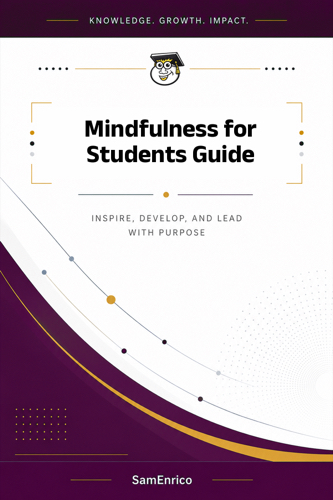
Non-FictionSelf-HelpStudent Mindfulness
Mindfulness for Students Guide eBook
Improve focus and reduce exam anxiety with beginne
Improve focus and reduce exam anxiety with beginner meditation using this guide.
Formats
Free sample
Chapter 1: The Broken Browser--–- You are sitting in the library. Or maybe at your desk. Or perhaps on your bed with a laptop balanced precariously on your knees. Your textbook is open to page forty-seven. You have been "studying" for forty-five minutes.
In that time, you have checked your phone eleven times. You have opened Instagram, closed it, and opened it again. You have thought about the email you haven't replied to. You have wondered what your ex is doing. You have planned your dinner.
You have worried about the exam that is still three weeks away. You have read the same sentence six times. You still do not know what it means.You close the book. You tell yourself you are lazy. You tell yourself you lack discipline.
You tell yourself that everyone else is managing just fine, and you are the broken one.This chapter exists to tell you that you are not broken. Your brain is doing exactly what brains evolved to do. The problem is not a character flaw. The problem is that your ancient neural hardware is trying to navigate a modern information environment it was never designed for. And once you understand why your brain behaves like a browser with thirty-seven tabs open, you can stop blaming yourself and start fixing the actual problem.Welcome to the first principle of mindfulness for students: distraction is not a sin.
It is a habit. And habits can be rewired.The Myth of the Perfectly Focused Student Before we go any further, let us name the ghost that haunts every student who struggles with focus. Somewhere inside you, there is an image of an Ideal Student. This mythical creature wakes up at 5:00 AM, drinks green tea, reviews flashcards before breakfast, attends every lecture with laser attention, never checks their phone during study sessions, and falls asleep peacefully at 10:00 PM knowing they have done everything perfectly.Here is the truth: that student does not exist.Even the highest-achieving students you know—the ones with the 4.0 GPAs and the prestigious internships—struggle with distraction. They simply have better strategies for noticing when their mind has wandered and returning it to the task at hand.
The difference between you and them is not a magical gene for concentration. It is a skill. And like any skill, it can be learned.The author of this book once taught a neuroscience student who could meditate for forty-five minutes with what appeared to be perfect focus. When asked about his practice, he laughed. "I spend forty-five minutes thinking about everything except my breath," he said.
"I think about groceries, arguments I had five years ago, what I will eat for dinner. The only difference now is that I notice it happening faster, and I don't get upset about it anymore."That is the secret. Not the absence of distraction. The speed of recovery.Your Brain: A Brief and Slightly Embarrassing Tour To understand why your focus falters, you need to understand a small piece of neuroscience. Do not worry.
There will not be a test. You do not need to memorize any Latin names. But there is one concept that will change how you see every wandering thought, every bout of procrastination, every moment of staring at a blank page.Your brain has something called the Default Mode Network (DMN).Think of the DMN as your brain's idle engine. When you are not actively engaged in a task—when you are walking to class, waiting in line, brushing your teeth, or even supposedly reading a textbook while your mind drifts—the DMN activates. It is the network responsible for mind-wandering, self-referential thought, and mental time travel (remembering the past and imagining the future).Here is what the DMN loves to do: worry.
Plan. Ruminate. Compare. Regret. Rehearse conversations that will never happen.
Replay conversations that already happened and went badly. The DMN is essentially your brain's built-in anxiety generator. From an evolutionary perspective, this was useful. If your ancestors spent their idle time worrying about where the next meal would come from or whether that rustle in the bushes was a predator, they were more likely to survive. The anxious ones lived.
The relaxed ones got eaten.But you are not living on the savanna. You are living in a world of deadlines, social media comparisons, tuition bills, and academic pressure. And your DMN is running constantly, generating an endless stream of thoughts about what you should be doing, what you are not doing, and how everyone else is doing it better.The DMN becomes particularly active during stress. When you are worried about an upcoming exam, your DMN runs in overdrive. And here is the cruel irony: the DMN is also the network that pulls you away from focused study.
So the more stressed you are about studying, the harder it becomes to actually study. You sit down with your textbook. Your DMN fires up. "Remember that time you failed a test in tenth grade? Remember how embarrassed you were?
What if that happens again? What if you fail this class? What if you never graduate? What if you end up living in your parents' basement forever?" Thirty minutes later, you have read nothing. You feel worse.
And you conclude that you are lazy.You are not lazy. You are fighting three hundred thousand years of evolution with zero training.Why "Just Try Harder" Is Terrible Advice Almost every student has received some version of this advice: "You just need to focus. Try harder. Apply yourself."This advice fails for one simple reason: willpower is not a muscle. It is a limited resource that depletes with use.Psychologists have known this since the late 1990s, when Roy Baumeister and his colleagues conducted a famous experiment involving radishes and chocolate chip cookies.
They brought hungry students into a room. One group was told to eat radishes while ignoring fresh-baked cookies. The other group was allowed to eat the cookies. Then both groups were given impossible puzzles to solve. The radish group gave up much faster.
Their willpower had been depleted by the effort of resisting cookies, leaving them with less energy for the puzzle.What does this have to do with studying? Everything. Every time you force yourself to ignore your phone, resist the urge to check email, or drag your attention back to a boring textbook, you are spending willpower. And willpower is finite. By the end of a long study day, you have very little left.
This is not a personal failing. This is biology.The solution is not to try harder. The solution is to stop relying on willpower entirely. Mindfulness does not require you to force your attention to stay put. It teaches you to notice when your attention has wandered and gently return it, without judgment, without self-criticism, without spending willpower on resistance.This is the fundamental insight that separates mindful focus from brute-force concentration.
Brute force says: "I will chain myself to this chair until I finish this chapter." Mindfulness says: "I will notice when my mind drifts. I will return to the page. I will do this again and again, with kindness, for as long…
This is the end of the free sample. Get the eBook to keep going. Buy now
About this book
Details
- Author
- Poindexter Debroah
- Publisher
- SamEnrico
- Language
- English
- Genre
- Non-Fiction, Self-Help, Student Mindfulness
- Released
- 2026-06-06
- Pages (approx.)
- 155
- Available as
- eBook, Audiobook

Read better in the ZLOADR app
Your eBooks on your phone or tablet. Sign in with your SamEnrico account and start reading.
More by Poindexter Debroah
 The Phthalate Prevention GuidePoindexter Debroah$11.99
 The Dahlia Medical Examiner NotesPoindexter Debroah$11.99
 Burnout Recovery WorkbookPoindexter Debroah$11.99
 The Phantom of the Rio: The Escape Artist Who Fooled ProhibitionPoindexter Debroah$11.99
 National BuyerPoindexter Debroah$11.99
 TikTok Skin Care RoutinePoindexter Debroah$12.99
 How to Produce Belt AccessoriesPoindexter Debroah$11.99
 How to Become a Glaze HandlerPoindexter Debroah$11.99
You may also like
 Hong Kong Handover 1997Dunn Johnnie$11.99
 Zumba For Postnatal Recovery CourseNeal Christian$11.99
 Zumba for BeginnersLadner Nikia$11.99
 YouTube Comment Mining GuideHumes Pandora$12.99
 Worry Box MeditationCarlin Rudy$11.99
 Workplace Stress MeditationNguyen Lynn$11.99
 Workplace Stress and Sleep RepairHawley Ivory$11.99
 Workplace Perfectionism CureDelaney Jeffry$11.99
 Workplace Injustice Anger GuideWallen Isabelle$11.99
 Work Addiction and Burnout LinkGreenwood Ester$11.99
 Women in Yoga and WellnessBeattie Galina$11.99
 Women in Stand Up ComedyChun Evangeline$11.99