
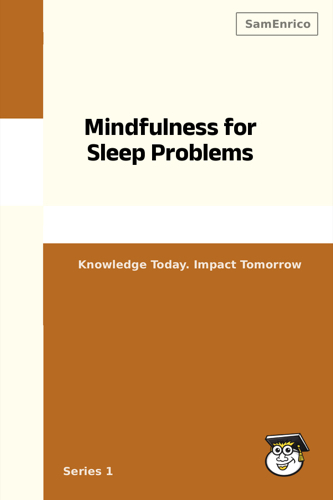
Non-FictionSelf-HelpSleep Hygiene
Mindfulness for Sleep Problems eBook
MBSR practices to quiet racing thoughts and prepar
by Hamby Alise
MBSR practices to quiet racing thoughts and prepare for restful sleep.
Formats
Free sample
Chapter 1: The 3 AM Spiral--It is 3:17 in the morning. You have been staring at the ceiling for forty-seven minutes, or perhaps it has been four hours—time has lost its shape. Your heart is beating faster than it should for someone lying perfectly still. Your mind is not still at all. It is replaying a mistake you made at work three days ago, then projecting it into a catastrophe that will unfold tomorrow, then jumping to a worry about your health because you cannot sleep, then circling back to the mistake again.
This is not thinking. This is a spiral. And you are trapped inside it.If you are reading this book, you know this scene intimately. Perhaps it happens every night. Perhaps it happens only once a week, but that is enough to fill your days with dread as the sun goes down.
Perhaps you have tried everything: lavender oil, white noise machines, melatonin gummies, sleep trackers, early bedtimes, late bedtimes, no caffeine after noon, warm milk, cold rooms, weighted blankets, and the desperate prayers of a person who would trade almost anything for eight uninterrupted hours.None of it has worked. Not because you are doing it wrong. Not because you are broken. But because you have been fighting the wrong enemy.The enemy is not wakefulness. The enemy is the story you tell yourself about wakefulness.This chapter will show you why your brain turns against you in the dark, why counting sheep is a waste of breath, and why the first and most radical step toward restful sleep is something you can do right now, in this moment, without changing anything at all.The Universal Experience of the 3 AM Mind Let us name what happens at 3 AM, because naming is the first form of taming.Clinical sleep medicine calls it "sleep maintenance insomnia"—the inability to stay asleep through the night.
But that clinical language misses the terror of it. The 3 AM wake-up is different from difficulty falling asleep at the beginning of the night. When you cannot fall asleep at 11 PM, you are still somewhat rational. You can tell yourself, "It's early. I still have time." But when you wake at 3 AM, the night is half over.
The pressure is immense. The clock is ticking. And your prefrontal cortex—the part of your brain responsible for rational thought, impulse control, and perspective-taking—is offline.What is online instead is your amygdala. The amygdala is the brain's smoke detector. It does not reason.
It does not negotiate. It only detects threats and sounds the alarm. And here is the cruel irony: for the chronically sleepless person, the brain has learned to treat wakefulness itself as a threat.Think about that. Your brain is not worried about a predator outside your cave. It is not worried about a rival tribe stealing your food.
It is worried about the fact that you are awake. And because it is worried, it releases cortisol and norepinephrine—the identical stress hormones that would flood your system if you were facing an actual physical danger. Your heart races. Your muscles tense. Your attention narrows to a laser focus on every possible bad outcome.
And then you lie there, in the dark, in a bed that is supposed to be your sanctuary, feeling exactly as alert as you would feel if someone were trying to break into your home.This is not a moral failure. This is not a sign of weakness. This is a neurological misfire. Your ancient survival brain does not understand that you are safe. It only understands that something is wrong, and it will keep screaming until you either fall asleep (which you cannot force) or convince it otherwise (which you have not yet learned how to do).The Neuroscience of Hyperarousal Let me be precise about what is happening inside your skull, because precision dissolves shame.The human brain has a network called the salience network.
It includes the amygdala, the insula, and the anterior cingulate cortex. Its job is to scan the environment—both external and internal—for anything that matters. Most of the time, it operates quietly in the background. But when it detects something it considers threatening, it lights up like a Christmas tree and hijacks your attention.In people with chronic insomnia, the salience network is hyperactive. Studies using functional MRI have shown that when insomniacs are lying in a dark scanner, trying to rest, their amygdalae show more activity than good sleepers who are being shown frightening images.
In other words, a sleepless person at rest has a more reactive threat-detection system than a well-rested person watching horror movies.This is what researchers call hyperarousal. It is a state of physiological and cortical alertness that persists even when you are exhausted, even when you are lying down, even when every rational part of you knows you need to sleep. Hyperarousal is the engine of the 3 AM spiral. And it is self-reinforcing: the more you experience it, the more your brain learns to expect it, and the more your brain expects it, the faster it triggers it.You can think of hyperarousal as a smoke detector that has been installed too close to the toaster. Every time you make toast, the alarm goes off.
You cannot stop making toast—wakefulness is inevitable for all humans. But you can learn to recalibrate the alarm. You can teach your brain that wakefulness is not a fire.Why Counting Sheep Fails (And What to Do Instead)Let me tell you why counting sheep is a beloved but useless remedy.The logic seems sound: if you fill your mind with a simple, repetitive task, you will crowd out anxious thoughts and drift toward sleep. The problem is that counting activates the verbal, analytical, sequential parts of your brain—specifically the left prefrontal cortex and the language centers. These are the exact regions that keep you awake.
You are essentially pouring gasoline on the fire and wondering why the fire is still burning.What you need instead is to deactivate the verbal mind and activate the sensory mind. This is why the MBSR (Mindfulness-Based Stress Reduction) approach is so radically different from traditional sleep hygiene advice. MBSR does not ask you to stop thinking. It asks you to change what you do with your thoughts. It does not ask you to force sleep.
It asks you to create the conditions for sleep to arrive on its own, like a cat that only approaches when you stop calling it.The most important word in that last sentence is "force." You cannot force sleep. No one can. Sleep is not an action; it is a surrender. It is the opposite of effort. When you try to sleep, you are actually doing the one thing that guarantees you will stay awake.
This is the Performance Paradox, which we will explore in depth in Chapter 2. For now, simply hold this counterintuitive truth: The more you try, the less you succeed.The First MBSR Invitation: Noticing Without Labeling This chapter ends with a practice. But before we get there, I need you to understand what this practice is not.It is not a relaxation technique. It…
This is the end of the free sample. Get the eBook to keep going. Buy now
About this book
Details
- Author
- Hamby Alise
- Publisher
- SamEnrico
- Language
- English
- Genre
- Non-Fiction, Self-Help, Sleep Hygiene
- Released
- 2026-06-07
- Pages (approx.)
- 145
- Available as
- eBook, Audiobook

Read better in the ZLOADR app
Your eBooks on your phone or tablet. Sign in with your SamEnrico account and start reading.
More by Hamby Alise
 Cousteau's Ganges ExplorationHamby Alise$11.99Cousteau's Ganges ExplorationHamby Alise$11.99
 Weasel Words Influence GuideHamby Alise$11.99
 Manipulative AI Systems BanHamby Alise$11.99
 Restless Leg Syndrome Natural RemediesHamby Alise$11.99
 Six Days of Thunder: Israel's Lightning Strike in 1967Hamby Alise$11.99
 Talent Shortage Hotspots GuideHamby Alise$12.99
 Process Mapping Prompt WorkbookHamby Alise$12.99
 How to Start a Bus Cleaning (non- Specialised) Business (Beginners Guide)Hamby Alise$11.99
 Understanding Keratoderma Palmoplantar Spastic ParalysisHamby Alise$17.99
 Strategy and Operations ManagerHamby Alise$11.99
You may also like
 Hong Kong Handover 1997Dunn Johnnie$11.99
 Zumba For Postnatal Recovery CourseNeal Christian$11.99
 Zumba for BeginnersLadner Nikia$11.99
 YouTube Comment Mining GuideHumes Pandora$12.99
 Worry Box MeditationCarlin Rudy$11.99
 Workplace Stress MeditationNguyen Lynn$11.99
 Workplace Stress and Sleep RepairHawley Ivory$11.99
 Workplace Perfectionism CureDelaney Jeffry$11.99
 Workplace Injustice Anger GuideWallen Isabelle$11.99
 Work Addiction and Burnout LinkGreenwood Ester$11.99
 Women in Yoga and WellnessBeattie Galina$11.99
 Women in Stand Up ComedyChun Evangeline$11.99