

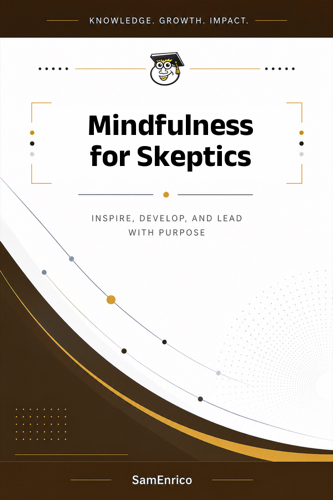
Mindfulness for Skeptics eBook
Presents secular, science based meditation without
by Reeder Mario
Presents secular, science based meditation without spiritual terminology.
Formats
Free sample
Chapter 1: Your Brain’s Broken Record--–- Let’s run a quick experiment. Stop reading for exactly three seconds. Don’t just skim past this instruction. Actually stop. Look at the wall, the window, your own hands.
Three seconds of nothing. Go.Welcome back. What happened in those three seconds? For almost everyone, something happened. Maybe you thought, “This is stupid.” Maybe you started planning what you’re doing later today.
Maybe you felt your phone buzz in your pocket and wondered who texted. Maybe you rehearsed an old argument from three years ago or worried about a meeting that hasn’t happened yet.Very few people experienced three seconds of pure, silent, present-moment awareness. And that’s not because you’re broken. It’s because your brain has a design flaw.Here’s the most important number you will read in this entire book: forty-seven percent. According to a landmark Harvard study by psychologists Matthew Killingsworth and Daniel Gilbert, the human mind wanders forty-seven percent of waking hours.
That means nearly half your life—half your conscious experience on this planet—you are not paying attention to what you are actually doing. You are somewhere else. And here is the kicker: when the researchers tracked people’s happiness in real time, they found that a wandering mind is reliably an unhappy mind. Not sometimes. Not for some people.
Reliably. Across twenty-two thousand measurements, people were consistently less happy when their minds were wandering than when they were focused on whatever they were doing, even if what they were doing was boring or unpleasant.Think about that for a moment. You could be stuck in traffic, actively paying attention to the road, and you would be statistically happier than if you were stuck in traffic while mentally rehearsing a work conflict. The problem is not your circumstances. The problem is where your brain goes when you are not steering it.This chapter is about why your brain does that, why it is not your fault, and why understanding the mechanism is the first step toward fixing it.
We are going to name the enemy, map its territory, and stop blaming ourselves for a biological machine that was never designed for the twenty-first century.The Machine They Didn’t Tell You About Neuroscience has a name for the brain network responsible for mind-wandering, rumination, self-criticism, and mental time travel. It is called the Default Mode Network, or DMN for short. The name itself tells you something important: “default” mode. This is not a bug that shows up when you are tired or stressed. This is the brain’s factory setting, the resting state it returns to automatically whenever you are not actively engaged in an external task.The DMN is a connected set of brain regions including the medial prefrontal cortex, the posterior cingulate cortex, and parts of the temporal lobes.
When you are focused on a demanding task—solving a math problem, following a recipe, having a conversation—these regions quiet down. The brain’s “task-positive networks” take over. But the moment your attention loosens, the DMN lights up like a Christmas tree. It begins generating what neuroscientists call “stimulus-independent thoughts”: thoughts that have nothing to do with what is actually happening around you.Here is what the DMN produces on a typical day.First, mental time travel. Your brain constantly projects you into the past and future.
It replays old conversations and imagines future ones. It relives embarrassments from high school and rehearses presentations for next week. This ability to time travel is evolutionarily useful—you need to learn from the past and plan for the future—but the DMN does not know when to stop. It runs constantly, even when there is nothing useful to learn or plan.Second, self-referential thinking. The DMN is the neural substrate of the “me” voice.
It generates the running commentary about whether you are doing well or poorly, whether people like you, whether you measure up. This is where self-criticism lives. “I should have said something different.” “Why did I eat that?” “They probably think I am incompetent.” The DMN does not produce neutral observations. It produces evaluations, judgments, and comparisons.Third, rumination. When the DMN gets stuck, it loops.
It takes a problem or a regret and spins it over and over without resolution. Depression and anxiety are strongly correlated with a hyperactive DMN that cannot disengage. The same neural machinery that helps you solve problems becomes a trap when it will not shut off.The critical insight for a skeptic is this: your inner critic is not a spiritual failure. It is not a sign that you are insufficiently enlightened or that you have bad karma. It is a biological machine running on autopilot.
And like any machine, it can be understood, calibrated, and overridden.The Savanna in Your Skull To understand why the DMN behaves this way, you need to understand mismatch theory. Your brain evolved over hundreds of thousands of years on the African savanna. It was designed to solve the problems of a hunter-gatherer existence: finding food, avoiding predators, navigating small-group social dynamics. That brain worked brilliantly. It kept your ancestors alive long enough to pass down their genes.But that brain is now living in a world it never anticipated.
The savanna had no smartphones, no email, no social media, no quarterly performance reviews, no traffic jams, no twenty-four-hour news cycles. The savanna had immediate, physical threats. A rustle in the grass might be a lion. A rival tribe member might be a genuine danger. The brain evolved to treat social slights as survival threats because in small-band hunter-gatherer societies, being ostracized could mean death.Now fast forward to today.
Your boss sends a curt email. The DMN interprets this as a social threat. Your amygdala—the brain’s alarm system—activates. Your sympathetic nervous system releases cortisol and adrenaline. Your body prepares for fight or flight.
But there is no lion. There is no rival with a spear. There is just an email. The physiological response is completely mismatched to the actual danger.The savanna brain also evolved for acute, brief stressors. A predator appears.
You fight or flee. The event ends in minutes. Then you rest. Today, your stressors are chronic and low-grade. The mortgage.
The relationship tension. The never-ending inbox. The DMN keeps the threat-detection system running at a low hum all day, every day. This is what we call “stress,” but it is really just a mismatch between an ancient brain and a modern world.This is not a metaphor. This is evolutionary biology.
Your brain is not broken. It is doing exactly what it evolved to do. The problem is that it evolved for a world that no longer exists.The Happiness Data The Killingsworth and Gilbert study deserves a closer look because its findings are counterintuitive and profound. The researchers developed a smartphone app that contacted participants at random intervals throughout the day. When the app pinged, participants reported what they were doing, whether their minds were wandering, and how they felt.
The study collected over two hundred fifty thousand data points from more than five thousand participants.The results were striking. People’s…
This is the end of the free sample. Get the eBook to keep going. Buy now
About this book
Details
- Author
- Reeder Mario
- Publisher
- SamEnrico
- Language
- English
- Genre
- Non-Fiction, Self-Help, Science
- Released
- 2026-06-09
- Pages (approx.)
- 144
- Available as
- eBook, Audiobook

Read better in the ZLOADR app
Your eBooks on your phone or tablet. Sign in with your SamEnrico account and start reading.
More by Reeder Mario
 The Nun Who Became a SaintReeder Mario$11.99
 No Field Trip Permission SlipReeder Mario$11.99
 H2S SIBO TreatmentReeder Mario$11.99
 Nightmare and Chronic PainReeder Mario$11.99
 Hungarian Reformation Ottoman Alliance GuideReeder Mario$11.99
 The Assertiveness Anxiety ProtocolReeder Mario$11.99
 Costco Sample to Cart LinkReeder Mario$11.99
 Advance Care Planning GuideReeder Mario$11.99
 The Pathfinders: Simon Fraser and the Birth of British ColumbiaReeder Mario$11.99
 Echoes from the Edge: The Day the Internet Almost DiedReeder Mario$11.99
 Black Gold and Blood: The Untold War Over Nigeria's OilReeder Mario$11.99
 Understanding Acro Coxo Mesomelic DysplasiaReeder Mario$17.99
You may also like
 Hong Kong Handover 1997Dunn Johnnie$11.99
 Zumba For Postnatal Recovery CourseNeal Christian$11.99
 Zumba for BeginnersLadner Nikia$11.99
 YouTube Comment Mining GuideHumes Pandora$12.99
 Worry Box MeditationCarlin Rudy$11.99
 Workplace Stress MeditationNguyen Lynn$11.99
 Workplace Stress and Sleep RepairHawley Ivory$11.99
 Workplace Perfectionism CureDelaney Jeffry$11.99
 Workplace Injustice Anger GuideWallen Isabelle$11.99
 Work Addiction and Burnout LinkGreenwood Ester$11.99
 Women in Yoga and WellnessBeattie Galina$11.99
 Women in Stand Up ComedyChun Evangeline$11.99