
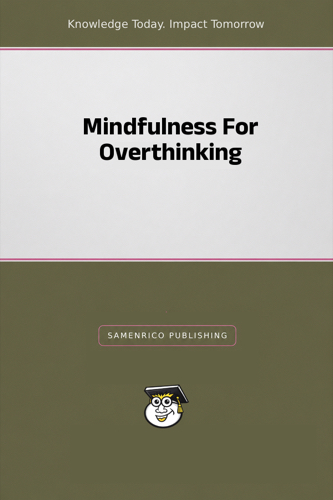
Non-FictionSelf-HelpRumination
Mindfulness For Overthinking eBook
Break rumination cycles by noticing repetitive tho
Break rumination cycles by noticing repetitive thought patterns without engagement.
Formats
Free sample
Chapter 1: The 3 AM Spiral--The ceiling stares back at you. You’ve counted every crack, every shadow, every imperfection in the plaster. The clock on your nightstand reads 3:14 AM, then 3:15, then 3:16. Your brain, which was mercifully quiet when you laid down at 11 PM, is now a stadium filled with screaming voices. That thing you said in a meeting eight months ago?
Replaying in high definition. That text message your friend left on read for six hours? You’ve constructed fourteen possible explanations, each worse than the last. The email you have to send tomorrow morning? You’ve rewritten it seventeen times in your head, and you’re already anticipating the worst possible reply.You are not sleeping.
You are not resting. You are running a marathon inside your own skull.This is the 3 AM spiral. And if you’re reading this book, you know it intimately.Here’s what makes the spiral so cruel: the harder you try to solve the problem—the more effort you pour into thinking your way out—the deeper you sink. You tell yourself, “I just need to figure this out.” So you think harder. You replay the conversation again, searching for the clue you missed.
You run the numbers, the possibilities, the outcomes. And with each pass, your chest gets tighter, your jaw clenches further, and sleep retreats another thousand miles away.By 4 AM, you’re not solving anything. You’re spinning.This chapter is about why that happens. More importantly, it’s about why your best efforts to stop overthinking are actually making it worse—and what to do instead. Spoiler: the answer is not better thinking.
It’s something far simpler, and far harder. It’s learning to stop wrestling with your thoughts and start watching them instead.The Paradox of Effort Let me tell you about Sarah.Sarah is a thirty-two-year-old graphic designer. She’s good at her job—detail-oriented, thorough, the kind of person who catches mistakes everyone else misses. Two weeks before she came to see me, she sent a text message to a close friend: “Hey, are we still on for coffee Saturday?”Her friend replied, “Yeah, let’s catch up then.”That was it. No exclamation point.
No emoji. No “Can’t wait!” Just four words and a period.By 3 AM that night, Sarah had constructed a full-blown crisis. She reread the text exchange forty-seven times (she counted). She scrolled through previous conversations to see if her friend had always used periods or if this was new. She checked her friend’s social media to see if she’d posted anything happy or sad.
She drafted six follow-up texts, deleted them all, then re-read the original exchange again.She spent three hours trying to figure out if her friend was angry with her.Here’s what Sarah did not do: sleep. Here’s what Sarah did not do: ask her friend directly. Here’s what Sarah did not do: feel better by morning. In fact, she felt worse—exhausted, ashamed of how much time she’d wasted, and somehow even more convinced that something was wrong.Sarah’s story is not unusual. It’s not a sign of mental illness or weakness.
It’s a perfect example of what psychologists call the paradox of effort: the more energy you put into controlling or suppressing your thoughts, the more those thoughts control you.This paradox has been demonstrated in laboratories for decades. In one famous study from the late 1980s, participants were told not to think about a white bear. That’s it. Just don’t think about a polar bear for five minutes. What happened?
They thought about the white bear once every minute on average. They couldn’t stop. Then, when the suppression period ended and they were allowed to think about anything, they thought about the white bear even more than a control group who had never been asked to suppress. The act of trying not to think about something made it hyper-accessible, like a locked door that everyone suddenly wants to open.This is the ironic rebound effect—the brain’s cruel sense of humor. When you try to suppress a thought, your brain has to do two things at once.
First, it has to search for anything other than the forbidden thought (the “operating process”). Second, it has to unconsciously check whether the forbidden thought has appeared (the “monitoring process”). That monitoring process backfires. It keeps the thought right at the edge of awareness, ready to spring forward the moment your attention flags.You’ve experienced this. Someone says, “Don’t think about your ex.” What’s the first thing you see?
Your ex’s face. Someone says, “Try not to worry about the presentation.” What happens? You worry about the presentation. The instruction to suppress is actually a trigger to obsess.Sarah wasn’t trying to suppress her worry. She was trying to solve it.
She believed that if she just thought hard enough, she would find the answer, and the anxiety would go away. This is the second trap: mistaking rumination for problem-solving.The Problem-Solving Trap Here is a distinction that will save you hundreds of hours of lost sleep: problem-solving and rumination are not the same thing.Problem-solving is goal-directed, time-limited, and action-oriented. It follows a clear sequence: define the problem, generate possible solutions, evaluate the options, choose one, take action, then stop. Problem-solving ends with a decision or a behavior. You might spend twenty minutes figuring out the best route to work.
You pick one. You drive. You’re done.Rumination looks similar on the surface but is fundamentally different. Rumination is repetitive, passive, abstract, and focused on distress rather than solutions. It asks questions that have no answers: “Why did she say it that way?” “What does it mean about me?” “What if I’m actually a terrible person and everyone secretly knows it?” Rumination doesn’t end.
It loops. Each pass through the thought feels productive—you’re working on it, after all—but nothing changes. The thought is the same. The feeling is worse.The psychologist Susan Nolen-Hoeksema spent decades studying rumination, particularly in the context of depression. She found that people who ruminate don’t just feel sad longer; they also generate fewer effective solutions to problems.
They get stuck in abstract, unanswerable questions about why something happened rather than concrete, solvable questions about how to respond.Here’s the kicker: rumination feels like problem-solving. Your brain releases small hits of dopamine when you replay a memory or rehearse a future conversation because it interprets the activity as “working on a threat.” But you’re not working. You’re spinning. The hamster wheel is a brilliant metaphor: the hamster runs faster and faster, sweat flying, heart pounding, convinced that if it just runs a little harder, it will reach the destination. But the wheel never moves.
The hamster mistakes motion for progress.Sarah was on that wheel. She believed that if she just reviewed the text message one more time, she would find the clue she’d missed. But there was no clue. There was only a four-word reply that meant nothing. Her friend wasn’t angry.…
This is the end of the free sample. Get the eBook to keep going. Buy now
About this book
Details
- Author
- Stanley Shannon
- Publisher
- SamEnrico
- Language
- English
- Genre
- Non-Fiction, Self-Help, Rumination
- Released
- 2026-06-06
- Pages (approx.)
- 124
- Available as
- eBook, Audiobook

Read better in the ZLOADR app
Your eBooks on your phone or tablet. Sign in with your SamEnrico account and start reading.
More by Stanley Shannon
 The Grocery Store Impulse TrapStanley Shannon$11.99
 Louis Bacon MooreStanley Shannon$11.99
 The Nobel Medicine ImmunologyStanley Shannon$11.99
 Physics Nobel Genius Stories GuideStanley Shannon$11.99
 Self Talk for CreativesStanley Shannon$11.99
 Mouth Covering Gesture GuideStanley Shannon$11.99
 Anapanasati After WakingStanley Shannon$11.99
 The Maid of the Dardanelles: A Heroine’s Stand in the War of Austrian SuccessionStanley Shannon$11.99
 The Falklands: Blood and Ice in the South AtlanticStanley Shannon$11.99
 The Unseen Hand: How Frida Kahlo Painted Her PainStanley Shannon$11.99
 Growing ConandronStanley Shannon$11.99
 How to Produce Body Painting SuppliesStanley Shannon$11.99
You may also like
 Hong Kong Handover 1997Dunn Johnnie$11.99
 Zumba For Postnatal Recovery CourseNeal Christian$11.99
 Zumba for BeginnersLadner Nikia$11.99
 YouTube Comment Mining GuideHumes Pandora$12.99
 Worry Box MeditationCarlin Rudy$11.99
 Workplace Stress MeditationNguyen Lynn$11.99
 Workplace Stress and Sleep RepairHawley Ivory$11.99
 Workplace Perfectionism CureDelaney Jeffry$11.99
 Workplace Injustice Anger GuideWallen Isabelle$11.99
 Work Addiction and Burnout LinkGreenwood Ester$11.99
 Women in Yoga and WellnessBeattie Galina$11.99
 Women in Stand Up ComedyChun Evangeline$11.99