
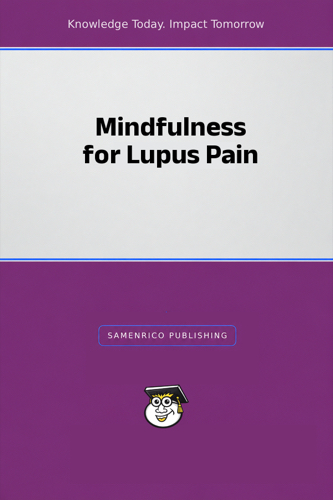
Mindfulness for Lupus Pain eBook
Manage autoimmune flare pain and fatigue through m
by Neville Rubi
Manage autoimmune flare pain and fatigue through meditation.
Formats
Free sample
Chapter 1: The Cortisol Trap--–- You wake up before your alarm. Not because you are well-rested, but because your body feels like it has been hit by a truck. Your joints are stiff. Your jaw is sore from clenching all night. Your mind is already racing through the list of things you were supposed to do yesterday but could not because you were too exhausted.
And then comes the thought—the one that haunts every lupus patient at some point: Did I cause this? Was it the stress? If I had just relaxed more, would my body be functioning right now?Here is the answer you have been looking for, and it comes in two parts. Part one: No, you did not cause your lupus. Lupus is an autoimmune disease with genetic, hormonal, and environmental triggers that are largely outside your control.
You did not bring this upon yourself through worry or overwork. Part two: Yes, chronic stress may be the match that lights the gasoline. And this is not your fault either—it is biology. The goal of this chapter is to help you understand exactly how stress becomes inflammation, why your nervous system may be stuck in a danger loop, and how mindfulness can help you step off that treadmill without adding more shame to the load.The first thing to understand is that stress is not a weakness or a character flaw. It is a survival mechanism.
Tens of thousands of years ago, when a saber-toothed tiger appeared, your body's stress response—known as the fight-or-flight response—saved your life. Your heart rate increased. Blood rushed to your muscles. Your immune system prepared to heal wounds. And once the tiger was gone, your body returned to a resting state.
This is how the system is supposed to work.But lupus changes the rules. For reasons that researchers are still working to understand, the stress response in lupus patients does not turn off properly. The tiger is gone, but the alarm keeps ringing. And over time, this chronic activation of the stress response begins to directly fuel the inflammation that drives your symptoms.Let us walk through the biology, because understanding this will change how you see your own body.Deep inside your brain, a small region called the hypothalamus acts as the command center for your stress response. When you perceive a threat—whether it is a real physical danger or a worrying email from your boss—the hypothalamus sends a signal to your pituitary gland, which then signals your adrenal glands to release cortisol.
Cortisol is often called the stress hormone, but it is also one of your body's most powerful natural anti-inflammatory agents. In a healthy person, cortisol rises quickly during stress and then falls quickly, taking inflammation down with it.In lupus patients, however, research shows a blunted cortisol response. Your body produces cortisol, but over time, your cells become resistant to it—similar to what happens with insulin in type 2 diabetes. The cortisol is there, but your cells no longer listen to its anti-inflammatory commands. This means that when you experience stress, the resulting inflammation has no natural off switch.
It just keeps burning.This is not speculation. Studies have shown that lupus patients have higher baseline levels of pro-inflammatory cytokines—proteins like interleukin-6 and tumor necrosis factor-alpha—than healthy controls. These are the same molecules that drive the pain, fatigue, and organ damage in lupus. And chronic stress raises them even further. One study of lupus patients found that those who reported higher levels of daily stress had significantly higher disease activity scores measured by their rheumatologists—not just by their own subjective ratings.There is another layer to this that is difficult to talk about but essential to name.
Research has consistently found that lupus patients have higher rates of childhood trauma, post-traumatic stress disorder, and adverse childhood experiences than the general population. This does not mean that trauma causes lupus. What it means is that early-life stress can sensitize your HPA axis—the hypothalamic-pituitary-adrenal system—so that it becomes hyper-reactive to stress later in life. Your nervous system was trained in a difficult environment to expect danger around every corner. And now, even though the original danger may be long gone, your body still responds to a late bill or a missed phone call as if it were a life-threatening event.Many lupus patients also worry about the so-called Type A personality—the idea that hard-driving, ambitious, perfectionistic people are more prone to autoimmune disease.
This chapter wants to be very clear: that idea has largely been debunked. Lupus does not discriminate by personality type. However, there is a relevant pattern that affects many people with lupus, regardless of their baseline temperament. High-achieving, conscientious people—the ones who have always pushed through fatigue, who have never allowed themselves to rest, who have built their identities around productivity—often ignore early warning signs. They push through the low-grade fever.
They push through the morning stiffness. They tell themselves that resting is lazy. And by the time they finally stop, the flare is already inevitable.Mindfulness is often marketed as a relaxation technique, and that is a problem. If you have lupus, and someone tells you to just relax, you may feel a surge of anger. Relax?
You have been trying to relax for years. You have tried bubble baths and deep breathing and expensive supplements. Relaxation is not the issue. What you need is not a way to escape stress but a way to intercept it before it becomes a flare. This is the fundamental reframing that this book offers.
Mindfulness is not learning to relax. Mindfulness is learning to listen. It is training your attention so that you can catch the earliest signals of stress—the clenched jaw, the shallow breathing, the racing thoughts—before they cascade into a full inflammatory response.Think of it this way. Your nervous system has been over-trained for danger. It is like a smoke alarm that has been set to the most sensitive setting.
The smoke alarm is not broken. It is doing exactly what it was designed to do. The problem is that the setting is wrong for the environment you are in now. Mindfulness is the tool that allows you to recalibrate that setting. You do not need to tear out the alarm.
You just need to adjust the sensitivity.The research on mindfulness and cortisol is actually quite encouraging. Multiple randomized controlled trials have shown that mindfulness-based stress reduction can lower cortisol levels by 20 to 30 percent after as little as one week of daily practice. One study of patients with autoimmune diseases found that those who completed an eight-week MBSR program had significantly lower levels of inflammatory markers and reported less fatigue and pain than those who did not. Another study followed lupus patients specifically and found that MBSR reduced not only perceived stress but also disease activity as measured by standard rheumatology indices.This is not about positive thinking. It is not about pretending that your pain does not exist or that your life is easy when it is not.
The patients in these studies were not cured. They still had lupus. They still had flares. But they reported something…
This is the end of the free sample. Get the eBook to keep going. Buy now
About this book
Details
- Author
- Neville Rubi
- Publisher
- SamEnrico
- Language
- English
- Genre
- Non-Fiction, Self-Help, Lupus
- Released
- 2026-06-09
- Pages (approx.)
- 143
- Available as
- eBook, Audiobook

Read better in the ZLOADR app
Your eBooks on your phone or tablet. Sign in with your SamEnrico account and start reading.
More by Neville Rubi
 Data Leak Vendor Breach Notification TemplatesNeville Rubi$11.99
 Pinterest VA For Wedding ProsNeville Rubi$11.99
 The Meeting Chat Etiquette GuideNeville Rubi$11.99
 Breast Cancer Mental Health GuideNeville Rubi$11.99
 The Frozen Spice Trail: Antarctica's Forgotten ExpeditionsNeville Rubi$11.99
 The Clockwork Dreamer: How a 14-Year-Old Built the First Steam-Powered CarNeville Rubi$11.99
 Understanding Coleman–randall SyndromeNeville Rubi$17.99
 How to Start a Shovel Loaders Business (Beginners Guide)Neville Rubi$11.99
 Compliance ManagerNeville Rubi$11.99
 Safe Notes Vs Convertible GuideNeville Rubi$12.99
 Board Preparation BlockNeville Rubi$12.99
You may also like
 Hong Kong Handover 1997Dunn Johnnie$11.99
 Zumba For Postnatal Recovery CourseNeal Christian$11.99
 Zumba for BeginnersLadner Nikia$11.99
 YouTube Comment Mining GuideHumes Pandora$12.99
 Worry Box MeditationCarlin Rudy$11.99
 Workplace Stress MeditationNguyen Lynn$11.99
 Workplace Stress and Sleep RepairHawley Ivory$11.99
 Workplace Perfectionism CureDelaney Jeffry$11.99
 Workplace Injustice Anger GuideWallen Isabelle$11.99
 Work Addiction and Burnout LinkGreenwood Ester$11.99
 Women in Yoga and WellnessBeattie Galina$11.99
 Women in Stand Up ComedyChun Evangeline$11.99