
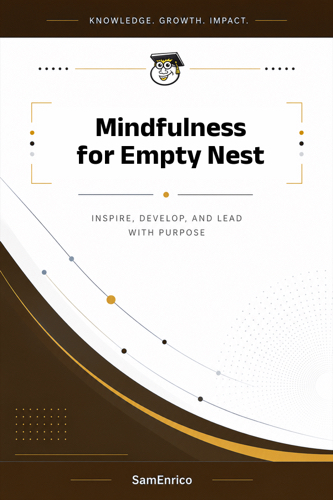
Mindfulness for Empty Nest eBook
Cope when children leave home.
by Johnson Joan
Cope when children leave home.
Formats
Free sample
Chapter 1: The Repotted Life...--–- The first time I cried in a grocery store, it wasn’t because I missed my daughter. It was because I didn’t know who I was without a shopping list for her.I stood in the produce section, staring at a bag of oranges that I had no reason to buy. For eighteen years, I had known exactly how many oranges to purchase—three, because she ate one every morning before school. But she had left for college three weeks ago, and I was still reaching for oranges. My hand hovered over the bag, then retreated.
I felt a strange, hollow vertigo, as if the fluorescent lights had suddenly revealed that the floor beneath me was not solid ground but a painted stage.I walked out with nothing. Not because I didn’t need food, but because I had forgotten how to shop for only myself.That night, I sat in my car in the driveway for twenty minutes before I could go inside. The house was not empty in the way a house is empty when no one is home. It was empty in the way a body is empty after an organ has been removed—still functioning, still breathing, but missing something that had once been essential to its survival.This is the experience of the empty nest. And if you are reading this, you already know it.The Lie We Have Been Told Our culture has a script for empty nest parents, and it goes something like this: Be proud.
Enjoy your freedom. Take a trip. Join a gym. This is your time now.On the surface, these sentiments are kind. Underneath, they are devastating.
They tell you that your grief is inappropriate, that your disorientation is a failure of gratitude, and that the appropriate response to the departure of your child is a kind of cheerful resignation followed by immediate self-improvement.I want to say something that no one else will say to you: It is okay to feel like you have been uprooted.Not just sad. Not just lonely. But genuinely, existentially unmoored. Because you have been.For nearly two decades—perhaps longer—your life has been organized around the needs, schedules, and presence of another human being. Your morning alarm was set to their school start time.
Your grocery list was written in their preferred snacks. Your weekends were a negotiation of their activities. Your body learned to wake at the sound of their cough, to tense at the click of their door, to relax only when you heard their key in the lock.And now, suddenly, none of that is true.You are not failing at the empty nest. You are experiencing a psychological displacement. And the first step toward healing is not to feel better.
The first step is to stop pretending you aren’t hurt.The Plant Metaphor: Why “Repotting” Hurts Let me offer you a different metaphor than the one you have been given.You have not been “set free.” You have been repotted.Imagine a houseplant that has spent eighteen years in the same pot. Its roots have grown around every curve of that container. They have threaded through the drainage holes. They have created a complex, living architecture that exactly mirrors the shape of its home.Now imagine taking that plant—healthy, thriving, deeply embedded—and yanking it out of its pot. You have to break some roots to do it.
You have to disturb the soil. You have to expose the tender underbelly of the root system to the air for the first time in nearly two decades.That plant will look shocked. It will wilt. Its leaves may droop. For days or weeks, you will wonder if you have killed it.But you haven’t killed it.
You have repotted it.The plant is not dying. It is relocating. And relocation requires a period of visible, uncomfortable, undeniable stress. That is not a sign of failure. It is a sign that the plant is alive enough to feel the change.You are that plant.The empty nest is not a celebration.
It is a repotting. And you are not supposed to look like a blooming flower the day after your roots have been disturbed.The Two Lives: Your Child’s vs. Your Empty Life One of the most disorienting aspects of the empty nest is the way it collapses two separate realities into one confused emotional response.There is your child’s new life—which is, presumably, full of growth, excitement, independence, and appropriate challenges. This is their launch. This is what you raised them to do.
You can be genuinely proud of this, even while grieving the absence of their daily presence.And then there is your empty life—which is not their fault, not their responsibility, and not actually “empty” at all. It only feels empty because you have not yet learned to see it clearly.The confusion happens when we merge these two lives. We feel sad about their departure, and we interpret that sadness as a commentary on our worth. We think: If I were a more interesting person, I wouldn’t miss them this much. If I had a better marriage, I wouldn’t feel so lost.
If I had a real hobby, I wouldn’t be standing in the grocery store crying over oranges.But that is not the truth.The truth is that you miss them because you love them. And you feel lost because your daily life was organized around them. Those are two different things. One is a feeling. The other is a structure.You can love your child completely and still need to rebuild the structure of your days.
You can be proud of their independence and still grieve the loss of their presence. These are not contradictions. They are parallel truths.The Soil Check: Naming Your Emotional State Without Judgment Before we go any further, I want you to do something that will feel strange. I want you to sit down—right now, if possible—and simply check your soil.The Soil Check is a practice I developed after watching dozens of empty nesters describe their emotional states in ways that were either catastrophizing (“I’m falling apart”) or minimizing (“I’m fine, really”). Neither of these is useful.
The first creates panic. The second creates denial.The Soil Check uses the metaphor of garden soil to help you name your current state with precision and without shame.Sit somewhere quiet. Close your eyes. Take three slow breaths. Then ask yourself: What kind of soil am I right now?Here are the four most common soil states for empty nesters:Dry Soil You feel exhausted, numb, or disconnected.
You are going through the motions of your day without feeling much of anything. You may be sleeping too much or too little. You may have stopped crying because you don’t have the energy. Dry soil is not a failure—it is a protective state. Your psyche is conserving water.
The risk is that dry soil cracks if left unattended. You need gentle, consistent hydration: small acts of self-care, not…
This is the end of the free sample. Get the eBook to keep going. Buy now
About this book
Details
- Author
- Johnson Joan
- Publisher
- SamEnrico
- Language
- English
- Genre
- Non-Fiction, Self-Help, Parenting
- Released
- 2026-06-07
- Pages (approx.)
- 120
- Available as
- eBook, Audiobook

Read better in the ZLOADR app
Your eBooks on your phone or tablet. Sign in with your SamEnrico account and start reading.
More by Johnson Joan
 Sugar and Growth Hormone SuppressionJohnson Joan$11.99
 Multitasking Myth Interruption CureJohnson Joan$11.99
 Burnout Prevention For StudentsJohnson Joan$11.99
 Meth Employment ReentryJohnson Joan$11.99
 Active Listening ProtocolJohnson Joan$11.99
 Upwork Time Tracker GuideJohnson Joan$11.99
 Grief and Friendships After Child LossJohnson Joan$11.99
 The Vanishing Billionaire: How a Disappearing Fortune Exposed a Global ConspiracyJohnson Joan$11.99
 The Silk and the Sword: The Forbidden Love of Empress Wu Zetian and XuanzangJohnson Joan$11.99
 Growing AdeniaJohnson Joan$11.99
 Scholarship Renewal for Africans WorkbookJohnson Joan$12.99
 Interview Question Legal Trap GuideJohnson Joan$12.99
You may also like
 Hong Kong Handover 1997Dunn Johnnie$11.99
 Zumba For Postnatal Recovery CourseNeal Christian$11.99
 Zumba for BeginnersLadner Nikia$11.99
 YouTube Comment Mining GuideHumes Pandora$12.99
 Worry Box MeditationCarlin Rudy$11.99
 Workplace Stress MeditationNguyen Lynn$11.99
 Workplace Stress and Sleep RepairHawley Ivory$11.99
 Workplace Perfectionism CureDelaney Jeffry$11.99
 Workplace Injustice Anger GuideWallen Isabelle$11.99
 Work Addiction and Burnout LinkGreenwood Ester$11.99
 Women in Yoga and WellnessBeattie Galina$11.99
 Women in Stand Up ComedyChun Evangeline$11.99