
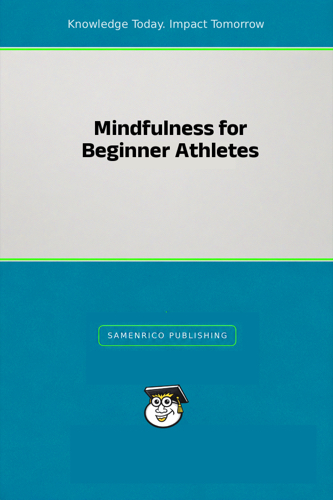
Non-FictionSelf-HelpSports Psychology
Mindfulness for Beginner Athletes eBook
Uses meditation to improve focus, recovery, and pe
by Reese Patti
Uses meditation to improve focus, recovery, and performance under pressure.
Formats
Free sample
Chapter 1: The Unseen Rep--–- You have practiced your sport thousands of times. You have run the sprints, drilled the footwork, logged the miles, and shot the same shot until your muscles memorized the motion. But there is one thing you have never practiced—not once, not deliberately. You have never practiced what to do with your brain when the game is on the line.This is not your fault. No coach gave you a drill for the moment your heart starts hammering before the starting gun.
No trainer designed a workout for the ten seconds after you make a terrible error and the crowd groans. No one handed you a playbook for the voice inside your head that whispers, You don't belong here, you're going to choke, everyone is watching.And yet, that voice—and your response to it—determines whether you win or lose more than any physical skill you possess.Consider this: every athlete you have ever admired has the same muscles, the same lungs, the same cardiovascular capacity as the person who finished last. The difference is not biology. The difference is what happens inside their skull when pressure arrives. The difference is a trained mind.This book exists because no one ever taught you that your attention is a muscle.
No one told you that your ability to recover from a mistake is a skill that can be drilled, measured, and improved like your vertical leap or your forty-yard dash. No one explained that the difference between choking and rising to the occasion is not personality or "clutch gene"—it is a set of teachable, learnable, repeatable techniques.This is not a book about relaxing. It is not a book about candles, incense, or finding your inner peace. It is a book about performance. It is a book for athletes who want to win.
And it starts with a single, uncomfortable truth: you have been training the wrong muscle your entire career.The Muscle You Never Knew You Had Every time you step onto the field, court, track, or mat, you are using your body. That much is obvious. But you are also using something else—something invisible, unmeasured, and almost never discussed. You are using your attention.Attention is not a metaphor. It is a finite, trainable, biological resource managed by specific networks in your brain.
Neuroscientists call these networks the "attentional systems," and they function exactly like muscles: they fatigue with overuse, they strengthen with practice, and they fail under extreme load.Here is what no one tells you: when you choke—when you airball the free throw, drop the simple pass, or false start off the blocks—it is almost never because your body forgot how to perform. Your body knows what to do. You have done it ten thousand times. You choke because your attention system overheats.The science is straightforward. Under pressure, your brain's prefrontal cortex—the part responsible for deliberate decision-making—begins to work overtime.
It starts analyzing movements that should be automatic. It starts monitoring outcomes you cannot control. It starts generating worst-case scenarios. This is called "paralysis by analysis," and it is the leading cause of athletic failure in high-stakes moments.Think of your attention like a spotlight. In practice, that spotlight is wide and calm.
It illuminates the relevant cues—the ball, your breathing, your positioning—without much effort. But when pressure arrives, the spotlight narrows. It starts jerking around wildly, landing on everything except what matters. It fixates on the crowd, the scoreboard, the referee's bad call, the memory of your last mistake. And then, just when you need it most, the spotlight flickers and dies.The athlete who wins is not the one who never loses the spotlight.
The athlete who wins is the one who can relight it faster than everyone else.That is what this book teaches. Not how to keep your mind perfectly still—that is impossible. But how to notice when your attention has wandered, and how to bring it back, again and again, faster and faster, until the act of returning becomes automatic. That act—the noticing and returning—is what we call the unseen rep.Why Standard Meditation Fails Athletes You may have heard that meditation is good for you. Tech executives meditate.
Yoga instructors meditate. Celebrities talk about mindfulness on podcasts. And if you have ever tried to meditate the way they describe—sitting cross-legged, eyes closed, trying to clear your mind—you probably hated it.There is a good reason for that. You are an athlete. You are a doer, not a sitter.
The kind of meditation designed for stressed-out office workers or people seeking spiritual enlightenment is almost perfectly wrong for you.Standard mindfulness, as it is commonly taught, emphasizes three things: relaxation, stress reduction, and the elimination of thoughts. These are not your goals. Your goals are focus, recovery, and performance under pressure. You do not want to be relaxed on the starting line—you want to be alert. You do not want to eliminate thoughts—you want to control which thoughts you listen to.
And you certainly do not want to reduce all stress—some stress is the fuel of great performance.This book offers something different. Call it athletic mindfulness.Athletic mindfulness is not about calming down. It is about showing up. It is about training your attention to land where you point it and stay there until you decide to move it. It is about learning to feel the burn in your lungs without panicking.
It is about noticing the voice that says "you can't" and choosing not to believe it.The practices in this book are designed for people who hate sitting still. They are short—most take five minutes or less. They are active—you will practice them while moving, breathing, and even while competing. And they are measurable—you will know when they are working because your performance will improve.The Three Pillars of Athletic Mindfulness Every skill in this book rests on three foundational abilities. Think of these as the pillars that hold up your mental game.
If any pillar is weak, the entire structure wobbles.Pillar One: Focus (The Lock In)Focus is the ability to anchor your attention on a single, relevant cue and keep it there despite distractions. That cue might be your breath, the feeling of the ball in your hands, the sound of your feet on the ground, or a simple word you repeat silently.When your focus is strong, you do not notice the crowd. You do not think about the score. You do not replay the last mistake. You are entirely present in the single action you are performing right now.When your focus is weak, you are everywhere except where you need to be.
Your mind races ahead to the outcome or drags behind to the error. You miss the cue that matters because you are busy reacting to the one that does not.Focus is trainable. Every time you notice your mind has wandered and gently return it to your chosen anchor, you are doing one rep for your focus muscle. This is the unseen rep. And just like…
This is the end of the free sample. Get the eBook to keep going. Buy now
About this book
Details
- Author
- Reese Patti
- Publisher
- SamEnrico
- Language
- English
- Genre
- Non-Fiction, Self-Help, Sports Psychology
- Released
- 2026-06-10
- Pages (approx.)
- 135
- Available as
- eBook, Audiobook

Read better in the ZLOADR app
Your eBooks on your phone or tablet. Sign in with your SamEnrico account and start reading.
More by Reese Patti
 Chunking Postal Codes GuideReese Patti$11.99
 Parenting Stress for LGBTQ ParentsReese Patti$11.99
 Civil Rights Movement 1964Reese Patti$11.99
 The Poisoned Chalice: The Mysterious Disappearance of Dorothy Jane ScottReese Patti$11.99
 Product Selection Strategy for Brazil vs Ghana MarketsReese Patti$12.99
 How to Produce Brass Instrument LubricantsReese Patti$11.99
 Ultimate Handbook Guide to Hubli-dharwad : (India) Travel GuideReese Patti$11.99
 Customer Analytics and SegmentationReese Patti$11.99
You may also like
 Hong Kong Handover 1997Dunn Johnnie$11.99
 Zumba For Postnatal Recovery CourseNeal Christian$11.99
 Zumba for BeginnersLadner Nikia$11.99
 YouTube Comment Mining GuideHumes Pandora$12.99
 Worry Box MeditationCarlin Rudy$11.99
 Workplace Stress MeditationNguyen Lynn$11.99
 Workplace Stress and Sleep RepairHawley Ivory$11.99
 Workplace Perfectionism CureDelaney Jeffry$11.99
 Workplace Injustice Anger GuideWallen Isabelle$11.99
 Work Addiction and Burnout LinkGreenwood Ester$11.99
 Women in Yoga and WellnessBeattie Galina$11.99
 Women in Stand Up ComedyChun Evangeline$11.99