
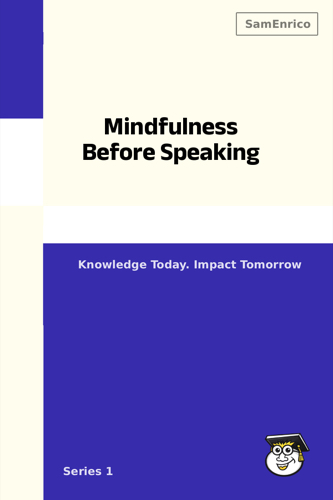
Mindfulness Before Speaking eBook
Observe thoughts without judgment for three minute
Observe thoughts without judgment for three minutes using meditation app guidance.
Formats
Free sample
Chapter 1: The Reactivity Gap--You just said something you wish you could take back. The words are still hanging in the air between you and the other person—your partner, your child, your colleague, a stranger on the internet—and already you feel the hot wash of regret climbing up your chest. In the next few seconds, you will do one of two things. You will double down, justify, explain, or deflect. Or you will fall silent, ashamed, and begin the slow, painful process of trying to repair damage that you know, deep down, never needed to happen in the first place.This moment is not a character flaw.
It is not a sign that you are a bad person, an angry person, or a person who cannot control themselves. It is, quite simply, a failure of observation. And the good news—the extraordinary, life-changing news—is that observation is a skill. It can be trained. It can be strengthened.
And it can be deployed in the milliseconds before you open your mouth to speak again.Welcome to the first chapter of Mindfulness Before Speaking. Before we build anything, we have to understand what keeps breaking. Before we learn the practices, the pauses, the frameworks, and the app-guided exercises that will fill the rest of this book, we have to stare directly at the problem: Why do we say what we don't mean? Why does the sharp word escape before the kind one? Why do we so often become the person we least want to be in the very moment we need to be our best?The answer lies in a tiny window of time—a gap of approximately 200 to 300 milliseconds—between an external trigger and your internal reaction.
That gap is where your entire life lives. And right now, for most people, that gap is a battleground where the oldest parts of your brain consistently defeat the wisest parts. This chapter will show you exactly what happens inside your skull in those fractions of a second. You will learn why your amygdala—a tiny, almond-shaped cluster of neurons—routinely hijacks your prefrontal cortex, the seat of logic, planning, and self-control. You will meet the reactivity gap, understand its evolutionary logic, and see why modern life has turned a survival mechanism into a relationship destroyer.But this chapter is not just neuroscience.
It is also a promise. By the time you finish reading these pages, you will have a new way of seeing every difficult conversation you have ever had and every one you will have in the future. You will understand why regret is not a punishment but a signal. And you will be introduced to the framework that anchors this entire book: O.A.S.I.S., a five-step protocol for turning the reactivity gap from a danger zone into a space of freedom. Let us begin.The Anatomy of a Verbal Wound Imagine you are driving home after a long day of work.
You are tired, hungry, and already thinking about the argument you do not want to have with your partner about whose turn it is to cook dinner. You walk through the door. The house is messy. The dog has not been walked. And your partner, without looking up from their phone, says, "Oh, you're finally here.
I thought you'd never get back."Something happens inside you. It is not a thought, not yet. It is faster than a thought. It is a sensation—a tightening in your jaw, a flush of heat behind your sternum, a sudden alertness that feels like stepping onto a battlefield. Before you have consciously decided to speak, your mouth opens and out comes: "Well, maybe if you got off your phone once in a while, the house wouldn't be a disaster."The words are out.
The damage is done. And five seconds later, you are already asking yourself: Why did I say that? That is not even what I am actually upset about.This sequence—trigger, sensation, reaction, regret—is so common that we have learned to treat it as normal. "I just have a short fuse." "I'm just passionate." "That's just how I am." But these explanations are not explanations at all. They are rationalizations that protect us from a more uncomfortable truth: we are not in control of our own mouths as much as we believe we are.The science of this moment is surprisingly precise.
When your partner spoke, your auditory cortex processed the sound of their voice in about 30 milliseconds. That information was then routed to two different places simultaneously: the thalamus (a sensory relay station) and directly to the amygdala (the brain's threat-detection system). The amygdala does not wait for analysis. It does not ask, "Is this actually dangerous?" It asks only one question: "Could this be a threat?" And if the answer is even maybe, the amygdala sounds the alarm.Here is what happens next. The amygdala activates the hypothalamic-pituitary-adrenal (HPA) axis, flooding your system with cortisol and adrenaline.
Your heart rate increases. Your blood pressure rises. Your digestion slows down (because your body thinks it might need to run or fight). And crucially, your prefrontal cortex—the part of your brain responsible for impulse control, long-term planning, and perspective-taking—is partially shut down. This is not a design flaw.
It is a feature. When your ancestors were being chased by saber-toothed tigers, they did not need to reflect on the tiger's childhood or consider the long-term relational consequences of running away. They needed to run. Now.But here is the problem. Your amygdala cannot tell the difference between a saber-toothed tiger and a sarcastic comment from your partner.
It cannot distinguish between a physical threat to your life and a perceived threat to your ego. To your ancient limbic system, being criticized feels exactly like being attacked. And so it responds with the same biological cascade: flood, hijack, react.The verbal wound you inflict in those moments is not a sign of malice. It is a sign of biology doing exactly what it evolved to do—just in the wrong environment. The gap between the trigger (their words) and your reaction (your words) is where this hijacking occurs.
And that gap, typically lasting 200 to 300 milliseconds, is the only thing standing between you and the person you want to be when you speak.The Science of the Reactivity Gap Let us slow down time. Way down. Imagine that every second is stretched into a minute. What you would see in those 200 to 300 milliseconds is a battle between two neural pathways: the low road and the high road.The low road is fast. It is automatic.
It is unconscious. It runs from your sensory organs directly to your amygdala, bypassing the cortex entirely. This is why you can flinch at a loud noise before you even know what the noise was. This is why you can feel your face flush with anger before you have consciously registered the insult. The low road is efficient, but it is also crude.
It makes mistakes. It flags false positives constantly. That sound outside your window at 2 a.m. is probably the wind, but your low road says "threat"…
This is the end of the free sample. Get the eBook to keep going. Buy now
About this book
Details
- Author
- Viera Vanetta
- Publisher
- SamEnrico
- Language
- English
- Genre
- Non-Fiction, Mental Wealth, Mindfulness
- Released
- 2026-06-09
- Pages (approx.)
- 117
- Available as
- eBook, Audiobook

Read better in the ZLOADR app
Your eBooks on your phone or tablet. Sign in with your SamEnrico account and start reading.
More by Viera Vanetta
 Cross Training DelegationViera Vanetta$11.99
 Body Language and DisabilityViera Vanetta$11.99
 Senior Exercise LogbookViera Vanetta$11.99
 The Ottoman Healers of the Crimean War: Unsung Heroes of the BattlefieldViera Vanetta$11.99
 Market ManagerViera Vanetta$11.99
 Freelancer Pricing Without Fear ManualViera Vanetta$12.99
 How to Become a Meat BlenderViera Vanetta$11.99