
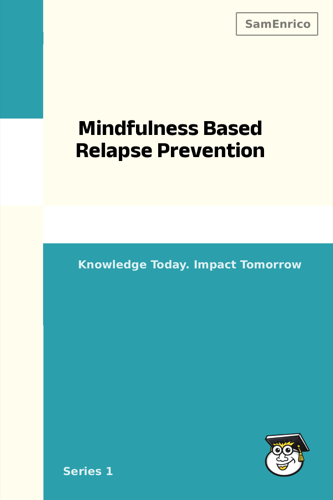
Non-FictionSelf-HelpAddiction Recovery
Mindfulness Based Relapse Prevention eBook
Prevent addiction relapse by riding out cravings l
by Sun Jerrod
Prevent addiction relapse by riding out cravings like waves without acting.
Formats
Free sample
Chapter 1: The Autopilot Lie--You have likely been told, more times than you can count, that your cravings are the enemy. That the urge to use is a sign of weakness. That if you just had more willpower, more discipline, more grit, you could simply say no and walk away. And every time the craving has returned—louder, hungrier, more convincing than the last—you have concluded something terrible about yourself. You are broken.
You are addicted because you are weak. You are the problem.This chapter exists to tell you something that might sound impossible, even offensive, given everything you have been taught: the craving is not the enemy. The craving is not a command. The craving is not evidence of moral failure. And the single biggest reason you have struggled to stay sober is not because your cravings are too strong.
It is because you have been fighting them the wrong way.What you are about to learn will reframe everything you think you know about addiction, relapse, and recovery. It is not a trick. It is not positive thinking. It is a scientifically grounded, clinically tested understanding of how the addicted brain actually works—and why the instinct to fight, suppress, or outrun a craving is precisely the instinct that keeps you trapped.This chapter will take you through three essential discoveries. First, you will see the autopilot trap: the neurological loop where triggers fire directly into reactions with zero conscious awareness.
Second, you will understand why willpower is structurally incapable of solving this problem, and why believing it should be able to has caused so much unnecessary shame. Third, you will be introduced to the foundational shift that makes everything else in this book possible: moving from the "doing" mode of fighting and fixing to the "being" mode of observing and allowing.By the end of this chapter, you will have a new answer to the question that has haunted you. The problem is not that you have cravings. The problem is that you have been trying to control something that cannot be controlled—and ignoring the one thing that can be changed.The moment a craving arrives, you have a choice. Not a choice between using and not using.
That choice comes later. The first choice is far more fundamental: will you fight the wave, or will you learn to ride it?The Autopilot Trap: How Triggers Become Commands Close your eyes for a moment. Not literally, if you are reading in a public place. But imagine this. You have driven the same route home from work five hundred times.
One evening, you get in the car, turn onto the familiar road, and twenty minutes later you pull into your driveway with almost no memory of the drive. You changed gears. You stopped at lights. You signaled turns. And yet your conscious mind was elsewhere—planning dinner, replaying a conversation, worrying about tomorrow.That is autopilot.
It is not a bug in human neurology. It is a feature. The brain automates repetitive behaviors to conserve energy for novel problems. Without autopilot, you would have to consciously direct every finger movement while tying your shoes, every breath while walking up stairs, every word while ordering coffee. You would collapse under the weight of conscious effort.Autopilot is efficient.
It is also, for the addicted brain, a trap.Addiction hijacks the autopilot system. Through repeated pairings of a trigger (a stressor, a time of day, a location, an emotion) with the substance, the brain learns to connect those two events so tightly that the trigger alone begins to fire the same neural circuits as the substance itself. Pavlov's bell did not contain food. But after enough pairings, the bell alone made the dogs salivate. Your trigger—the argument with your partner, the walk past the bar, the 5 PM clock—has become a bell.
And your craving is the salivation.Here is what happens inside the brain in that moment. The trigger activates the amygdala, the brain's threat-detection system. The amygdala does not know the difference between a predator and a craving. It only knows that something important is happening. It sends a signal to the nucleus accumbens, the reward center, which releases dopamine—not the chemical of pleasure, as often misstated, but the chemical of wanting.
Dopamine says: pay attention. Something rewarding is available. Go get it.Simultaneously, the trigger activates the dorsolateral striatum, the region responsible for habit execution. This is the autopilot switch. In a healthy brain, the prefrontal cortex—the seat of executive function, planning, and inhibition—would step in and say: not now.
But addiction damages the prefrontal cortex. It thins the gray matter. It reduces the density of connections between the prefrontal cortex and the deeper reward structures. The result is that the autopilot signal reaches the motor cortex before the inhibition signal has even left the station.By the time you consciously notice the craving, your body may already be moving toward the substance. Your hand may already be reaching for the phone, the bottle, the dealer's number.
This is not a metaphor. This is neuroanatomy.The autopilot trap, then, is this: triggers activate the behavioral sequence of using before conscious awareness has a chance to intervene. You are not deciding to use. You are running a script. And by the time you realize the script is playing, you are halfway through the second act.This is why you have experienced cravings that felt like they came out of nowhere.
This is why you have found yourself in a bar or a using environment with no memory of deciding to go there. This is why "just say no" has never worked for you—because saying no requires a conscious choice, and the autopilot loop bypasses consciousness entirely.The first step out of the trap is simply seeing it. Not judging it. Not hating yourself for it. Just seeing it.
The craving is not your enemy. The craving is the bell. The autopilot is the learned response. And neither one is a moral failure.Why Willpower Fails: The Depletion Problem If you have ever blamed yourself for lacking willpower, you have plenty of company. The cultural story of addiction is still, despite decades of neuroscience, a moral story.
Good people resist temptation. Strong people say no. Weak people give in. Every relapse feels like proof that you belong in the third category.But the science of willpower tells a different story—one that should come as a profound relief.Willpower, also called ego depletion or executive function, is a finite resource. It is not a character trait.
It is not something you either have or you do not have. It is more like a muscle: it can be strengthened over time, but it fatigues with use. Every act of self-control draws from the same limited pool. Resisting the morning donut. Forcing yourself to answer emails.
Biting your tongue during an argument. And, yes, saying no to a craving.By late afternoon, after dozens of small acts of resistance, your willpower pool is depleted. This is not speculation. It has been demonstrated in dozens of studies. Participants who are asked to resist eating fresh-baked cookies…
This is the end of the free sample. Get the eBook to keep going. Buy now
About this book
Details
- Author
- Sun Jerrod
- Publisher
- SamEnrico
- Language
- English
- Genre
- Non-Fiction, Self-Help, Addiction Recovery
- Released
- 2026-06-10
- Pages (approx.)
- 135
- Available as
- eBook, Audiobook

Read better in the ZLOADR app
Your eBooks on your phone or tablet. Sign in with your SamEnrico account and start reading.
More by Sun Jerrod
 Free Creator Workflow AutomationSun Jerrod$11.99
 Endometriosis Pain GuideSun Jerrod$11.99
 Solar Temple French Police Files WorkbookSun Jerrod$11.99
 LBO Exit Multiples DatabaseSun Jerrod$11.99
 The Unseen Revolution: How a 19th-Century Typist Changed the WorldSun Jerrod$11.99
 The Silent Architect: How a Forgotten Diplomat Shaped Cold War EspionageSun Jerrod$11.99
 Understanding Cerebellar Degeneration, SubacuteSun Jerrod$17.99
 Dubai Student Mobile GuideSun Jerrod$12.99
 ESG Performance in Asia GuideSun Jerrod$12.99
 Assistant Kitchen ManagerSun Jerrod$11.99
 How to Become a Automatic Bandsaw TenderSun Jerrod$11.99
You may also like
 Hong Kong Handover 1997Dunn Johnnie$11.99
 Zumba For Postnatal Recovery CourseNeal Christian$11.99
 Zumba for BeginnersLadner Nikia$11.99
 YouTube Comment Mining GuideHumes Pandora$12.99
 Worry Box MeditationCarlin Rudy$11.99
 Workplace Stress MeditationNguyen Lynn$11.99
 Workplace Stress and Sleep RepairHawley Ivory$11.99
 Workplace Perfectionism CureDelaney Jeffry$11.99
 Workplace Injustice Anger GuideWallen Isabelle$11.99
 Work Addiction and Burnout LinkGreenwood Ester$11.99
 Women in Yoga and WellnessBeattie Galina$11.99
 Women in Stand Up ComedyChun Evangeline$11.99