
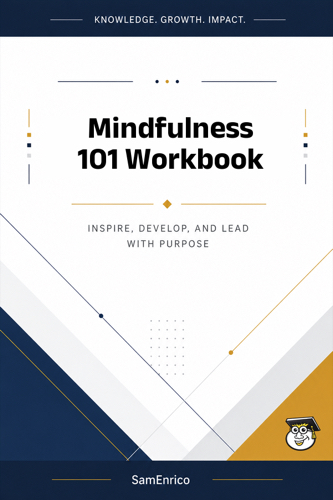
Mindfulness 101 Workbook eBook
Interactive exercises to build attention and aware
Interactive exercises to build attention and awareness from the ground up.
Formats
Free sample
Chapter 1: The Silent Autopilot--–- You are about to discover something that will unsettle you, then liberate you. Here it is: for most of your waking life, you have not actually been awake. You have been running on a program called autopilot, and you did not even know the program existed.Think back to this morning. Can you remember the exact sensation of your feet touching the floor when you got out of bed? Can you recall the first three thoughts that went through your mind before you picked up your phone?
Can you describe the taste of your first sip of coffee or tea, not as a memory of a taste but as an actual sensation you felt in that moment? If you are like most people, the answer is no. Not because your memory is bad, but because you were not there. Your body was brushing its teeth, but your mind was already at work. Your hand was holding a mug, but your attention was already scrolling through a feed.
You were moving through the world as a ghost, haunting your own life.This is not a moral failure. It is not laziness or weakness. It is the default setting of the human brain, amplified by a world that has learned to monetize your distraction. The average person checks their phone ninety-six times a day. The average attention span on any single screen has dropped to forty-seven seconds.
The average mind wanders forty-seven percent of the time, according to Harvard researchers Killingsworth and Gilbert—and here is the part they do not tell you: when the mind wanders, people report being significantly less happy. Not a little less. Significantly less.You have been told that mindfulness is about sitting cross-legged, burning incense, and emptying your mind. That is not mindfulness. That is a stereotype sold by people who have never tried to sit still for five minutes.
Real mindfulness is not about emptiness. It is about fullness with choice. It is about noticing that your mind has wandered and bringing it back—not as a punishment, but as a rep. Like lifting a weight. Like doing a pushup for your attention.This chapter is called The Silent Autopilot because that is what we are dismantling: the invisible program that runs your life while you are busy thinking you are in charge.
By the end of this chapter, you will have felt the difference between autopilot and awareness with your own body. You will have completed your first mindfulness practice. And you will understand why the single most important skill of the twenty-first century is not coding, not data analysis, not artificial intelligence—but the simple, ancient ability to pay attention on purpose.The Neuroscience of Not Being There Let us begin with a definition. Mindfulness is not relaxation, though relaxation often follows it. Mindfulness is not positive thinking, though positivity often emerges from it.
Mindfulness is the ability to pay attention, on purpose, in the present moment, without judgment. That last part—without judgment—is where most people get stuck. They sit down to practice, their mind wanders to a grocery list, and they think, “I am terrible at this.” That thought is not mindfulness. That thought is judgment. And judgment is just another distraction dressed up as self-awareness.Here is what the top ten mindfulness books agree on, even when they disagree on everything else: distraction is the human default setting.
You were not born distracted. You were born with a brain designed to scan for threats, novelty, and rewards. In the savanna, that kept you alive. In the modern world, that keeps you trapped. Your phone is a threat-reward-novelty machine.
Your email inbox is a slot machine. Your social media feed is a Skinner box designed by engineers who studied exactly how to keep your attention jumping from one thing to the next.The neuroscience is clear and it is fascinating. Your brain has something called the default mode network, or DMN. This is a collection of brain regions that become active when you are not focused on anything in particular—when you are daydreaming, ruminating, planning, or worrying. The DMN is the neural correlate of autopilot.
It is the voice in your head that narrates your life, criticizes your choices, replays old arguments, and rehearses future conversations. The DMN is not your enemy. It is a useful tool for planning and reflection. But when the DMN runs unchecked, it becomes a tyranny. It is the source of anxiety, depression, and the nagging sense that you are never quite where you are.Here is the good news.
Mindfulness practice literally changes the DMN. Studies using functional MRI have shown that after eight weeks of mindfulness training, the default mode network becomes less active and less strongly connected. The brain literally spends less time in autopilot mode. Instead of the DMN running the show, the executive control network—the part of the brain responsible for focused attention and deliberate action—gains influence. You are not destroying the DMN.
You are simply putting it in its proper place: as a tool you use, not a master that uses you.The research is overwhelming. Eight weeks of mindfulness practice has been shown to increase gray matter density in the hippocampus, which is involved in learning and memory. It has been shown to decrease gray matter density in the amygdala, which is the brain’s fear and stress center. And it has been shown to strengthen the connection between the prefrontal cortex, which is responsible for executive function, and the rest of the brain. These changes are measurable on an MRI.
They are not mystical. They are mechanical. They are the result of repeated attention training, exactly like building a bicep through repeated curls.But you do not need an MRI to know it works. You need only sit down for three minutes and try. You will notice something immediately: your mind does not want to stay where you put it.
That is not failure. That is the starting line.The Myth That Keeps You Stuck Let us kill a myth right now. You will never empty your mind. Anyone who tells you otherwise is selling something. The brain is an organ that produces thoughts the way the stomach produces acid and the lungs produce breath.
Thoughts are not your enemy. They are not a sign that you are doing mindfulness wrong. They are simply the weather of the mind. Your job is not to stop the weather. Your job is to notice it without being destroyed by it.Imagine you are standing in a field.
Clouds pass overhead. Some are dark and heavy. Some are light and fluffy. Some look like animals. Some look like nothing at all.
You do not try to push the clouds away. You do not try to grab them. You simply watch them pass. That is mindfulness of thoughts. You are the sky, not the weather.Most people live their lives as if they are the weather.
A dark thought comes: “I am not good enough.” And instead of watching it pass, they become it. They wear it like a coat. They carry it…
This is the end of the free sample. Get the eBook to keep going. Buy now
About this book
Details
- Author
- Olvera Yolande
- Publisher
- SamEnrico
- Language
- English
- Genre
- Non-Fiction, Self-Help, Workbook
- Released
- 2026-06-09
- Pages (approx.)
- 148
- Available as
- eBook, Audiobook

Read better in the ZLOADR app
Your eBooks on your phone or tablet. Sign in with your SamEnrico account and start reading.
More by Olvera Yolande
 Customer Service First Contact ResolutionOlvera Yolande$11.99
 The Opioid Constipation GuideOlvera Yolande$11.99
 Loneliness After Moving CitiesOlvera Yolande$11.99
 Francis San Francesco ImageOlvera Yolande$11.99
 The Silent Plague: The Forgotten Epidemic That Shaped CivilizationOlvera Yolande$11.99
 Analcite MiningOlvera Yolande$11.99
 Waitlist Building StrategiesOlvera Yolande$12.99
 Digital Marketing MOOC GuideOlvera Yolande$12.99
 Learn to Play the Timpani (Kettledrum)Olvera Yolande$11.99
 How to Start a Pharmaceutical Goods Importer (wholesale) Business (Beginners Guide)Olvera Yolande$11.99
You may also like
 Hong Kong Handover 1997Dunn Johnnie$11.99
 Zumba For Postnatal Recovery CourseNeal Christian$11.99
 Zumba for BeginnersLadner Nikia$11.99
 YouTube Comment Mining GuideHumes Pandora$12.99
 Worry Box MeditationCarlin Rudy$11.99
 Workplace Stress MeditationNguyen Lynn$11.99
 Workplace Stress and Sleep RepairHawley Ivory$11.99
 Workplace Perfectionism CureDelaney Jeffry$11.99
 Workplace Injustice Anger GuideWallen Isabelle$11.99
 Work Addiction and Burnout LinkGreenwood Ester$11.99
 Women in Yoga and WellnessBeattie Galina$11.99
 Women in Stand Up ComedyChun Evangeline$11.99