
Non-FictionSelf-HelpWalking Meditation
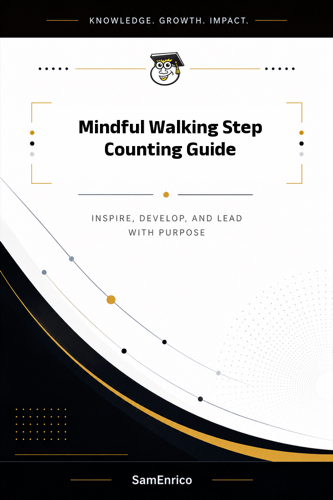
Mindful Walking Step Counting Guide eBook
Focus attention on each footstep using a gentle co
Focus attention on each footstep using a gentle count from one to ten, returning when distracted.
Formats
Free sample
Chapter 1: The Forgotten Footfall--–- Every morning, you wake up, swing your legs out of bed, and place your feet on the floor. You stand. You walk to the bathroom. You walk to the kitchen. You walk to the car, the train, the office, the grocery store, the bedroom, the couch, and back again.
By the time you fall asleep tonight, you will have taken roughly six thousand steps. You will remember almost none of them.This is not a failure of memory. It is a failure of attention—and it is the single greatest unused resource in your life.Six thousand footsteps. That is the average daily step count for an adult in a developed nation, according to large-scale pedometer studies compiled over the past decade. Six thousand chances to train your attention, regulate your nervous system, interrupt the loop of anxious thinking, and connect with the present moment.
Six thousand opportunities you will miss today, and tomorrow, and the day after, unless you learn to see what is already happening beneath your feet.The problem is not that you are lazy, undisciplined, or incapable of focus. The problem is that walking has become invisible to you. You learned to walk so long ago—typically between nine and fifteen months of age—that the movement has been relegated to your brain’s automatic processing centers. Your basal ganglia, cerebellum, and spinal cord handle the mechanics while your prefrontal cortex wanders off to worry about tomorrow’s meeting, rehearse yesterday’s argument, or scroll through an imaginary feed of things that have not happened yet. Walking happens to you, not by you.This book is about reclaiming those six thousand daily steps as a practice.
Not an additional task. Not another item on your to-do list. A practice that requires no special clothes, no cushion, no app, no studio, no fee, and no separate time carved out of an already overflowing schedule. The practice is simple, almost embarrassingly so: you place your attention on each footstep. You count each step silently from one to ten.
When your mind wanders—and it will, constantly, continuously, without fail—you notice that it has wandered, and you return to one. That is it. That is the entire method.And yet, within that ridiculously simple structure lies a transformation that has been documented by neuroscientists, psychologists, contemplative teachers, and millions of practitioners across twenty-five hundred years of human history. Walking meditation, as it is called in Buddhist traditions, is not a feel-good stroll in the park. It is a rigorous attention-training protocol disguised as something you already do every single day.The Six Thousand Step Gap Let us sit with that number for a moment.
Six thousand steps. If each step takes roughly half a second, you are spending about fifty minutes per day walking—nearly an hour of movement that your brain treats as background noise. Now consider what else you do for fifty minutes per day. The average person spends fifty-two minutes per day on social media. Forty-three minutes watching television.
Thirty-eight minutes commuting. Twenty-eight minutes eating. All of these activities have been studied, optimized, monetized, and turned into habits. Walking is the only one that has been completely ignored.Why? Because walking sits in a strange cognitive category.
It is too automatic to require conscious effort, but too complex to be truly mindless. Walking requires continuous sensory feedback, balance adjustments, obstacle negotiation, and micro-corrections. Your brain is doing real work during those fifty minutes—it is simply doing that work without your awareness. The gap between the work your brain is doing and the awareness you have of that work is what this book calls the Six Thousand Step Gap. Closing that gap is the entire project.Consider what happens during a typical walking minute right now.
Your feet strike the ground. Your ankles dorsiflex and plantarflex. Your knees absorb shock. Your hips rotate. Your spine counter-rotates.
Your arms swing in opposition. Your eyes scan for obstacles. Your vestibular system monitors balance. Your brain integrates all of this information hundreds of times per second. And you?
You are thinking about what to make for dinner.The gap is not a character flaw. It is an evolutionary feature. Automaticity freed your ancestors to scan for predators while walking, to plan the next hunt while migrating, to solve problems while moving from one water source to another. The problem is that the same automaticity now frees you to ruminate, catastrophize, rehearse, and doomscroll while your feet carry you through the world. The machinery is the same.
The content has changed. And the cost is enormous.The Cost of an Unseen Walk What do you lose when you walk without awareness? The short answer is: a tremendous amount of low-hanging fruit for mental health. The long answer requires a brief tour of three research domains.Attention Restoration. In the 1980s, psychologists Rachel and Stephen Kaplan proposed Attention Restoration Theory, which suggests that directed attention—the kind you use to focus on work, resist distraction, and solve problems—fatigues with use.
When directed attention is exhausted, you become irritable, impulsive, and error-prone. The Kaplans identified four qualities of experiences that restore directed attention: being away (psychological distance from routine demands), extent (a sense of connected richness), fascination (effortless interest), and compatibility (the environment supports your intentions). Mindful walking, done correctly, provides all four simultaneously. The counting loop provides fascination. The movement provides being away.
The ground beneath your feet provides extent. The simplicity of the practice provides compatibility. You are not just walking; you are restoring your cognitive engine.Default Mode Network Suppression. In 2001, neuroscientist Marcus Raichle discovered the default mode network (DMN)—a set of brain regions that become active when you are not focused on an external task. The DMN is responsible for mind-wandering, self-referential thought, rumination, and mental time travel (past and future).
When the DMN runs unchecked, you are more likely to be anxious, depressed, and stuck in repetitive thought loops. Meditation, including mindful walking, suppresses DMN activity. A 2019 study comparing seated mindfulness to mindful walking found that both reduced DMN connectivity, but walking had the added benefit of reducing physiological arousal. You are not just quieting your mind; you are turning down the volume on the brain network that generates most of your suffering.Interoceptive Training. Interoception is the sense of the internal state of your body.
It is how you know whether your heart is racing, your stomach is tight, or your breath is shallow. Poor interoception is correlated with anxiety disorders, depression, eating disorders, and alexithymia (difficulty identifying emotions). Walking meditation is a form of interoceptive training because it forces you to feel the body in motion—the pressure of the foot, the swing of the arm, the shift of weight. Counting the steps provides a cognitive scaffold that keeps you from drifting back into thought. Over time, this training generalizes: you become better at sensing your emotional state before it escalates into a crisis.
You learn to feel anxiety as a pattern of muscle tension and breath rhythm, not as an overwhelming narrative about the future.The Portable Meditation Seated meditation has a public relations problem. It sounds…
This is the end of the free sample. Get the eBook to keep going. Buy now
About this book
Details
- Author
- Breeden Rosalina
- Publisher
- SamEnrico
- Language
- English
- Genre
- Non-Fiction, Self-Help, Walking Meditation
- Released
- 2026-06-07
- Pages (approx.)
- 143
- Available as
- eBook, Audiobook

Read better in the ZLOADR app
Your eBooks on your phone or tablet. Sign in with your SamEnrico account and start reading.
More by Breeden Rosalina
 Microaggression Anger Triggers WorkbookBreeden Rosalina$11.99
 Fertility and Uterine FibroidsBreeden Rosalina$11.99
 Nightmare Processing for Hospice WorkersBreeden Rosalina$11.99
 Pomodoro Technique for ProcrastinationBreeden Rosalina$11.99
 Love in the Peloton: The Secret Romance of the First Arab Tour de France RiderBreeden Rosalina$11.99
 How to Start a Personnel Carrier (armoured Fighting Vehicle) Business (Beginners Guide)Breeden Rosalina$11.99
 Donut FryerBreeden Rosalina$11.99
 Cisco Remote Internship BlueprintBreeden Rosalina$12.99
 Cardinal Health SWOTBreeden Rosalina$12.99
 Understanding OligopherniaBreeden Rosalina$17.99
You may also like
 Hong Kong Handover 1997Dunn Johnnie$11.99
 Zumba For Postnatal Recovery CourseNeal Christian$11.99
 Zumba for BeginnersLadner Nikia$11.99
 YouTube Comment Mining GuideHumes Pandora$12.99
 Worry Box MeditationCarlin Rudy$11.99
 Workplace Stress MeditationNguyen Lynn$11.99
 Workplace Stress and Sleep RepairHawley Ivory$11.99
 Workplace Perfectionism CureDelaney Jeffry$11.99
 Workplace Injustice Anger GuideWallen Isabelle$11.99
 Work Addiction and Burnout LinkGreenwood Ester$11.99
 Women in Yoga and WellnessBeattie Galina$11.99
 Women in Stand Up ComedyChun Evangeline$11.99