
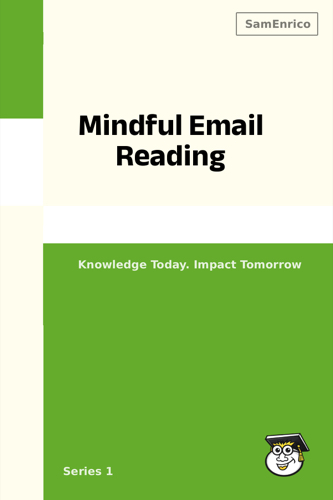
Mindful Email Reading eBook
Opens email with awareness to avoid anxiety spikes
Opens email with awareness to avoid anxiety spikes.
Formats
Free sample
Chapter 1: The Dopamine Doorbell--–- The chime arrives at 7:43 AM. You haven't even swallowed your first sip of coffee. Your hand moves toward the phone before your conscious mind registers the sound. By 7:44, you are reading an email about a quarterly report that isn't due for three weeks, your heart rate has increased by 12 percent, and you have already forgotten the dream you were previously trying to recall. This is not a failure of willpower.
This is a neurological ambush.Let us name the thing that has happened to you. It is not laziness. It is not a lack of discipline. It is not evidence that you are "bad with technology" or "too anxious" or "simply not cut out for modern work." What you just experienced is a well-documented, meticulously engineered neurological event known in research circles as conditioned attentional capture, but what we will call throughout this book the dopamine doorbell – a Pavlovian response welded to a Skinnerian reward schedule, delivered through a device that sits six inches from your sleeping face.You are not broken. You are being hacked.And the first step toward freedom is not to delete your email account, move to a cabin in the woods, and renounce modern civilization.
The first step is far simpler and far more difficult: you must simply see what is happening. You must pull back the curtain on the machinery of your own distraction. Because once you see the dopamine doorbell for what it is – a stimulus-response loop designed to exploit the most ancient circuits of your mammalian brain – you can never unsee it. And that act of seeing is the beginning of everything.The Anatomy of a Digital Ambush Before we can change our relationship with email, we must understand exactly what happens inside the nervous system during that split second between the sound of a notification and the opening of a message. This is not abstract neuroscience.
This is the story of your morning, your afternoon, and your evening, repeated fifty to one hundred times per day, three hundred and sixty-five days per year, across approximately four billion email users worldwide.Let us walk through the sequence frame by frame.Frame One: The Trigger. A sound, a vibration, a red badge icon, or simply the sight of an unread count in your peripheral vision. Your brain processes this stimulus in approximately 80 milliseconds – faster than you can blink. Critically, your brain does not distinguish between an email from your CEO announcing layoffs and an email from a clothing brand announcing a 20 percent off sale. The initial processing happens in the thalamus, which routes sensory information without evaluating content.
Your nervous system begins to respond before it knows what it is responding to.Frame Two: Dopamine Release. The trigger activates your brain's reward prediction error system, centered in the ventral tegmental area and the nucleus accumbens. In plain language: your brain releases a small burst of dopamine – not because the email is important, but because it might be important. This is the crucial insight that email designers understand and that most users do not. Dopamine is not released in response to reward; it is released in response to the possibility of reward.
A predictable reward – checking your email every hour and always finding three routine messages – eventually produces no dopamine at all. Your brain habituates. But an unpredictable reward – sometimes an angry client, sometimes a birthday greeting, sometimes nothing at all – keeps dopamine spiking indefinitely.This is called a variable reward schedule, and it is the same mechanism that makes slot machines addictive. The psychologist B.F. Skinner discovered this phenomenon in the 1950s when he observed that pigeons would peck a button most relentlessly when the food reward came unpredictably.
Not when it came every time. Not when it never came. When it came sometimes – just often enough to sustain hope. Your inbox is a slot machine, and every "ding" is a pull of the lever.Frame Three: Cortisol Elevation. Here is where email uniquely damages peace of mind.
Dopamine gets you to open the door, but cortisol – the primary stress hormone – rushes in once you are inside. As your brain anticipates opening the message, it simultaneously prepares for threat. The hypothalamic-pituitary-adrenal (HPA) axis activates. Your heart rate increases. Your breathing becomes shallower.
Your peripheral vision narrows – a physiological response designed for facing predators on the savanna, now deployed against a message from your boss about "a quick word."This cortisol spike happens before you read the email. It happens in the 200 milliseconds between seeing the notification and opening the message. By the time your eyes touch the first sentence, your body is already in a state of low-grade emergency. This is why even neutral emails can feel stressful. The stress is not in the content; the stress is in the anticipation of the content.Frame Four: The Open.
You read the email. Two things can happen. If the email is benign or pleasant – a thank-you, a confirmation, a funny note from a colleague – you experience a small wave of relief. The cortisol drops. The dopamine fades.
You close the email, and within thirty seconds, you have largely forgotten it. If the email is stressful – a criticism, a demand, bad news – the cortisol remains elevated. Your amygdala (threat center) now has specific content to work with. You may re-read the message three or four times, each pass deepening the stress response. You may begin drafting an angry reply.
You may close the email only to open it again two minutes later to "make sure you read it correctly." This is the stress loop, and it can last for hours.Frame Five: The Residue. Regardless of whether the email was benign or stressful, you now have a cognitive souvenir. This is what the organizational psychologist Sophie Leroy calls attention residue – the fragment of the previous task that remains in working memory after you switch to a new task. When you close your email and return to the report you were writing, a ghost of that email stays with you. The ghost is stronger for stressful emails, but it exists for all emails.
And it takes an average of twenty-two minutes for the residue to fully dissipate. During those twenty-two minutes, you are not working at full capacity. You are working at a deficit.The Mathematics of Madness Let us do what most mindfulness books avoid: let us do the math.The average knowledge worker receives approximately 120 emails per day. The average knowledge worker checks email 74 times per day, according to a study by the American Psychological Association. That is once every 6.5 minutes of an eight-hour workday.
But these checks are not evenly distributed. They cluster around moments of transition – after finishing a task, before starting a new one, during moments of boredom, whenever the dopamine doorbell rings.Each check takes approximately 90 seconds of direct handling time – reading, triaging, maybe replying. That is 111 minutes per day, or nearly two hours, just in the mechanical act of processing email. But the direct handling time is not the real cost. The real cost is the attention residue.Seventy-four checks per day, each leaving twenty-two minutes of residue.
But residue overlaps and stacks. It is not a simple multiplication problem. A more accurate model: each email check interrupts…
This is the end of the free sample. Get the eBook to keep going. Buy now
About this book
Details
- Author
- Rockwell Sherly
- Publisher
- SamEnrico
- Language
- English
- Genre
- Non-Fiction, Self-Help
- Released
- 2026-06-10
- Pages (approx.)
- 149
- Available as
- eBook, Audiobook

Read better in the ZLOADR app
Your eBooks on your phone or tablet. Sign in with your SamEnrico account and start reading.
More by Rockwell Sherly
 The CPO Market by AgeRockwell Sherly$11.99
 Student Loan Repayment BenefitRockwell Sherly$11.99
 Safe Crisis ManagementRockwell Sherly$11.99
 Reflective Listening Technique MasteryRockwell Sherly$11.99
 Paleo Keto Hybrid ApproachRockwell Sherly$11.99
 Networking for NonprofitsRockwell Sherly$11.99
 Morning Routine AppsRockwell Sherly$11.99
 The Underdogs of '99: How Australia's W-League Defied the Odds in the Champions LeagueRockwell Sherly$11.99
 The Ghosts of Tycho Brahe: The Alchemist of the StarsRockwell Sherly$11.99
 How to Start a Precision Tube Made of Steel Business (Beginners Guide)Rockwell Sherly$11.99
 Service Providers Guide to Healthcare ConsultantsRockwell Sherly$11.99
 How to Produce Wall Patching Compounds and PlasterRockwell Sherly$11.99
You may also like
 Hong Kong Handover 1997Dunn Johnnie$11.99
 Zumba For Postnatal Recovery CourseNeal Christian$11.99
 Zumba for BeginnersLadner Nikia$11.99
 YouTube Comment Mining GuideHumes Pandora$12.99
 Worry Box MeditationCarlin Rudy$11.99
 Workplace Stress MeditationNguyen Lynn$11.99
 Workplace Stress and Sleep RepairHawley Ivory$11.99
 Workplace Perfectionism CureDelaney Jeffry$11.99
 Workplace Injustice Anger GuideWallen Isabelle$11.99
 Work Addiction and Burnout LinkGreenwood Ester$11.99
 Women in Yoga and WellnessBeattie Galina$11.99
 Women in Stand Up ComedyChun Evangeline$11.99