
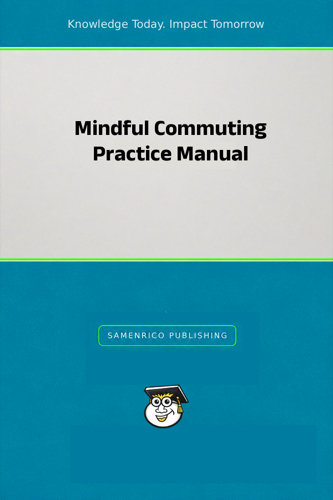
Non-FictionSelf-HelpTransit Mindfulness
Mindful Commuting Practice Manual eBook
Transform train, bus, or drive time into mindfulne
Transform train, bus, or drive time into mindfulness by feeling seat, watching thoughts, and noticing surroundings.
Formats
Free sample
Chapter 1: The 4,000-Hour Heist--You will spend approximately four thousand hours commuting over the course of your working life. Let that number land. Four thousand hours. That is one hundred and sixty-six full days. That is nearly six months of your waking life spent in motion between the places that actually matter.
Enough time to learn a new language fluently, write a novel from start to finish, train for and complete three marathons, or watch every episode of every critically acclaimed television series produced in the last decade. Instead, most people spend those hours in a fog of mild irritation, numb scrolling, or simmering road rage. They arrive at work already exhausted. They return home already resentful. The commute does not merely take your time.
It takes your presence. And it gives you nothing in return but a slightly elevated heart rate, a vague sense of having lost something you cannot name, and a quiet resignation that this is simply how life is supposed to feel.This book is the heist. You are going to take those four thousand hours back.But first, you need to understand what you are up against. Your commute is not neutral. It is not simply empty time between the places that matter, like a hallway you pass through on your way to a real room.
Your brain treats transition moments as danger zones. When you leave home and have not yet arrived at work, when you are neither here nor there, your brain's default mode network—the neural system responsible for self-referential thought, rumination, and mind-wandering—activates like a dormant alarm system that has just detected an intruder. This is not a design flaw. Evolutionarily, transitions were when your ancestors were most vulnerable. Leaving the cave, crossing open ground, entering a new territory—these were moments of heightened risk.
Your brain learned to fill those gaps with hypervigilance and worry as a survival mechanism. The problem is that modern commuting triggers the same ancient circuitry. You are not crossing the savanna. You are sitting on a train with Wi-Fi. But your nervous system does not know the difference.The good news is that you can rewire this response.
The commute is not a wasteland of lost time. It is a dojo—a training ground for mindfulness that is actually superior to sitting on a cushion in a quiet room. Because life does not happen in quiet rooms. Life happens in traffic jams, crowded platforms, delayed trains, unexpected detours, and the strange smell of the person who just sat down next to you and started watching videos without headphones. If you can learn to be present there, you can be present anywhere.
The quiet room teaches you nothing about the chaos. The commute teaches you everything.This chapter introduces the three anchors that will form the backbone of every practice in this book: feeling the seat, watching thoughts, and noticing surroundings. It also gives you a decision tree for handling any stimulus you encounter during your commute—whether it is neutral, irritating, dangerous, or self-generated. By the end of this chapter, you will understand exactly why your commute has been stealing from you, how much it has stolen already, and how you are going to take it back, one breath at a time, starting tomorrow morning.The Neuroscience of the Gray Zone Your brain has a default mode. This is not a metaphor.
It is a measurable neurological reality. When you are not actively engaged in a task—not solving a problem, not talking to someone, not focusing on your breath, not reading these words—your brain defaults to a network of regions that neuroscientists call the Default Mode Network, or DMN. The DMN is responsible for autobiographical memory, which is the story you tell yourself about your past. It is responsible for theory of mind, which is your constant guessing about what other people think of you. And it is responsible for mental time travel, which is your endless planning for the future and regretting of the past.
These are useful functions in moderation. You need to remember where you live. You need to anticipate what your boss might say. You need to learn from mistakes. The problem is that the DMN does not have an off switch.
It activates automatically whenever your attention is not otherwise occupied. And once activated, it tends to spiral. A single worry about being late becomes a cascade of worries about your reputation, your job security, your entire future. A single memory of an awkward conversation becomes a full replay with director's commentary and alternate endings.Commuting is the DMN's perfect storm. You are in motion but not physically active.
You are surrounded by people but not interacting with them. You are going somewhere but have not yet arrived. Your brain interprets this attentional vacuum as an invitation and floods it with worry, planning, rumination, and daydreaming. This is why you arrive at work already rehearsing the argument you will have with your boss at 2:00 PM. This is why you arrive home already replaying the mistake you made at 9:30 AM.
The commute did not cause those thoughts. But it gave them a stadium in which to echo, amplify, and multiply.This book calls that stadium the Gray Zone. The Gray Zone is the mental fog between home and work where time disappears without your consent. It is not a physical place. It is a neurological state.
And you have been living in it for thousands of hours without even noticing that you were anywhere at all. The Gray Zone is where your attention goes to die. Not dramatically, not with a bang, but with a slow, quiet, almost imperceptible fade into nothing.There is hope. Neuroplasticity—the brain's ability to reorganize itself by forming new neural connections throughout your life—means that you can weaken the DMN's grip. You are not stuck with the brain you have.
Every time you deliberately anchor your attention on a physical sensation, a thought label, or an external sound, you are strengthening the brain's task-positive network, which is the DMN's antagonist. These two networks are like a seesaw. When one goes up, the other goes down. You cannot destroy the DMN. You would not want to.
It helps you remember your mother's birthday and avoid walking into traffic. But you can learn to choose which network is active at any given moment. You cannot stop the DMN from offering you a worry. But you can stop boarding that train. You can watch it pull away from the platform while you remain exactly where you are, solid and still and free.The Three Anchors: Your Toolbelt for the Gray Zone This book organizes all of its practices around three core anchors.
An anchor is simply something you return your attention to when you notice that you have drifted into autopilot. Anchors work because they give the mind a job. The DMN activates when the mind has nothing to do. Give it a clear, simple, repeatable task, and the DMN quiets down almost immediately. You do not need to fight your brain.
You just need to occupy it.Anchor One: Feeling the Seat. This is the physical anchor. It includes any sensation of…
This is the end of the free sample. Get the eBook to keep going. Buy now
About this book
Details
- Author
- Bustos Damaris
- Publisher
- SamEnrico
- Language
- English
- Genre
- Non-Fiction, Self-Help, Transit Mindfulness
- Released
- 2026-06-10
- Pages (approx.)
- 123
- Available as
- eBook, Audiobook

Read better in the ZLOADR app
Your eBooks on your phone or tablet. Sign in with your SamEnrico account and start reading.
More by Bustos Damaris
 Ayatollah Khomeini LeadershipBustos Damaris$11.99
 GAD Alcohol Anxiety GuideBustos Damaris$11.99
 Emergency Quadrant One GuideBustos Damaris$11.99
 Culture Brand PositioningBustos Damaris$11.99
 Inanna’s Descent: The Goddess and the Underworld’s Forbidden LoveBustos Damaris$11.99
 The Silk Road of the Skies: Ibn Firnas and the Dream of FlightBustos Damaris$11.99
 Understanding Guizar–Vasquez–Sanchez–manzano SyndromeBustos Damaris$17.99
 Foreign Corporation vs LLC ComparisonBustos Damaris$12.99
 Artificial Intelligence Workforce Disruption ForecastBustos Damaris$12.99Artificial Intelligence Workforce Disruption ForecastBustos Damaris$12.99
 Tax AnalystBustos Damaris$11.99
 How to Start a Buckets Made of Wood Business (Beginners Guide)Bustos Damaris$11.99
You may also like
 Hong Kong Handover 1997Dunn Johnnie$11.99
 Zumba For Postnatal Recovery CourseNeal Christian$11.99
 Zumba for BeginnersLadner Nikia$11.99
 YouTube Comment Mining GuideHumes Pandora$12.99
 Worry Box MeditationCarlin Rudy$11.99
 Workplace Stress MeditationNguyen Lynn$11.99
 Workplace Stress and Sleep RepairHawley Ivory$11.99
 Workplace Perfectionism CureDelaney Jeffry$11.99
 Workplace Injustice Anger GuideWallen Isabelle$11.99
 Work Addiction and Burnout LinkGreenwood Ester$11.99
 Women in Yoga and WellnessBeattie Galina$11.99
 Women in Stand Up ComedyChun Evangeline$11.99