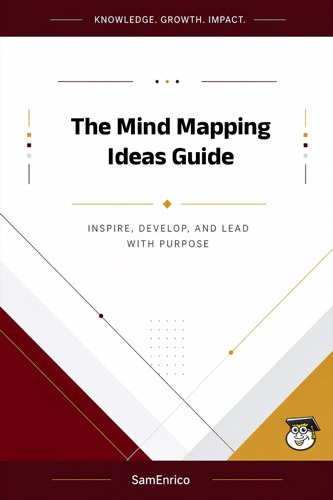
Mind Mapping For Study eBook
Create visual diagrams that show connections betwe
by Harden Tisa
Create visual diagrams that show connections between concepts.
Formats
Free sample
Chapter 1: The Nightmare Before Notes--It is 11:47 PM. You have been staring at the same paragraph for forty-five minutes. Your highlighter has become a weapon of self-deception—you have colored nearly every word on the page, which means you have effectively highlighted nothing. Your notes, if they can be called that, are a dense forest of abbreviations, arrows, and desperate underlining. Somewhere in the margins, you have written “THIS WILL BE ON THE TEST” three times, each with an increasing number of exclamation points.
You have re-read the same sentence about mitochondrial membranes so many times that the words have dissolved into meaningless sounds. Your coffee is cold. Your back hurts. And somewhere in the back of your exhausted mind, a terrible suspicion is growing: you are not actually learning anything.You are not alone.This is the secret shame that haunts lecture halls and libraries across the world. Students spend hundreds of hours hunched over textbooks, rewriting notes, highlighting passages, and re-reading chapters, only to sit down for an exam and feel the horrifying sensation of information dissolving like sugar in water.
The problem is not your intelligence. The problem is not your work ethic. The problem is not even the professor or the textbook. The problem is the tool you are using to capture information. You are trying to store a three-dimensional, interconnected, radiant world of knowledge inside a straight line.
You are trying to put an ocean into a garden hose.This chapter will show you why your brain rebels against linear notes, how the architecture of your neurons demands a different approach, and why a single blank page—drawn correctly—can replace fifty pages of traditional notes. By the time you finish reading, you will understand not just how mind mapping works, but why your brain has been begging you to use it all along.The Confession Booth: What Every Student Knows But Rarely Admits Before we talk about solutions, let us name the enemy. For just a moment, put aside the polite fiction that your current study methods are working. Let us be honest about what actually happens when you take traditional linear notes.You sit in a lecture hall. The professor speaks at a rate of approximately 120 to 160 words per minute.
You write at a rate of approximately 20 to 30 words per minute. This mathematical impossibility means you are already falling behind before the lecture begins. You cannot possibly capture everything, so you make choices. You abbreviate. You skip transition words.
You develop a frantic shorthand that you will not be able to decipher tomorrow. By the time you write down the first half of a complex idea, the professor has moved on to the second half, and you are left with a sentence fragment that floats in isolation, disconnected from the structure that would give it meaning.The result is a strange hybrid: notes that are too detailed to be called an outline and too sparse to be called a transcript. They exist in a cursed middle ground, neither complete enough to stand alone nor structured enough to trigger recall.Then comes the studying. You sit down with your notebook and do what generations of students have done before you: you re-read. You read the same sentences again, hoping that repetition will somehow transmute ink into memory.
But here is the cruel truth that no one tells you—re-reading is one of the most inefficient study methods ever measured. Research in cognitive psychology consistently shows that re-reading creates what scientists call “fluency illusions.” The more times you read a passage, the more familiar it feels. And the more familiar it feels, the more your brain mistakes that familiarity for actual learning. You are not remembering the information. You are remembering the experience of having seen the words before.
These are entirely different neurological events.You might spend three hours re-reading a chapter, close the book, and feel a warm sense of accomplishment. You have done the work. You have put in the time. Surely, the information has lodged itself somewhere in your memory. Then the exam arrives, and the prompt asks you to explain the same concept you read four times.
Your mind goes blank. The information is in there somewhere—you can almost feel it—but you cannot find the neural pathway that leads to it. You are standing in a vast library where every book has been ripped from its shelf and thrown onto a pile. The information exists. But you have lost the map.The Anatomy of a Memory: Why Your Brain Is Not a Filing Cabinet To understand why mind mapping works, you must first understand how your brain actually stores information.
Most people operate under a mistaken model of memory that scientists call the “file cabinet fallacy.” This is the intuitive but incorrect belief that memories are stored in discrete locations, like documents in labeled folders. When you need to remember something, you simply open the correct drawer and pull out the file.This is not how the brain works at all.Your brain contains approximately 86 billion neurons. Each neuron connects to thousands of others, creating a network of roughly 100 trillion connections, or synapses. When you learn something new, you are not placing a file into a drawer. You are growing new connections between neurons.
You are physically altering the architecture of your brain. Every memory is a pattern of activation across this vast network—a specific sequence of neurons firing in a specific order.Here is the crucial insight: your brain stores information associatively. One thought leads to another, which leads to another, in a branching cascade of connections. Think about what happens when someone says the word “apple.” You do not simply retrieve a dictionary definition from a mental filing cabinet. Instead, your brain radiates outward: apple → red → fruit → sweet → pie → grandmother’s kitchen → childhood → memory of a specific orchard.
In less than a second, a single word has activated dozens of associated concepts. This is not a glitch. This is the fundamental operating principle of your nervous system.Now consider how linear notes work. A traditional outline or paragraph forces information into a straight line. Point A leads to point B, which leads to point C.
There is no room for branches, for tangents, for lateral connections. The structure of the notes directly contradicts the structure of your memory. You are using a linear tool to capture a radiant process. No wonder the information does not stick.Mind mapping works because it mirrors the brain’s natural architecture. A mind map begins with a central idea—a single neuron, if you will—and radiates outward along associative branches.
Each branch represents a connection between concepts. Each sub-branch represents a deeper level of association. When you create a mind map, you are not simply recording information. You are building a physical model of how your brain will later need to retrieve that information. The map becomes a training ground for your memory.The 65 Percent Solution: What the Science Actually Says The numbers are worth pausing over.
A meta-analysis published in the journal Educational Psychology Review examined dozens of studies on visual learning techniques and found that students who…
This is the end of the free sample. Get the eBook to keep going. Buy now
About this book
Details
- Author
- Harden Tisa
- Publisher
- SamEnrico
- Language
- English
- Genre
- Non-Fiction, Self-Help, Mind Mapping
- Released
- 2026-06-10
- Pages (approx.)
- 140
- Available as
- eBook, Audiobook

Read better in the ZLOADR app
Your eBooks on your phone or tablet. Sign in with your SamEnrico account and start reading.
More by Harden Tisa
 Homicide Detective Stress GuideHarden Tisa$11.99
 Anger Management Online CourseHarden Tisa$11.99
 Snowboarder Self HypnosisHarden Tisa$11.99
 Senior Visualization GuideHarden Tisa$11.99
 CPR for Trauma VictimsHarden Tisa$11.99
 Goal Setting for Data ScientistsHarden Tisa$11.99
 Eugène Atget: The Ghostly Streets of Old ParisHarden Tisa$11.99
 Byzantium Echoes: The Golden Voice of KassiaHarden Tisa$11.99
 The Essential Guide to Chicago BluesHarden Tisa$11.99
 How to Produce Print ServersHarden Tisa$11.99
 How to Produce Egg CookersHarden Tisa$11.99
 Niger Seed: NyjerHarden Tisa$11.99