
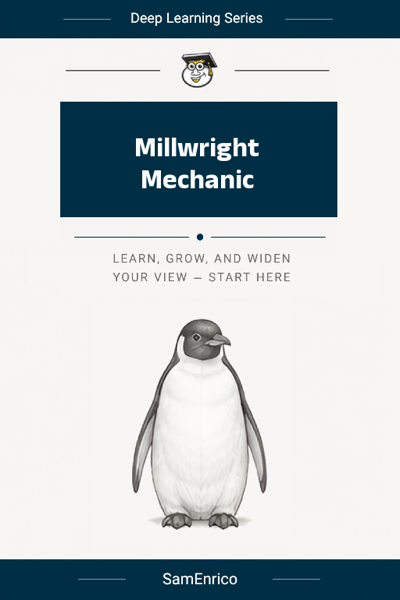
Non-FictionInformativeEducational
Millwright Mechanic Audiobook
A Coursebook on Millwright Mechanic
by Bello Yer
A Coursebook on Millwright Mechanic
Formats
Free sample
Chapter 1: The Bolt That Killed--“ – The call came in at 2:17 AM on a Tuesday. A 4,000-pound press brake had dropped fifteen feet when a single eyebolt sheared. The operator was not under it—miracles still happened. The investigation found a 3/4-inch eyebolt, rated for 5,000 pounds vertical, installed at a 45-degree angle. The side load reduced its capacity to 1,500 pounds.
The rigging plan had been a verbal “that looks about right.” Three people almost died because no one had read the load chart.”The Millwright’s First Question: “What Can Kill Me?”Before you touch a wrench, before you open a blueprint, before you calculate a single decimal—you ask one question. What can kill me? This is not pessimism. This is professionalism. The millwright trade has no room for the reckless, the hurried, or the arrogant.
Every machine in every plant in every industry is a collection of stored energies waiting to be released. Your job is not to release them. Your job is to control them, redirect them, or render them safe before you put your hands anywhere near moving parts.This chapter establishes the identity and legal framework of the modern millwright, but more critically, it argues that safety is not a separate activity you complete before starting work. Safety is the work. Safety is the workflow.
Safety is the decision-making framework that governs every measurement, every lift, every torque value, and every alignment tolerance you will ever perform. The millwright who separates safety from skill is the millwright who goes home in an ambulance—or does not go home at all.The Evolution of a Dangerous Trade The word “millwright” comes from two Old English roots: “mill” (a grinding apparatus) and “wright” (a builder or repairer). For five hundred years, millwrights built watermills and windmills from timber, cutting gears by eye and setting stones by feel. The Industrial Revolution transformed them into iron workers, erecting steam engines and line shafts. The 20th century added electricity, hydraulics, pneumatics, and electronics.
Through all this change, one constant remained: the millwright works at the intersection of man, machine, and stored energy.What has changed is the expectation of precision. A millwright in 1850 worked to the thickness of a thumbnail—perhaps 1/16 of an inch. A millwright in 1950 worked to 0.005 inches using dial indicators. A millwright today works to 0.001 inches or finer, using lasers and vibration analyzers. The tools…
This is the end of the free sample. Get the Audiobook to keep going. Buy now
About this book
Details
- Author
- Bello Yer
- Publisher
- SamEnrico
- Language
- English
- Genre
- Non-Fiction, Informative, Educational
- Released
- 2026-05-11
- Pages (approx.)
- 148
- Available as
- eBook, Audiobook

Listen in the VoxFlicks app
Audiobooks and audio dramas wherever you go. Sign in with your SamEnrico account and press play.
More by Bello Yer
 Sports Nutrition HandbookBello Yer$11.99
 Assertiveness In Healthcare Teams HandbookBello Yer$11.99
 ABCDE for Medical DecisionsBello Yer$11.99
 The Arthritis Heat Cold Therapy GuideBello Yer$11.99
 ABCDE For Garden PlanningBello Yer$11.99
 The Silk Road Tycoons: The Black Merchants of the Indian OceanBello Yer$11.99
 Energy ACE Rwanda GuideBello Yer$12.99
 VAT Group Registration GuideBello Yer$12.99
 Understanding Rigid Spine SyndromeBello Yer$17.99
 How to Start a Drawing Pin Business (Beginners Guide)Bello Yer$11.99
You may also like
 Hong Kong Handover 1997Dunn Johnnie$11.99
 Zumba For Postnatal Recovery CourseNeal Christian$11.99
 Zumba for BeginnersLadner Nikia$11.99
 YouTube Comment Mining GuideHumes Pandora$12.99
 Worry Box MeditationCarlin Rudy$11.99
 Workplace Stress MeditationNguyen Lynn$11.99
 Workplace Stress and Sleep RepairHawley Ivory$11.99
 Workplace Perfectionism CureDelaney Jeffry$11.99
 Workplace Injustice Anger GuideWallen Isabelle$11.99
 Work Addiction and Burnout LinkGreenwood Ester$11.99
 Women in Yoga and WellnessBeattie Galina$11.99
 Women in Stand Up ComedyChun Evangeline$11.99