
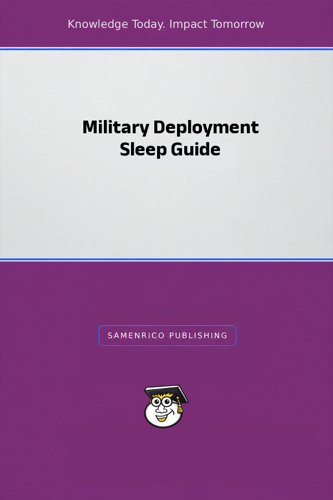
Military Deployment Sleep Guide
Rests in combat zones when possible.
by Arce Rosio
Rests in combat zones when possible.
Formats
About this book
Free sample
Chapter 1: The Adrenaline Trap...--–- The engine of the MRAP had been silent for forty-seven minutes. Sergeant First Class Marcus Donovan knew this because he had been counting the seconds since the last mortar impact, not out of fear but out of a desperate, almost pathetic hope that the silence would finally allow him to sleep. His body was a furnace of exhaustion—eyes gritty, limbs heavy, thoughts moving through molasses. Yet every time he closed his eyes, his heart resumed its gallop. He could feel his pulse in his temples, in his throat, in the hollow of his wrists.
The firefight had ended three hours ago. The adrenaline, however, had not received the message.Donovan is not a weak soldier. He is not untrained. He is not anxious in the clinical sense. He is simply human, and his brain is doing exactly what evolution designed it to do: keeping him alive by keeping him awake.
The problem is that the threat is gone, but his neurochemistry remains stuck in the "kill" setting. This is the Adrenaline Trap, and it is the single greatest obstacle to tactical rest in a combat zone.This chapter explains the physiological and neurological reasons why soldiers cannot sleep during lulls, even when they desperately need to. We will explore the biology of the stress response, the architecture of the body's internal clock, and the concrete, measurable ways that sleep deprivation degrades combat performance. By the end of this chapter, you will understand why your body betrays your intentions to rest—and more importantly, you will have the first set of tools to begin reversing that betrayal.The Neurobiology of the Adrenaline Crash To understand why sleep eludes you after combat, you must first understand the sympathetic nervous system (SNS). Think of the SNS as your body's internal warfare department.
When a threat appears—an IED blast, small-arms fire, a near-miss from a rocket—the SNS activates what is colloquially known as the "fight or flight" response. The brain's amygdala, acting as a threat radar, signals the hypothalamus, which in turn activates the adrenal glands. Within…
This is the end of the free sample. Get the eBook to keep going. Buy now
Contents
- Chapter 1
- Chapter 2
- Chapter 3
- Chapter 4
- Chapter 5
- Chapter 6
- Chapter 7
- Chapter 8
- Chapter 9
- Chapter 10
- Chapter 11
- Chapter 12
Details
- Author
- Arce Rosio
- Publisher
- SamEnrico
- Language
- English
- Genre
- Non-Fiction, Self-Help, Military
- Released
- 2026-06-09
- Pages (approx.)
- 151
- Available as
- eBook, Audiobook

Read better in the ZLOADR app
Your eBooks on your phone or tablet. Sign in with your SamEnrico account and start reading.
More by Arce Rosio
 Large Animal Disaster PlanningArce Rosio$11.99
 Restless Leg Syndrome Complete Self Care GuideArce Rosio$11.99
 Canning GeorgeArce Rosio$11.99
 The Koresh MyopiaArce Rosio$11.99
 Raimi Spidey EnergyArce Rosio$11.99
 Nefertiti Beauty QueenArce Rosio$11.99
 Catherine the Great's Noble Control WorkbookArce Rosio$11.99
 Memory Palace For ActorsArce Rosio$11.99
 The Raven’s Gambit: A Navajo Spy’s Shadow WarArce Rosio$11.99
 Whispers of the First Law: The Lost Code of HammurabiArce Rosio$11.99
 The Great Train Robbery Heist: A Diamond in the RoughArce Rosio$11.99
 The Dancer's Guide to ArdhaArce Rosio$11.99
You may also like
 Hong Kong Handover 1997Dunn Johnnie$11.99
 Zumba For Postnatal Recovery CourseNeal Christian$11.99
 Zumba for BeginnersLadner Nikia$11.99
 YouTube Comment Mining GuideHumes Pandora$12.99
 Worry Box MeditationCarlin Rudy$11.99
 Workplace Stress MeditationNguyen Lynn$11.99
 Workplace Stress and Sleep RepairHawley Ivory$11.99
 Workplace Perfectionism CureDelaney Jeffry$11.99
 Workplace Injustice Anger GuideWallen Isabelle$11.99
 Work Addiction and Burnout LinkGreenwood Ester$11.99
 Women in Yoga and WellnessBeattie Galina$11.99
 Women in Stand Up ComedyChun Evangeline$11.99