
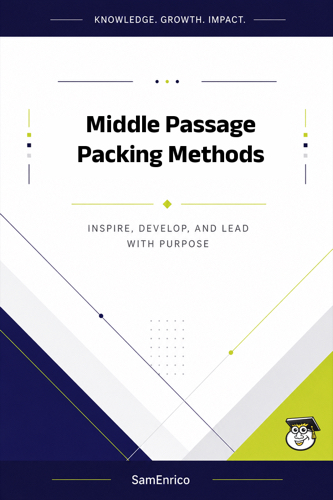
Middle Passage Packing Methods Audiobook
Examine how human beings were stacked like cargo t
Examine how human beings were stacked like cargo to maximize profit per voyage.
Formats
Free sample
Chapter 1: The Captain’s Ledger...--–- The journal entry is dated April 14, 1752. The handwriting is neat, almost fussy—the script of a man who prides himself on precision. “Stowed 132 negroes between decks. Losses: 3. Profit: £2,100.” No flourish.
No moral hesitation. Just the clean arithmetic of commerce. The man who wrote these words would later compose one of the most beloved hymns in Christian history. His name was John Newton, and in 1752, he was the captain of a slave ship called the Duke of Argyle. Twenty years later, he would renounce the trade, become an Anglican priest, and write “Amazing Grace.” But on that April day, he was not a man of God.
He was a logistician. And his ledger was the Bible of the Middle Passage.This chapter is about that ledger—not as a metaphor, but as a technology. The slave ship captain’s logbook was the first link in a chain of calculation that stretched from the coast of West Africa to the auction blocks of Jamaica and Virginia. It contained no poetry, no remorse, and very few names. It contained numbers.
And those numbers, when read correctly, reveal the central operating system of the transatlantic slave trade: the brutal, elegant, and wholly inhuman logic of packing.To understand how 12.5 million human beings were transported across the Atlantic in the holds of wooden ships, you must first understand that their captors did not see themselves as monsters. They saw themselves as businessmen. And businessmen, then as now, keep ledgers.The Two Schools of Thought Every industry has its internal debates. The slave trade was no exception. By the mid-eighteenth century, British, French, Portuguese, and Dutch slave merchants had divided into two warring camps.
They did not disagree about the morality of enslaving human beings. They disagreed about geometry.The first camp advocated for what was called tight packing. The philosophy was simple: cram as many captives as possible into the hold. Stack them like firewood. Ignore comfort entirely.
Yes, tight packing killed more people. Dysentery spread faster. Wounds festered. The stronger captives crushed the weaker ones. But the merchants who favored tight packing had done the math, and the math was brutal.Consider a hypothetical slave ship of 200 tons.
If you pack loosely—giving each captive roughly six feet of length and two feet of width—you can carry about 300 people. Historically, loose packing resulted in a mortality rate…
This is the end of the free sample. Get the Audiobook to keep going. Buy now
About this book
Details
- Author
- Estrella Magaly
- Publisher
- SamEnrico
- Language
- English
- Genre
- Non-Fiction, History, Cruelty
- Released
- 2026-06-06
- Pages (approx.)
- 102
- Available as
- eBook, Audiobook

Listen in the VoxFlicks app
Audiobooks and audio dramas wherever you go. Sign in with your SamEnrico account and press play.
More by Estrella Magaly
 Remote Work Focus EnvironmentEstrella Magaly$11.99
 Youth Sports Coach LegendEstrella Magaly$11.99
 Waterproof Gear PFAS DangerEstrella Magaly$11.99
 Success Without Burnout for CreativesEstrella Magaly$11.99
 Major Depressive Disorder Explained for FamiliesEstrella Magaly$11.99
 Loving Kindness for AcupunctureEstrella Magaly$11.99
 Digital Resilience TrainingEstrella Magaly$11.99
 The Dubai Mirage: The Billion-Dollar Pyramid Scheme That Shook the Middle EastEstrella Magaly$11.99
 The Butcher of the Outback: Australia’s Most Disturbing Highway KillerEstrella Magaly$11.99
 Service Providers Guide to Office OrganizersEstrella Magaly$11.99
 International Student Application EssaysEstrella Magaly$12.99
 Risk Mitigation One PagerEstrella Magaly$12.99
You may also like
 Hong Kong Handover 1997Dunn Johnnie$11.99
 Zumba For Postnatal Recovery CourseNeal Christian$11.99
 Zumba for BeginnersLadner Nikia$11.99
 YouTube Comment Mining GuideHumes Pandora$12.99
 Worry Box MeditationCarlin Rudy$11.99
 Workplace Stress MeditationNguyen Lynn$11.99
 Workplace Stress and Sleep RepairHawley Ivory$11.99
 Workplace Perfectionism CureDelaney Jeffry$11.99
 Workplace Injustice Anger GuideWallen Isabelle$11.99
 Work Addiction and Burnout LinkGreenwood Ester$11.99
 Women in Yoga and WellnessBeattie Galina$11.99
 Women in Stand Up ComedyChun Evangeline$11.99