
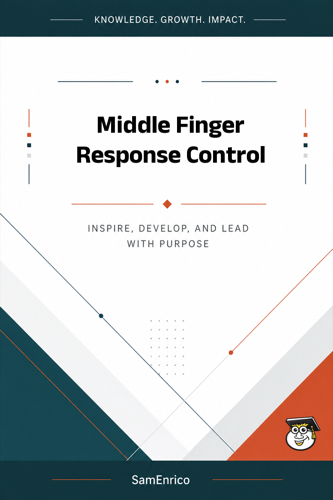
Non-FictionSelf-HelpImpulse Control
Middle Finger Response Control eBook
Teaches keeping both hands on the wheel to avoid r
Teaches keeping both hands on the wheel to avoid reactive gestures.
Formats
Free sample
Chapter 1: The Illusion of Justice--–- The finger shoots up before you decide to give it. That is the first and most important fact to understand about the middle finger response. It does not arrive after careful deliberation, after weighing the pros and cons, after consulting your moral compass. It arrives like a sneeze—sudden, explosive, and seemingly beyond your control. You feel the insult—a driver cutting across three lanes without a signal, brake lights flashing in your face, a horn blaring from behind—and your hand is already in the air before your brain has finished processing what just happened.This is not a failure of character.
It is not evidence that you are a bad person, an angry person, or a person who cannot control their temper. It is, quite simply, evidence that you have a human nervous system. And that nervous system evolved in a world very different from the one you navigate every morning on the interstate.The middle finger is not a decision. It is a reaction. And reactions, by definition, bypass the very parts of your brain that make you capable of choice.
This chapter is about understanding that mechanism so thoroughly that you can no longer lie to yourself about what the finger actually accomplishes. Because here is the uncomfortable truth that every driver who has ever flipped someone off needs to confront: the middle finger has never once improved a single situation. Not once. Not in the history of traffic. And the sooner you accept that, the sooner you can begin to dismantle the illusion that keeps you reaching for it again and again.The Anatomy of a Split-Second Let us walk through the neurology of the flip-off moment in slow motion, because what happens inside your skull in that half-second is nothing short of a biological civil war.You are driving home from work.
It has been a long day. Your shoulders are tight, your jaw is clenched, and you are already running late for dinner. You are in the middle lane, maintaining a safe following distance, when a sedan from the far right lane—no signal, no warning—swerves directly into the space you were occupying. You brake hard. Your coffee tips.
Your heart rate spikes from seventy beats per minute to one hundred and twenty in less than two seconds. And then, before you know what is happening, your left hand lifts off the steering wheel and your middle finger extends toward the sedan’s rear windshield.From the outside, it looks like a choice. From the inside, it feels like a choice. But it is not. Here is what actually happened inside your brain.The first system to activate was your amygdala—two small almond-shaped clusters of neurons deep within your temporal lobes.
The amygdala does not think. It does not reason. It does not ask questions like “Was that intentional?” or “Is this worth my energy?” The amygdala scans the environment for threats, and when it finds one, it sounds the alarm. To your amygdala, a sudden lane change at sixty-five miles per hour is not a traffic violation. It is a predator.
It is a physical threat to your survival. And the amygdala’s response to a predator is not to pause and reflect. Its response is to flood your body with stress hormones—cortisol, adrenaline, norepinephrine—and to prepare you for fight or flight.Notice that there is no option in that list for “politely express displeasure from a distance.” The amygdala does not have a “middle finger” circuit. What it has is a fight circuit. And the middle finger is simply the most socially acceptable (and legally safe) expression of the fight impulse available to a person strapped into a driver’s seat.Within three hundred milliseconds of the sedan’s merge, your amygdala had already done its damage.
Your heart was pounding. Your palms were sweating. Your muscles were tense. And your prefrontal cortex—the part of your brain responsible for impulse control, long-term planning, and social reasoning—was still booting up. By the time your prefrontal cortex came online, usually around five hundred to seven hundred milliseconds after the trigger, your hand was already in the air.You did not choose to flip that driver off.
Your amygdala chose for you. And your prefrontal cortex, arriving late to the scene, simply inherited the action and retroactively stamped it with the illusion of choice.This is not speculation. This is the standard model of affective neuroscience, confirmed by decades of research beginning with Joseph Le Doux’s work on the amygdala’s “low road” to emotional response. The low road is fast, automatic, and unconscious. The high road—through the sensory cortex to the thalamus to the prefrontal cortex—is slow, deliberate, and conscious.
By the time the high road arrives, the low road has already driven the car off the cliff.The Illusion of Justice Now we arrive at the most dangerous part of the middle finger response: what happens after the finger is already up. Because the moment your prefrontal cortex catches up to the action, it does not simply register what happened and move on. It tells you a story. And that story is almost always wrong.The story goes something like this: “That driver deserved it. They need to know that what they did was wrong.
Someone has to teach them a lesson. If no one ever calls out bad behavior, the roads will descend into chaos. I am not just reacting—I am administering justice.”This is the illusion of justice. And it is one of the most seductive cognitive traps in human experience.The illusion works like this: You feel the urge to punish someone who has wronged you. Your brain, desperate to make sense of that urge, retroactively constructs a moral justification for it.
“They deserve it.” “They need to learn.” “Someone has to stand up to bullies.” These justifications feel true because they arrive wrapped in the language of fairness and social order. But they are post-hoc rationalizations, not pre-action reasons. You are not flipping someone off because they deserve it. You are constructing the belief that they deserve it because you are already flipping them off.The evidence for this is clear and uncomfortable. Ask any driver, immediately after they have flipped someone off, why they did it.
They will give you a story about the other driver’s behavior: the cut-off, the tailgating, the brake check. Now ask them what they hope to accomplish. They will say something about teaching the other driver a lesson, or making them aware of their mistake, or simply expressing justified anger. Now follow up one week later and ask them whether the other driver’s behavior has changed as a result of the middle finger. The answer, invariably, is that they have no idea.
They never saw that driver again. They have no evidence whatsoever that the finger had any impact at all.And yet the illusion persists. Why?Because the middle finger provides immediate emotional relief. That relief is real. When you extend your middle finger, your brain releases a small amount of dopamine—the same neurotransmitter involved…
This is the end of the free sample. Get the eBook to keep going. Buy now
About this book
Details
- Author
- Davila Therese
- Publisher
- SamEnrico
- Language
- English
- Genre
- Non-Fiction, Self-Help, Impulse Control
- Released
- 2026-06-07
- Pages (approx.)
- 124
- Available as
- eBook, Audiobook

Read better in the ZLOADR app
Your eBooks on your phone or tablet. Sign in with your SamEnrico account and start reading.
More by Davila Therese
 The Withdrawal Cash Buffer GuideDavila Therese$11.99
 The Graduation CeremonyDavila Therese$11.99
 The Missing Milestone GuideDavila Therese$11.99
 Travel Friendly Stretching RoutinesDavila Therese$11.99
 Blood Moon Betrayal: The Last Dance of the Mayan KingsDavila Therese$11.99
 Operation Midnight Sun: The Untold Story of the 1980s Arctic Spy SwapDavila Therese$11.99
 Understanding Bardet–biedl Syndrome, Type 1Davila Therese$17.99
 One Page Webinar Funnel PlannerDavila Therese$12.99
 Gen X Home Improvement SpendingDavila Therese$12.99
 Game Console Developer Tools EngineerDavila Therese$11.99
 10 Ways to Use Chilled Soup (Recipe Book)Davila Therese$11.99
You may also like
 Hong Kong Handover 1997Dunn Johnnie$11.99
 Zumba For Postnatal Recovery CourseNeal Christian$11.99
 Zumba for BeginnersLadner Nikia$11.99
 YouTube Comment Mining GuideHumes Pandora$12.99
 Worry Box MeditationCarlin Rudy$11.99
 Workplace Stress MeditationNguyen Lynn$11.99
 Workplace Stress and Sleep RepairHawley Ivory$11.99
 Workplace Perfectionism CureDelaney Jeffry$11.99
 Workplace Injustice Anger GuideWallen Isabelle$11.99
 Work Addiction and Burnout LinkGreenwood Ester$11.99
 Women in Yoga and WellnessBeattie Galina$11.99
 Women in Stand Up ComedyChun Evangeline$11.99