
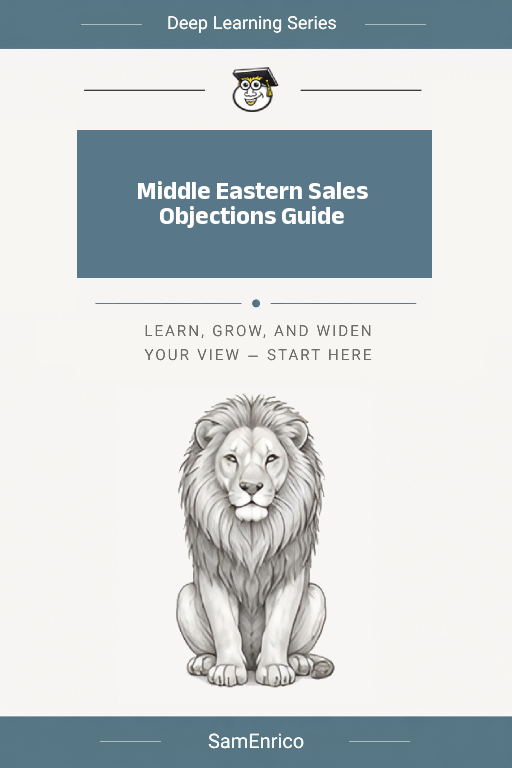
Non-FictionBusiness BriefObjection Handling
Middle Eastern Sales Objections Guide eBook
Handle price pushback, we already have a supplier,
Handle price pushback, we already have a supplier, and come back later with culturally appropriate responses.
Formats
Free sample
Chapter 1: The Insha’Allah Code...--–- The first time I lost a seven-figure deal in the Gulf, it wasn’t because my price was too high, my product was inferior, or my competitor was better. I lost it because I didn’t understand a single word: Insha’Allah.I had flown from London to Dubai for a single meeting with the procurement director of a mid-sized construction conglomerate. We had exchanged seventeen emails. The samples had been approved. The logistics had been mapped.
The client’s team had visited our factory in Germany. Everything pointed to a signature. When I presented the final contract, the director leaned back, smiled warmly, and said, “Insha’Allah, we will review and come back to you.”I heard “maybe.” I heard “polite no.” I heard the beginning of the end.So I did what most Western salespeople do. I pushed for a date. “When exactly?” I asked.
“Next week?” He repeated, “Insha’Allah.” I pushed again. “I need to book my return flight. Can you give me a specific day?” His smile faded. The warmth cooled. The meeting ended abruptly.
I flew home empty-handed.Three months later, I learned through a mutual contact that the deal had gone to a Turkish supplier who had done something I had not: they heard Insha’Allah, nodded, and asked a different question. Not “when,” but “who else?”That question changed everything.That Turkish supplier discovered that the procurement director did not have unilateral authority. His father, the founder, was still alive and still signed every check above five hundred thousand dirhams. The director could not say “I need my father’s approval” without losing face. So he said Insha’Allah instead.
The Turkish supplier asked, “Who else would like to see this proposal to feel comfortable?” The director admitted, quietly, “My father.” An introduction was arranged. The deal closed within two weeks.I had treated Insha’Allah as a brush-off. It was actually a timeline. A map. A coded message that said, “I cannot tell you the real reason, but if you ask the right question, I will show you the way.”This chapter is about decoding that message.
Because in Middle Eastern sales, Insha’Allah is not the end of the conversation. It is the beginning of the real one.The Western Trap: Why We Misread “God Willing”To understand why Western salespeople fail with Insha’Allah, we must first understand the cultural software we are running.Western business culture, particularly American and Northern European, is built on what anthropologists call low-context communication. In low-context cultures, the meaning is in the words. When an American says, “I will get back to you on Tuesday,” they almost always mean Tuesday. When a German says, “That price is too high,” they usually mean the price is too high.
Directness is a virtue. Clarity is a sign of respect.Middle Eastern business culture, by contrast, is high-context. The meaning is not in the words. It is in the relationship, the hierarchy, the history, and the unspoken constraints. What is said is often less important than what is not said.
Direct refusal is considered rude because it forces the other person to lose face. So instead of saying “no,” a buyer might say “Insha’Allah” – God willing. Instead of saying “I don’t have the authority,” they might say “We will see.” Instead of saying “your price is too high,” they might say “We like your product very much.”The Western salesperson hears these phrases and translates them through their own low-context filter. Insha’Allah becomes “probably not.” “We will see” becomes “stop bothering me.” “We like your product very much” becomes “we are about to buy.”Both translations are wrong.And both translations lose deals.What Insha’Allah Actually Means (And What It Does Not)Let us start with the literal meaning. Insha’Allah (إن شاء الله) translates to “if God wills.” It appears in the Quran as a reminder that no human can predict the future with certainty.
In daily Arab life, it is used constantly – for small things (“I will call you tomorrow, Insha’Allah”) and for large things (“The peace talks will succeed, Insha’Allah”).Because it is used so frequently, Westerners often dismiss it as verbal filler – a linguistic tic with no real meaning. This is a catastrophic mistake.In a sales context, Insha’Allah performs four specific functions, none of which are “no.”Function One: Buying Time for Internal Approvals As in the opening story, the buyer may need to consult a father, uncle, partner, board, or senior executive before committing. They cannot say “I need to ask my father” because that would reveal a lack of authority – a loss of face. Insha’Allah allows them to preserve dignity while buying the necessary time.Function Two: Testing Your Patience and Trustworthiness In Middle Eastern business culture, patience is a virtue. A buyer who says Insha’Allah may be watching to see how you react.
Do you push? Do you get frustrated? Do you respect their timeline? How you handle Insha’Allah tells them whether you are a transactional vendor or a long-term partner. Push too hard, and you fail the test.Function Three: Deferring a Decision You Are Not Ready to Make Sometimes the buyer genuinely wants to buy, but the timing is wrong.
Their budget is allocated for next quarter. Their warehouse is full. Their own customer has delayed a project. Insha’Allah is their way of saying “not yet” without killing the deal.Function Four: A Polite “No” That Invites a Better Question And yes, sometimes Insha’Allah means no. But here is the crucial insight: even when it means no, it is not a final no.
It is a “no to the current offer, but yes to a different conversation.” The buyer is leaving the door open for you to come back with something better – a different price, a different payment term, a different value proposition.The mistake Western salespeople make is treating all four functions identically. They hear Insha’Allah and either give up or push for a date. Neither response works for all four scenarios.What works is a diagnostic approach. You must determine which Insha’Allah you are hearing before you decide how to respond.The Three-Tier Insha’Allah Framework Based on analysis of hundreds of closed deals across the GCC, I have developed a diagnostic framework that distinguishes between the three real meanings hidden behind the word Insha’Allah.Note carefully: the buyer uses the same word for all three. The difference is not in the word itself but in the context and your follow-up questions.Tier One: Insha’Allah (Price)What the buyer actually means: “I want your product, but your price is higher than what I am willing to pay – or higher than what I told my boss I would pay.”How to identify it: The buyer has already seen your pricing.
They have engaged with your proposal. They have not introduced another decision-maker. When you ask about timeline, they hesitate but do not deflect.The wrong response: Immediately dropping your price. This signals that your first price was dishonest and invites further negotiation.The right response: Ask a…
This is the end of the free sample. Get the eBook to keep going. Buy now
About this book
Details
- Author
- Castillo Bonnie
- Publisher
- SamEnrico
- Language
- English
- Genre
- Non-Fiction, Business Brief, Objection Handling
- Released
- 2026-06-01
- Pages (approx.)
- 139
- Available as
- eBook, Audiobook

Read better in the ZLOADR app
Your eBooks on your phone or tablet. Sign in with your SamEnrico account and start reading.
More by Castillo Bonnie
 Self Esteem for Stretch MarksCastillo Bonnie$11.99
 Name Recall for NetworkingCastillo Bonnie$11.99
 Divorce and RetirementCastillo Bonnie$11.99
 Tobacco Freedom AffirmationsCastillo Bonnie$11.99
 PTSD DiagnosisCastillo Bonnie$11.99
 Gaming Industry Capital PlanCastillo Bonnie$11.99
 Unity Principle GuideCastillo Bonnie$11.99
 Pauling Linus Pauling InstituteCastillo Bonnie$11.99
 Kali's Dance of Destruction: The Black Goddess UnleashedCastillo Bonnie$11.99
 The Last Circus of the Roman EmpireCastillo Bonnie$11.99
 Ultimate Handbook Guide to Jiangdu : (China) Travel GuideCastillo Bonnie$11.99
 How to Produce Food Dehydrator AccessoriesCastillo Bonnie$11.99
You may also like
 Hong Kong Handover 1997Dunn Johnnie$11.99
 Zumba For Postnatal Recovery CourseNeal Christian$11.99
 Zumba for BeginnersLadner Nikia$11.99
 YouTube Comment Mining GuideHumes Pandora$12.99
 Worry Box MeditationCarlin Rudy$11.99
 Workplace Stress MeditationNguyen Lynn$11.99
 Workplace Stress and Sleep RepairHawley Ivory$11.99
 Workplace Perfectionism CureDelaney Jeffry$11.99
 Workplace Injustice Anger GuideWallen Isabelle$11.99
 Work Addiction and Burnout LinkGreenwood Ester$11.99
 Women in Yoga and WellnessBeattie Galina$11.99
 Women in Stand Up ComedyChun Evangeline$11.99