

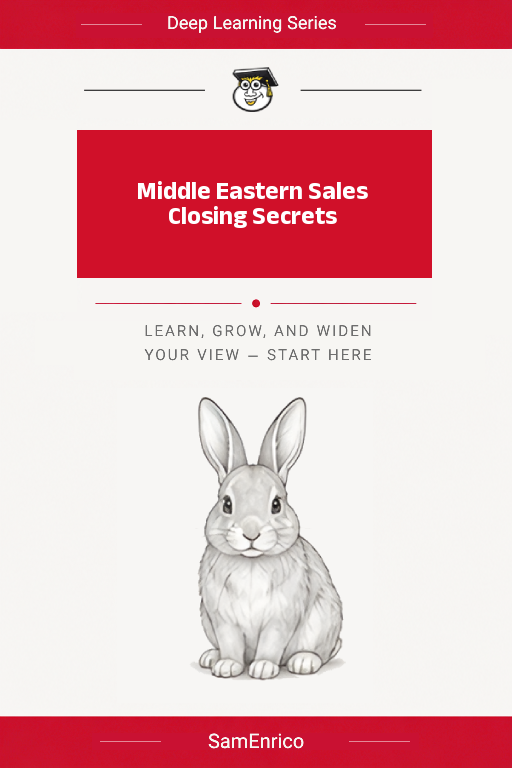
Middle Eastern Sales Closing Secrets eBook
Recognize verbal and non-verbal closing signals un
by Pyle Santa
Recognize verbal and non-verbal closing signals unique to Arab business culture.
Formats
Free sample
Chapter 1: The Silent Auditorium--–- The room was designed for listening, not speaking.I learned this the hard way on a Sunday morning in Jeddah, sitting on a worn cushion in a majlis that smelled of cardamom and old carpets. The walls were lined with books I could not read. The windows faced east, toward Mecca. And seven men in white thobes sat in a semicircle, watching me with the patience of desert hunters.I was twenty-eight years old, freshly promoted to Regional Sales Manager for a European logistics firm. I had closed deals in Frankfurt, Milan, and London.
I had a MBA from a good school. I had a Power Point deck with seventy-two slides, each one meticulously crafted to prove that my company's cold chain solution was superior to anything else in the Saudi market.I was also about to lose $2.4 million before I even said hello.The man who had invited me was named Faisal. He was the Operations Manager, young, energetic, educated in the United States. He spoke English with a slight Texan drawl from his years in Houston. We had exchanged fourteen emails over the previous month.
He had seen our brochures. He had reviewed our case studies. He had assured me that the meeting was "just a formality.""This is my uncle, Abu Abdullah," Faisal said, gesturing toward a man in the corner. The uncle was older, perhaps sixty, with a gray beard and eyes that seemed to look through me rather than at me. He wore a simple white thobe and a red ghutra held in place by a black agal.
He did not stand. He did not smile. He nodded once, and then his gaze drifted to the window.I made a mental note: Uncle. Probably retired. Not important.That mental note would cost me my job.The other five men were introduced as "colleagues" and "advisors." Their names blurred together in my memory almost immediately.
I was focused on Faisal. He was my champion. He was the one who had responded to my emails. He was the one who spoke my language, literally and figuratively.I opened my laptop. I connected it to the projector they had provided.
And I began to speak.The Presentation That Fooled Only Me For forty minutes, I performed the ritual that had worked everywhere else in the world. I walked through our company history – founded in 1972, publicly listed in 1998, operations in thirty countries. I presented our technical specifications – temperature ranges, backup systems, fuel efficiency metrics. I showcased our case studies – a pharmaceutical distributor in Germany, a food retailer in France, a hospital network in Italy.Faisal asked excellent questions. He challenged our assumptions about delivery timelines.
He probed our warranty terms. He wanted to know how we handled customs clearance in the region. I answered each question with enthusiasm, pulling up slides I had prepared for exactly these objections.The other six men sat in silence.Not the silence of boredom or distraction. I had seen those silences before. This was different.
This was the silence of an audience watching a play they had already decided to dislike. Their faces were masks. Their hands rested on their knees, motionless. Their eyes followed me, but their attention seemed to be elsewhere.I told myself they were impressed. I told myself they were simply letting Faisal do the talking because he was the most qualified.
I told myself that silence meant consent.Every single one of those assumptions was wrong.At minute forty-one, I reached the pricing slide. I had agonized over this number for days. Too high, and I would be rejected outright. Too low, and I would leave money on the table. I had settled on $2.4 million for the full implementation, including training and two years of on-site support.I presented the number.
I stopped talking.And the room became a tomb.Five seconds passed. Ten seconds. Fifteen. No one moved. No one coughed.
No one shuffled papers. The air itself seemed to thicken.My Western-trained brain went into full panic mode. In every sales training I had ever received, silence was the enemy. Silence meant objection. Silence meant confusion.
Silence meant the prospect was waiting for you to clarify, to justify, to concede.So I did what I had been trained to do. I filled the void."Of course," I said, hearing my voice crack slightly, "that's our standard rate for European clients. Given the size of this opportunity and our desire to establish a foothold in the Saudi market, I'm confident we could reduce the implementation fee by fifteen percent. And perhaps we could structure the support payments quarterly instead of annually. That would bring the effective first-year cost down to approximately..."I kept talking.
I offered a discount before anyone had asked for one. I restructured payment terms before anyone had complained. I devalued my own service in real time, watching my margins evaporate like morning mist.Faisal looked at his uncle.Abu Abdullah looked at the window.Then, slowly, with the deliberation of a man who had never been rushed in his life, Abu Abdullah stood up. He adjusted his ghutra. He nodded once at Faisal.
And he walked out of the room.The other five men followed him. Not hurriedly. Not rudely. They simply stood, one by one, and left. Within thirty seconds, Faisal and I were alone."That was very informative," Faisal said, standing to shake my hand.
His grip was brief, his eyes fixed on my tie rather than my face. "We will be in touch, Inshallah."I flew back to London believing I had done well. I had answered every question. I had offered flexibility on price. I had been proactive and accommodating.Three months later, I learned that the deal had gone to a local competitor.
Their price was higher than mine. Their technology was older. Their support team was smaller.But their salesperson had done one thing I had not. He had sat in silence after presenting his price. He had waited.
And when Abu Abdullah had finally spoken, it was to say, "Bring the contract tomorrow."I did not lose on price. I lost on patience. I lost on the single most important skill in Gulf sales: the ability to recognize that silence is not a question. It is a test.And I had failed so completely that I did not even know I was being examined.The Architecture of the Majlis Let me describe the room again, because I want you to understand how much information I missed.The majlis in Jeddah was approximately twenty feet by thirty feet. The entrance was on the south wall.
Directly opposite the entrance, against the north wall, was a single large cushion. This was the seat of honor, reserved for the most senior person present.I did not sit there. I knew enough to avoid that. But I also did not sit where I was directed – because no one directed me. Instead, I chose a seat near the projector connection, which happened to be against the east wall, far from the north.That choice was my first mistake.In Gulf culture, seating is not casual.
It is a map of the hierarchy. The most senior person sits in the position where they can see everyone…
This is the end of the free sample. Get the eBook to keep going. Buy now
About this book
Details
- Author
- Pyle Santa
- Publisher
- SamEnrico
- Language
- English
- Genre
- Non-Fiction, Business Brief
- Released
- 2026-05-28
- Pages (approx.)
- 160
- Available as
- eBook, Audiobook

Read better in the ZLOADR app
Your eBooks on your phone or tablet. Sign in with your SamEnrico account and start reading.
More by Pyle Santa
 Creative Visualization GuidePyle Santa$11.99
 Hospice Nurse Death Dying GuidePyle Santa$11.99
 Healing Body Shame Comprehensive WorkbookPyle Santa$11.99
 Body Scan For Altitude SicknessPyle Santa$11.99
 Kilimanjaro Rescue LeaderPyle Santa$11.99
 Crowded Space Anger GuidePyle Santa$11.99
 Bachelor Nation ConfessionsPyle Santa$11.99
 Nonprofit Mission Driven OverworkPyle Santa$11.99
 The Purple Robe Conspiracy: Blood and Silk in the Byzantine CourtPyle Santa$11.99
 Hearts of Iron and Stone: Love in the Baltic CrusadesPyle Santa$11.99
 The Mineral Guide to AndalusitePyle Santa$11.99
 Student Part Time Work Rules in ChinaPyle Santa$12.99
You may also like
 Hong Kong Handover 1997Dunn Johnnie$11.99
 Zumba For Postnatal Recovery CourseNeal Christian$11.99
 Zumba for BeginnersLadner Nikia$11.99
 YouTube Comment Mining GuideHumes Pandora$12.99
 Worry Box MeditationCarlin Rudy$11.99
 Workplace Stress MeditationNguyen Lynn$11.99
 Workplace Stress and Sleep RepairHawley Ivory$11.99
 Workplace Perfectionism CureDelaney Jeffry$11.99
 Workplace Injustice Anger GuideWallen Isabelle$11.99
 Work Addiction and Burnout LinkGreenwood Ester$11.99
 Women in Yoga and WellnessBeattie Galina$11.99
 Women in Stand Up ComedyChun Evangeline$11.99