
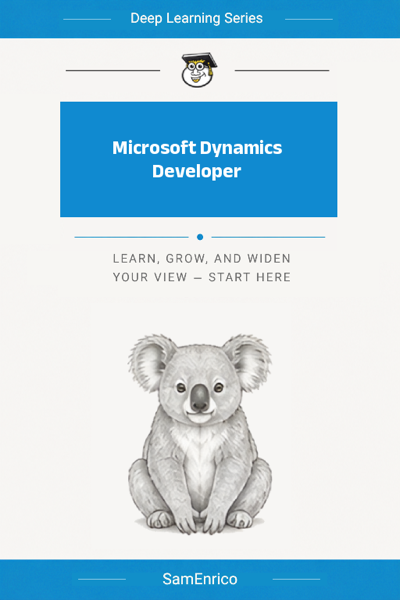
Microsoft Dynamics Developer eBook
A Coursebook on Microsoft Dynamics Developer
by TRUE Iraida
A Coursebook on Microsoft Dynamics Developer
Formats
Free sample
Chapter 1: The Invisible Backbone...---- Every time you swipe a credit card, order a package from an online retailer, or receive an invoice from your utility company, you are touching an ERP system. Most people never see these systems, hear their names, or think about the millions of transactions they process every minute. But you are not most people. You are here because someone told you – or perhaps you discovered on your own – that behind every well-run enterprise, there is a Dynamics developer who makes the chaos of business operations look effortless.This is not a book about learning a programming language. There are dozens of books, courses, and documentation sites that will teach you X++ syntax, AL language patterns, or how to write a select statement.
This is a book about becoming the developer that other developers call at 2:00 AM when the month-end close is failing and the CFO is pacing outside the server room. This is a book about understanding not just how Dynamics works, but why it works the way it does – and how to make it work better.If you are reading this, you have already made a choice that will define your career. You have chosen to specialize in one of the most demanding, least understood, and most valuable niches in the software development industry. Microsoft Dynamics developers are not a dime a dozen. You cannot learn this trade from a six-week boot camp.
The combination of technical depth, business process knowledge, and the ability to translate between accountants and algorithms is rare. That rarity translates directly into job security, compensation, and the quiet satisfaction of being the person who keeps the lights on.But before you write a single line of code, before you open Morph X or Visual Studio Code, you need to understand what you are getting into. This chapter is your orientation. It will explain why ERP development is fundamentally different from building a mobile app or a website. It will introduce you to the two major tracks in the Dynamics ecosystem – Finance & Operations and Business Central – and help you understand which one aligns with your career goals.
It will walk you through the tools and environments you will live in every day. And most importantly, it will set expectations for what it really means to be a Dynamics developer: the late nights, the firefighting, the moments of frustration when a bug takes three days to find, and the moments of triumph when you save the company a million dollars with a single well-placed index.Let me tell you a story.The Friday Night That Changed Everything In 2019, a manufacturing company in Ohio called Tier One Automotive was trying to close its books for the quarter. The CFO needed to report earnings to the parent company by Monday morning. On Friday at 4:30 PM, the inventory valuation report stopped running. It had worked perfectly for three years.
Now it was timing out after two hours and throwing a cryptic error: "Query execution timeout. Contact your system administrator."The in-house IT team had gone home for the weekend. The external consultants who had implemented the system were on another project. The only person who answered the phone was a junior Dynamics developer named Marcus, who had been on the job for six months.Marcus had never seen this error before. He had no documentation.
The person who wrote the report had left the company a year earlier. But Marcus knew three things: he knew how to use the Trace Parser, he understood that "query timeout" meant SQL was taking too long, and he knew that the inventory table had grown from 500,000 rows to 12 million rows over the past three years.He spent Friday night running traces. He spent Saturday morning identifying the slow query – a nested select inside a while select that was scanning the entire inventory table for every single product category. He spent Saturday afternoon rewriting the report as a single set-based operation with proper joins and aggregations. He deployed the fix on Sunday morning.
The report ran in 11 seconds.On Monday, the CFO sent an email to Marcus's manager with the subject line: "Who is this person and why aren't we paying him more?" Marcus got a promotion, a bonus, and a reputation that followed him for the rest of his career.Here is what Marcus understood that most developers do not: in ERP development, you are not just writing code. You are writing code that touches money. Every mistake has a direct, measurable cost. Every optimization has a direct, measurable benefit. The inventory report that Marcus fixed wasn't just a report – it was the basis for the company's quarterly earnings statement.
If he had failed, the parent company would have delayed funding, suppliers would have been paid late, and the CFO would have lost his job.That is the weight of being a Dynamics developer. It is not for everyone. But if it is for you, there is no more rewarding career in software.Why ERP Development Is Not Web Development If you are coming from a background in web or mobile development, you need to unlearn some habits. The rules are different here.Statefulness. Web applications are typically stateless.
A user requests a page, the server responds, and that's the end of the transaction until the next request. ERP systems are stateful. A single sales order can exist in multiple states (draft, confirmed, picked, packed, shipped, invoiced, posted). Each state change triggers validation rules, updates to inventory, creation of journal entries, and potentially emails to customers. You cannot restart a transaction midway through.
You cannot lose state.Transaction boundaries. In web development, a "transaction" might mean saving a form. In ERP development, a transaction can span dozens of tables, multiple companies, and sometimes multiple systems. The tts Begin and tts Commit keywords (in F&O) or the equivalent transaction handling in AL are not suggestions – they are the difference between a ledger that balances and a ledger that sends the finance team into a panic. A single uncommitted transaction can lock tables, block other users, and bring the system to a crawl.Financial precision.
Web applications can tolerate rounding errors. If your e-commerce site charges a customer $99.99 instead of $100.00, it's a minor inconvenience. If your ERP system posts a journal entry that is off by one cent, the trial balance will not zero, the period will not close, and the auditors will ask uncomfortable questions. Dynamics handles financial data with decimal precision that matches the regulatory requirements of every country where it operates. You will learn to respect the amount field.Integration complexity.
A typical web application might integrate with three or four external services. A typical Dynamics implementation integrates with banks, warehouses, shipping carriers, e-commerce platforms, CRM systems, HR systems, and sometimes custom-built legacy applications that no one understands. Each integration has its own failure modes, retry logic, and idempotency requirements. You will spend as much time thinking about what happens when the network fails as you do about the happy path.Upgrade pain. Web developers deploy continuously.
They break things, fix them, and move on. Dynamics developers deploy quarterly or annually because every deployment is a high-stakes…
This is the end of the free sample. Get the eBook to keep going. Buy now
About this book
Details
- Author
- TRUE Iraida
- Publisher
- SamEnrico
- Language
- English
- Genre
- Non-Fiction, Informative, Educational
- Released
- 2026-06-02
- Pages (approx.)
- 136
- Available as
- eBook, Audiobook

Read better in the ZLOADR app
Your eBooks on your phone or tablet. Sign in with your SamEnrico account and start reading.
More by TRUE Iraida
 Supply Determinants GuideTRUE Iraida$11.99
 B2B Business Plan GuideTRUE Iraida$11.99
 Touch Persuasion GuideTRUE Iraida$11.99
 Chasing Losses PsychologyTRUE Iraida$11.99
 Pandora’s Curiosity: The Unboxing of Humanity’s FateTRUE Iraida$11.99
 How to Become a Machining-and-assembly SupervisorTRUE Iraida$11.99
 Exit Interview GuideTRUE Iraida$12.99
 Learn to Play the Mando-bassTRUE Iraida$11.99