
Non-FictionCrisis ManagementCloud Computing
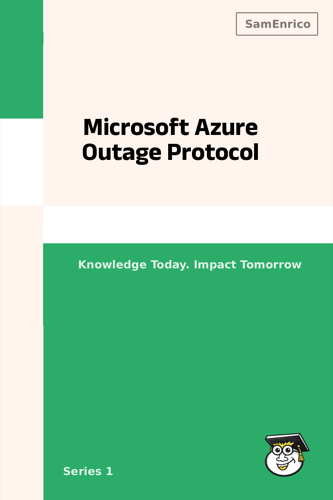
Microsoft Azure Outage Protocol eBook
Immediate action steps for when Azure regions go d
Immediate action steps for when Azure regions go dark, including failover, communication, and recovery procedures.
Formats
Free sample
Chapter 1: The Blame Pie...--–- The first sign of trouble was not an alert. It was silence. Maya Chen stared at her monitoring dashboard, watching the green lines flatten into straight, dead horizontals. Twelve thousand active users had just vanished. No errors.
No timeouts. No 500s. Just… nothing. Her e-commerce platform, which processed $2.3 million in daily revenue, had fallen off the face of the internet. She reached for her phone to call her boss, but it was already ringing.
On the other end, the VP of Engineering asked a question that would define the next forty-five minutes of her life: "Is it us, or is it Azure?"The Most Dangerous Question in Cloud Operations That question—is it us, or is it them?—has destroyed more careers than any technical failure. Because the answer determines everything. If it is you, you keep your engineers focused internally, checking DNS records, firewall rules, load balancer configurations, and recent code deploys. You save yourself the embarrassment of blaming Microsoft for your own mistake. If it is them, you stop debugging your own infrastructure immediately and shift into failover mode.
Every minute you spend chasing internal ghosts while Azure burns is a minute your customers spend staring at error messages.The tragedy is that most engineers get this question wrong. They default to blaming themselves—because humility is a virtue, because "cloud outages are rare," because the last three alerts were false alarms. Or they default to blaming Microsoft—because it is easier to point fingers than to run diagnostics. Both instincts are fatal.This chapter solves the first five minutes of any outage. You will learn a systematic method called The Blame Pie that forces you to rule out internal causes before blaming Azure, but also forces you to stop debugging internally the moment the evidence points to the cloud.
You will run a Shadow IT Discovery that inventories every resource in the affected region before you make a single failover decision. You will apply the Triangulation Method to compare three independent sources of truth about Azure's health. And you will walk away with a clear decision: fix local infrastructure or proceed to regional failover.But first, you need to understand what is at stake.The Cost of Getting It Wrong In July 2024, a mid-sized retail company experienced what looked like an Azure East US outage. Their shopping cart service was timing out. Their database queries were failing.
Their incident commander, a well-meaning senior architect named David, assumed the problem was their own recent deployment. He spent twenty-two minutes rolling back code, restarting pods, and blaming his team's "rushed release."The problem was not their code. Azure East US had suffered a cooling failure that took down two availability zones. David's company had Azure Site Recovery configured. They could have failed over to East US 2 in twelve minutes.
Instead, they lost forty-seven minutes of revenue—$840,000—because their incident commander asked the wrong question first.Three months later, a different company saw identical symptoms. Their incident commander, a young site reliability engineer named Priya, immediately declared "Azure is down" and initiated failover. She was wrong. The problem was a misconfigured firewall rule that her team had changed the night before. She failed over to a secondary region, incurred data replication costs, confused her customers with a "we are experiencing technical difficulties" banner, and spent six hours failing back to the primary region.
Her mistake cost $120,000 in unnecessary failover expenses and a week of lost trust from her leadership.The difference between David and Priya was not technical skill. Both were excellent engineers. The difference was a diagnostic protocol—a repeatable, dispassionate method for answering the most dangerous question in cloud operations.Introducing The Blame Pie The Blame Pie is a mental model that slices the possible causes of an outage into three distinct layers. You work through them in order, from the inside out, never skipping a layer and never spending more than ninety seconds on any single diagnostic test.Layer 1: Internal Network and Infrastructure (Your House)This layer includes everything under your direct control that does not touch Azure APIs. DNS resolution (your own DNS servers or third-party providers like Cloudflare, Go Daddy, or Route 53).
Firewall rules (on-premises or virtual appliances). ISP connectivity (your office network, your VPN, your colocation facility). Load balancer configurations (if you run your own ingress controllers). Recent code deploys (any change you pushed in the last twenty-four hours).The key insight: problems in Layer 1 often look exactly like Azure outages. Your DNS provider goes down, and suddenly your application cannot resolve yourapp.azurewebsites.net.
Your firewall rule changes, and Azure API calls start timing out. Your ISP has a routing issue, and the Azure portal becomes unreachable while the rest of the internet works fine.Layer 2: Azure Regional Services (Their House)This layer includes all Azure services running in a specific geographic region. Compute (VMs, AKS nodes, App Services). Storage (Blob, Files, Disks, Tables). Databases (SQL, Cosmos, Postgre SQL, My SQL).
Networking (Load Balancers, Application Gateways, VPN Gateways). Platform services (Functions, Logic Apps, Service Bus, Event Hubs, Redis Cache).The defining characteristic of a Layer 2 problem is regional scope. If Azure East US is having a problem, your resources in East US are affected, but your resources in East US 2 or Central US are fine. This is why the very first thing you do when you suspect an Azure outage is check resources in another region.Layer 3: Application Code (Your Logic)This layer includes your own application logic that runs on top of Azure. A bug in your checkout flow that crashes the payment service.
A memory leak that brings down your API after twelve hours. A deadlock in your database queries that locks all user sessions. A misconfigured connection string that points to a retired database.Layer 3 problems are the trickiest because they often appear suddenly (after a deploy) or gradually (as memory or connection pools exhaust). They can mimic regional failures because they cause widespread errors. But they have one telltale sign: they affect only your application, not other tenants in the same Azure region.The Blame Pie Protocol: Step by Step You have ninety seconds per layer.
Set a timer. Do not go over.Step 1: Test Layer 1 (Internal) – 90 Seconds Run three tests in parallel. Do not wait for results sequentially—fire them all at once.Test 1: DNS Resolution. From a machine outside your network (your phone on cellular, a cloud shell in a different region, a friend's laptop), run nslookup yourdomain.com and dig yourdomain.com. If resolution fails, your DNS provider is the problem.
If resolution succeeds but points to the wrong IP, your DNS records were changed.Test 2: Azure Portal Accessibility. Open the Azure portal in an incognito window. If the portal loads but your resources show errors, proceed to Layer 2. If the portal does not load at all, the problem could be your network—test by connecting to a VPN in a different geographic region.*Test 3: Third-Party Probing.* Use a free external uptime monitor (like Uptime Robot or Pingdom) or a paid tool (Datadog, New Relic). If these external tools report your site as down from multiple geographic locations, the problem…
This is the end of the free sample. Get the eBook to keep going. Buy now
About this book
Details
- Author
- Ferraro Providencia
- Publisher
- SamEnrico
- Language
- English
- Genre
- Non-Fiction, Crisis Management, Cloud Computing
- Released
- 2026-06-08
- Pages (approx.)
- 144
- Available as
- eBook, Audiobook

Read better in the ZLOADR app
Your eBooks on your phone or tablet. Sign in with your SamEnrico account and start reading.
More by Ferraro Providencia
 South African Business GuideFerraro Providencia$11.99
 Spiritual Legacy WorkbookFerraro Providencia$11.99
 Peer Comparison and Stress ReductionFerraro Providencia$11.99
 The ED Lifestyle Modification GuideFerraro Providencia$11.99
 The Last Breath of a King: The Poisoned Chalice ConspiracyFerraro Providencia$11.99
 How to Become a GasserFerraro Providencia$11.99
 BOP Financial Product GuideFerraro Providencia$12.99
 First Time Manager Promotion CaseFerraro Providencia$12.99
 Understanding ValinemiaFerraro Providencia$17.99
You may also like
 Hong Kong Handover 1997Dunn Johnnie$11.99
 Zumba For Postnatal Recovery CourseNeal Christian$11.99
 Zumba for BeginnersLadner Nikia$11.99
 YouTube Comment Mining GuideHumes Pandora$12.99
 Worry Box MeditationCarlin Rudy$11.99
 Workplace Stress MeditationNguyen Lynn$11.99
 Workplace Stress and Sleep RepairHawley Ivory$11.99
 Workplace Perfectionism CureDelaney Jeffry$11.99
 Workplace Injustice Anger GuideWallen Isabelle$11.99
 Work Addiction and Burnout LinkGreenwood Ester$11.99
 Women in Yoga and WellnessBeattie Galina$11.99
 Women in Stand Up ComedyChun Evangeline$11.99